National Institute of Standards and TechnologyMetric Kitchen: Cooking Measurement EquivalenciesUsed for defined measurement guidance or public food-safety guidance where applicable.
Open source ↗Ingredient Conversion Tools
Convert cooking ingredients between cups, grams, spoons, milliliters, ounces, and other practical kitchen measures. Ingredient specific conversions keep volume and weight from being treated as the same thing.
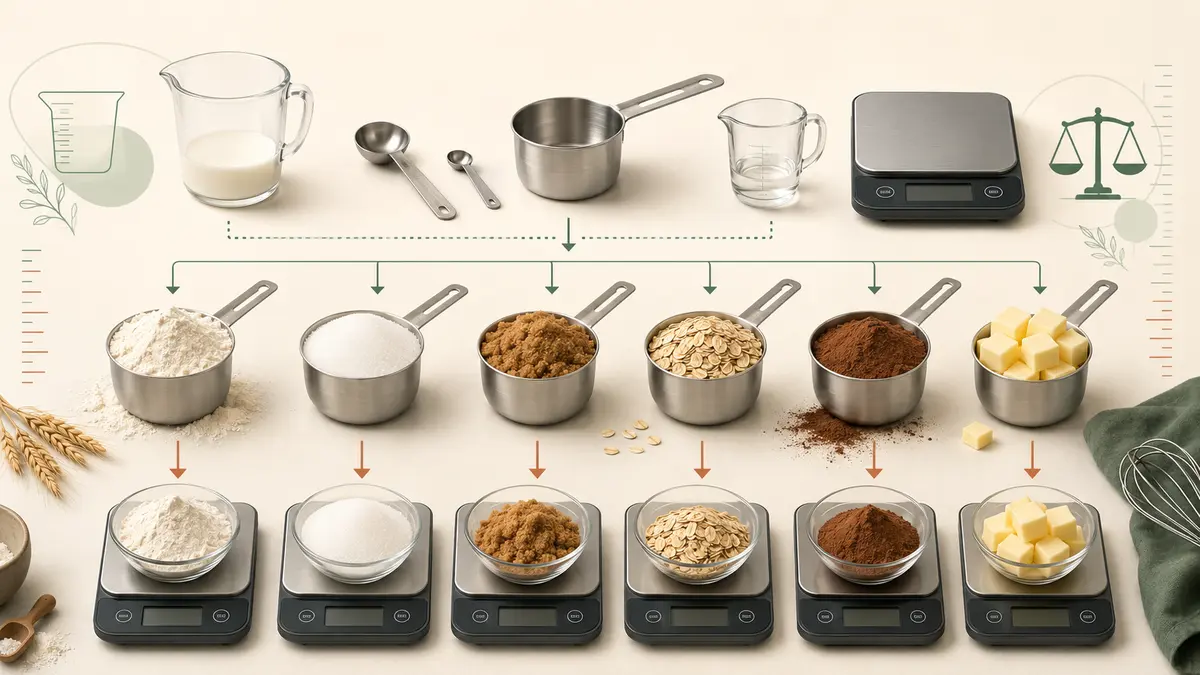
Ingredient conversion tools for cooking and baking
Ingredient Weight Database
Search the full public ingredient reference table with household measures, gram weights, states, confidence, sources, and review dates.
Best for checking the data behind a conversion.Cups to Grams Calculator
Search supported ingredients and convert cups into grams with ingredient specific references.
Best for US volume to metric weight.Grams to Cups Calculator
Convert ingredient weights back into practical cups and kitchen fractions.
Best when a metric recipe needs cup measures.Cooking Measurement Chart
Compare teaspoons, tablespoons, cups, milliliters, ounces, pounds, grams, and common kitchen equivalents.
Best for standard unit relationships.Flour Cups to Grams
Use the all purpose flour reference, common quantity chart, and flour measuring guidance.
Default reference: about 120 g per cup.Sugar Cups to Grams
Convert granulated sugar cups to grams and see common baking quantities.
Default reference: about 198 g per cup.Butter Cups to Grams
Convert butter cups, half cups, and common amounts into grams.
Useful for baking and recipe conversion.Why ingredient conversions need more than one unit formula
Cups to grams is not one universal conversion. A cup describes volume. A gram describes mass. The amount of mass that fits into a cup depends on the ingredient, its particle size, how tightly it is packed, and sometimes its preparation state. This is why a cup of flour weighs much less than a cup of honey.
Use a standard unit converter when both units measure the same dimension. Ounces to grams compares mass with mass. Milliliters to liters compares volume with volume. Inches to centimeters compares length with length. These conversions can use a fixed mathematical relationship without knowing what food is being measured.
Use an ingredient weight reference when volume becomes mass. Flour cups to grams, sugar cups to grams, butter cups to grams, and oats cups to grams each need their own culinary reference. The Ingredient Weight Database lets you inspect those reference values, while the Cups to Grams Calculator applies them to any supported amount.
Keep the recipe author's weight when one is already provided. If a tested recipe says 1 cup flour equals 125 g for that recipe, use the author's gram value instead of replacing it with a general reference. KitchenMathHub is most useful when the recipe gives only volume or when you need one consistent general conversion standard.
Popular cups to grams ingredient references
All purpose flour
120 g per US cup reference
Granulated sugar
198 g per US cup reference
Butter
113 g per half cup reference
Packed brown sugar
213 g per US cup reference
Unsifted powdered sugar
113 g per US cup reference
Unsweetened cocoa powder
84 g per US cup reference
Rolled oats
89 g per US cup reference
Honey
21 g per tablespoon reference
Flour cups to grams and why measuring method matters
KitchenMathHub uses about 120 g for one US cup of all purpose flour on the flour page. That value works as a consistent culinary reference for general conversion. The page also explains why a physical cup can contain more flour when it is scooped hard or packed into the measure.
Flour is sensitive to how the cup is filled. A light spoon and level method leaves more air between particles than pressing the cup into a bag. This is one reason baking recipes often become more repeatable when flour is weighed instead of measured by volume.
Different flours can need different references. All purpose flour, bread flour, cake flour, whole wheat flour, almond flour, oat flour, and other products do not have to weigh the same per cup. Use the ingredient that matches the recipe rather than applying the all purpose flour value to every flour.
Visit Flour Cups to Grams for common values such as half a cup, one cup, one and a half cups, two cups, and reverse gram to cup examples.
Sugar, brown sugar, and powdered sugar are different ingredients
Granulated sugar and brown sugar should not share one cup weight. Granulated sugar is made of free flowing crystals. Brown sugar contains moisture and is commonly measured in a packed state. Packing changes how much material fits inside the same cup volume.
KitchenMathHub uses about 213 g for one packed cup of brown sugar. The word packed is part of the measurement state. If a recipe asks for loosely filled brown sugar, that is a different situation and should not be silently treated as packed.
Powdered sugar can change with sifting. The dedicated page uses an unsifted powdered sugar reference. Sifting can introduce more air and change the amount that occupies a cup, so the state should remain visible in the ingredient record.
Use Sugar Cups to Grams, Brown Sugar Cups to Grams, or Powdered Sugar Cups to Grams when the sugar type matters.
Butter, cocoa, oats, and honey need their own conversion logic
Butter is easier to convert because it is sold in standardized weight based packages in many markets. KitchenMathHub uses a 113 g per half cup reference for the butter page, which gives about 226 g per cup. The page also connects cup measures with common baking quantities.
Cocoa powder is much lighter by volume than sugar or honey. A cup contains many small particles and air spaces. Natural cocoa and Dutch process cocoa also differ in processing and recipe behavior, so ingredient identity still matters even when the general cup weight looks similar.
Rolled oats should be treated as a grain form, not as flour. The flakes create large air spaces in a cup. Quick oats and other oat forms can pack differently. The oats page uses a rolled oats reference and explains the product state.
Honey is dense and sticky, so weight is often easier than scraping a measuring cup clean. The honey page starts from a direct tablespoon reference and can derive larger volume amounts. Weighing honey directly into a bowl can reduce mess when the recipe supports grams.
US cups, metric cups, and Australian tablespoons
A US cooking cup and a metric cup are not exactly the same volume. Kitchen measurements also vary by country, which is why a recipe's regional context can matter. NIST practical kitchen guidance commonly uses about 240 mL for a US cup, while a metric cup is commonly 250 mL.
An Australian tablespoon is larger than the common US tablespoon. This difference becomes important when a recipe uses several tablespoons. A converter that treats every tablespoon in the world as the same size can create a meaningful error.
Choose the source measurement system before converting a full recipe when possible. The Recipe Converter is designed to keep this context with the recipe instead of converting each line as if it came from nowhere.
Grams to cups for a metric recipe
Grams to cups uses the same ingredient reference in reverse. If one cup of an ingredient is defined as 120 g in the selected reference, then 180 g becomes 1.5 cups. This keeps forward and reverse conversion mathematically consistent.
Practical cup fractions are more useful than long decimal results. A result of 0.5 cup should display as half a cup. A result near 0.75 cup should display as three quarters of a cup when the rounding tolerance makes sense. The Grams to Cups Calculator handles this kitchen formatting.
Keep grams when you already have a reliable scale. Reverse conversion is useful when cups are the only measuring tools available, but a metric recipe written in grams often gives you the more repeatable baking measurement already.
Convert a whole recipe instead of one ingredient at a time
Use the Recipe Converter when several ingredient lines need conversion. It can recognize supported ingredient names, normalize quantities, and apply ingredient specific weight references where available. This is faster than copying every line into an individual converter.
Unknown ingredients should remain unchanged instead of receiving guessed weights. If a recipe says one cup of a homemade brittle mixture and there is no validated reference for that state, the safe product behavior is to keep the original measurement and flag it for review.
Ingredient aliases improve recognition but should not erase meaningful differences. “Icing sugar” can point to powdered sugar in a regional context, while self raising flour should not be mapped to all purpose flour merely because both contain the word flour.
Recipe conversion becomes more useful when it stays connected to serving and pan changes. A user can scale a recipe first, convert final ingredient amounts second, and then use the pan or oven tools without repasting the recipe.
How to get a more reliable kitchen conversion
Identify the exact ingredient
Choose all purpose flour instead of generic flour when possible. Choose packed brown sugar instead of generic sugar. Ingredient identity is part of the calculation.
Keep preparation state when it changes volume
Chopped, sliced, sifted, packed, melted, drained, and other states can affect how much food occupies a cup. Do not remove a state word if the conversion depends on it.
Use direct source values before derived values
When a strong culinary source gives a direct gram weight for the requested household measure, use that before deriving the answer from a rough physical density.
Round for the kitchen, not the laboratory
A calculated 395.5 g butter result can reasonably display near 396 g. A small yeast quantity may need finer precision. Useful rounding depends on the ingredient and scale of the recipe.
Questions about ingredient conversions
Is there one cups to grams conversion for every ingredient?
No. Cups measure volume and grams measure mass, so the gram result depends on the ingredient and its state.
How many grams are in one cup of flour?
KitchenMathHub uses about 120 g for one US cup of all purpose flour on its flour conversion page.
How many grams are in one cup of granulated sugar?
KitchenMathHub uses about 198 g for one US cup of granulated sugar on its sugar conversion page.
Can I convert grams back to cups?
Yes. The Grams to Cups Calculator uses the selected ingredient reference in reverse and returns practical cup fractions.
Are US and metric cups the same size?
No. KitchenMathHub treats US, metric, and Australian kitchen volume conventions separately where the difference matters.
Why does packed brown sugar need its own conversion?
Packing changes how much brown sugar fits into a cup, so packed brown sugar should not be treated like a loosely filled cup.
Should I weigh baking ingredients?
Weight is often more repeatable for flour, sugar, cocoa, and other dry ingredients because it avoids much of the variation caused by filling a cup.
Can I convert a whole recipe from cups to grams?
Yes. Use the Recipe Converter when several ingredients need measurement conversion in one recipe.
Is a fluid ounce the same as an ounce?
No. A fluid ounce is a volume unit, while an ounce without the fluid label normally refers to mass.
What if an ingredient has no validated gram reference?
Keep the original volume measurement or choose a supported ingredient instead of inventing a gram value.
Calculation transparency
Read methodologyHow to interpret this result
Result typeReference resource
Calculation basisDeclared methods and cited culinary or measurement sources
Sources shown5
Latest source reviewAug 15, 2026
Sources and assumptions are shown so you can judge whether a reference fits your recipe or kitchen situation.
Sources and methodology
These are the references used for data, conventions, safety targets, or calculation context on this page. Review dates show when KitchenMathHub last checked the cited source.
National Institute of Standards and TechnologyApproximate Conversions from U.S. Customary Measures to MetricUsed for defined measurement guidance or public food-safety guidance where applicable.
Open source ↗King Arthur BakingIngredient Weight ChartUsed for established culinary measurements, baking methods, or formula guidance.
Open source ↗King Arthur BakingRecipe Success GuideUsed for established culinary measurements, baking methods, or formula guidance.
Open source ↗Food Standards Australia New ZealandNutrition Panel Calculator User GuideUsed for defined measurement guidance or public food-safety guidance where applicable.
Open source ↗