King Arthur BakingThe essential alternative baking pan sizesUsed for established culinary measurements, baking methods, or formula guidance.
Open source ↗How to Scale a Recipe
Learn how to scale a recipe up or down with one clear formula, then handle fractions, partial eggs, baking pans, cooking time, and large batch changes without applying the serving multiplier to the wrong part of the recipe.
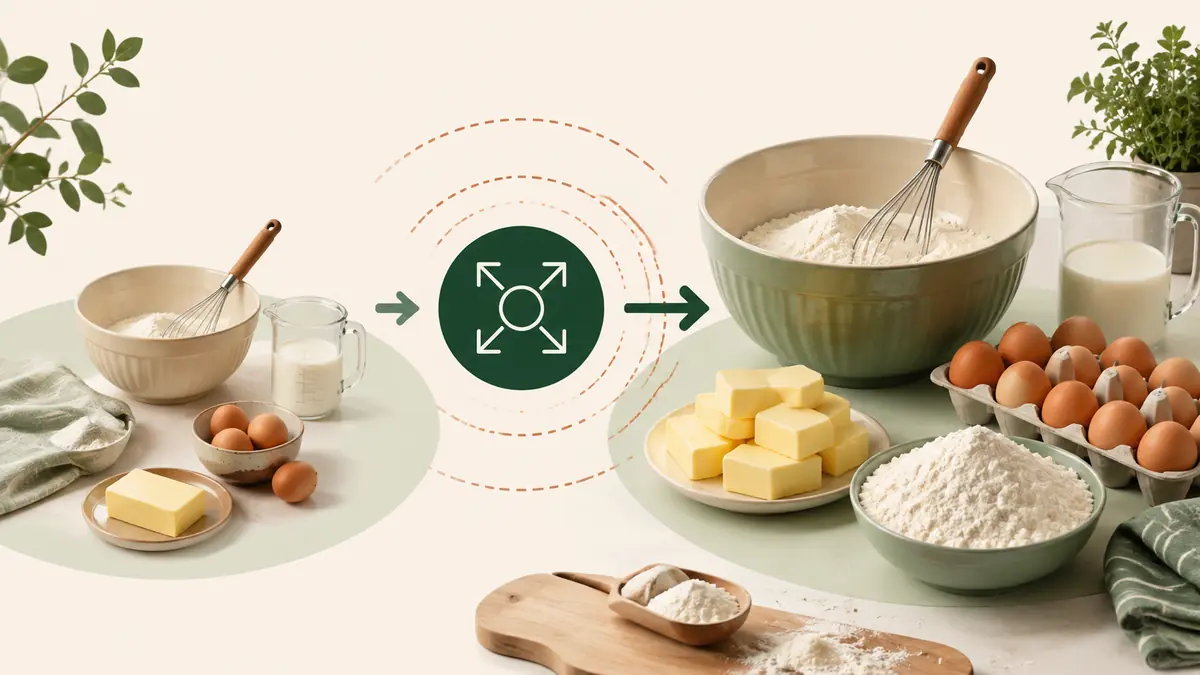
How to scale a recipe with the recipe multiplier formula
Start with the original yield and the target yield. The yield can be servings, cookies, muffins, loaves, jars, portions, or another clear output. If a recipe serves 4 and you want 10 servings, the original yield is 4 and the target yield is 10. If a cookie recipe makes 24 cookies and you want 36, use 24 and 36.
Calculate the recipe scale factor by dividing target yield by original yield. For 4 servings to 10 servings, 10 divided by 4 equals 2.5. For 8 servings to 6 servings, 6 divided by 8 equals 0.75. For 12 muffins to 24 muffins, 24 divided by 12 equals 2. The factor can be smaller than 1 when you reduce a recipe or larger than 1 when you increase it.
Multiply each scalable ingredient by the scale factor. A 2 cup ingredient multiplied by 2.5 becomes 5 cups. A 160 g ingredient becomes 400 g. Two eggs become 5 eggs. A range of 2 to 3 tablespoons becomes 5 to 7.5 tablespoons before practical formatting. Notes such as “to taste,” “for greasing,” and “as needed” should stay as instructions rather than receiving a made up number.
Recipe scale factor examples
| Original yield | Target yield | Scale factor | What happens to 2 cups |
|---|---|---|---|
| 4 servings | 10 servings | 2.5x | 5 cups |
| 6 servings | 9 servings | 1.5x | 3 cups |
| 8 servings | 6 servings | 0.75x | 1 1/2 cups |
| 12 servings | 6 servings | 0.5x | 1 cup |
| 24 cookies | 60 cookies | 2.5x | 5 cups |
How to double, triple, halve, or reduce a recipe
How to double a recipe
Doubling a recipe uses a 2x ingredient multiplier. One cup becomes 2 cups, 250 g becomes 500 g, and 3 eggs become 6 eggs. This is one of the easiest recipe scaling cases because the quantities often stay practical. Even so, do not double the oven temperature or automatically double the cooking time.
Equipment capacity is the first thing to check for a doubled batch. A doubled soup may need a larger pot. A doubled cookie recipe may need more trays or more oven batches. A doubled cake recipe may need two pans. A mixer bowl can also become too full when dough or batter expands during mixing.
How to triple a recipe
Tripling a recipe uses a 3x ingredient multiplier. One tablespoon becomes 3 tablespoons. Two cups become 6 cups. A 400 g ingredient becomes 1,200 g. The ingredient math is still simple, but a triple batch is large enough that cooking vessels, pan space, mixing, fermentation, and seasoning can behave differently.
Strong seasonings deserve a taste check in very large batches. Salt, chili, cayenne, extracts, concentrated sauces, and other powerful flavors can be scaled mathematically, but your preferred taste may not match the exact multiplier. The recipe math gives you the starting amount. Taste and recipe method still matter.
How to halve a recipe
Halving a recipe uses a 0.5x multiplier. Two cups become 1 cup, 1 tablespoon becomes 1/2 tablespoon, and 300 g becomes 150 g. Small batch cooking is usually simple until a count ingredient becomes fractional or a spoon quantity becomes too small to measure comfortably.
Small recipe scaling can make a kitchen scale more useful. Half of 1/4 teaspoon is 1/8 teaspoon. One third of 1/4 teaspoon is even smaller. For yeast, salt, and some baking ingredients, a scale that reads tenths of a gram can be easier than trying to estimate a tiny fraction of a spoon.
How to scale a recipe from 4 servings to 10 servings
Four to ten servings needs a 2.5x scale factor. This is a common long form recipe scaling problem because the target is not a simple double or triple. If the original recipe uses 2 cups broth, 1 cup rice, 400 g chicken, 2 tablespoons oil, and 2 eggs, the scaled amounts become 5 cups broth, 2 1/2 cups rice, 1,000 g chicken, 5 tablespoons oil, and 5 eggs.
The serving count does not tell you the cooking vessel automatically. Ten servings may fit in one large pot, two baking dishes, or several pans depending on the recipe. If the food is spread across the same depth as the original, the cooking time may stay closer to the original range. If the food becomes much deeper, the center can take longer to heat.
Use the exact target yield when you can. “Make a bigger batch” is vague. “Change 4 servings to 10” gives a clear multiplier. “Make 60 cookies instead of 24” also gives a clear multiplier. The more specific the yield, the more reliable the ingredient scaling becomes.
How to scale cups, tablespoons, teaspoons, and grams
Scale the quantity before you simplify the final measurement. If 3/4 cup is multiplied by 1.5, the exact result is 1.125 cups. That can be displayed as 1 1/8 cups. If 2/3 cup is doubled, the result is 1 1/3 cups. Keeping the underlying number accurate helps when several transformations happen in the same recipe.
Weight based recipes are often easier to scale than volume based recipes. Five hundred grams multiplied by 1.25 becomes 625 g. There is no need to choose a cup or spoon fraction. This is one reason bakers often prefer grams for flour, water, sugar, butter, salt, and dough ingredients.
Ranges should remain ranges when the recipe gives a choice. Two to 3 tablespoons of water can describe a dough that needs adjustment based on flour absorption. If the recipe doubles, keep the range at 4 to 6 tablespoons. Replacing the range with one fixed value would remove useful information.
Unit conversion is a separate step from recipe scaling. If you want to scale an American recipe and then convert cups to grams, apply the scale factor to the normalized original quantity first. Then use the ingredient conversion. This prevents repeated rounding from changing the final result.
How to handle partial eggs when you scale a recipe
Partial eggs are easiest to measure after whisking. Crack the egg into a small bowl and mix the yolk and white until even. Then weigh the amount you need. KitchenMathHub uses about 50 g for a large egg without shell, so half an egg is about 25 g and one quarter is about 12 to 13 g.
Do not round 2.5 eggs to 2 or 3 without thinking about the recipe. In pancakes or a flexible savory dish, a small change may not matter much. In cake, custard, brioche, or other formulas where egg affects structure, liquid, fat, and emulsification, weighing the partial egg is more reliable.
Whole egg weight is more useful than shell weight for recipe math. The shell is not part of the batter or dough. If you use a scale, tare the bowl first, whisk the egg, and measure the needed portion. This gives you a repeatable amount instead of estimating half of the egg by sight.
How to scale a baking recipe without changing the wrong variables
Pan size matters when batter quantity changes
A larger batch does not automatically fit the original baking pan. If you double an 8 inch cake recipe and pour all the batter into one 8 inch pan, the batter becomes much deeper and can overflow. The center may also bake much more slowly than the edge. You may need two pans or a larger pan with enough area and depth.
Use pan geometry when the goal is a different cake size. If you want to move from an 8 inch round cake to a 9 inch round cake, the serving multiplier may not be the best starting point. The area ratio is about 1.27, so the Cake Pan Conversion Calculator can scale batter for a similar layer height.
Yeast and leavening need recipe context
Yeast can be multiplied mathematically, but fermentation time is not a simple multiplier. Dough temperature, room temperature, flour, sugar, salt, yeast type, starter strength, and batch size all affect rise behavior. Use the scaled yeast quantity as part of the formula, then follow dough development and the recipe method.
Baking powder and baking soda should not receive a hidden correction. The transparent approach is to show the exact scaled quantity and remind you to review very large changes. Batter depth, mixing, acidity, pan size, and formula design can all affect how a larger baking batch behaves.
Cooking time when doubling or scaling a recipe
Doubling a recipe does not mean doubling the cooking time. A cookie tray still needs roughly the time required for one tray if cookie size and oven conditions stay similar. You may need more trays or more batches, but each batch does not automatically need twice as long.
Food depth is a major cooking time factor. A doubled casserole spread across two matching dishes may cook near the original time. The same doubled mixture packed into one deep dish may need much longer for the center to heat and set. This is why cooking time after scaling a recipe must be judged separately from the ingredient multiplier.
Use doneness cues and food temperature where they apply. Cakes can use visual and texture cues. Bread can use crust, structure, and internal doneness. Meat and poultry need safe internal temperature checks. A recipe scale factor tells you how much ingredient to use, not when the food is definitely done.
Common recipe scaling mistakes to avoid
Do not multiply every number in the instructions. A number may describe minutes, degrees, pan dimensions, mixer speed, folds, rests, or portions. Only ingredient quantities and clearly scalable yield counts should follow the recipe multiplier automatically.
Do not round fractions too early. One third written as 0.33 is already an approximation. If you scale that value and then convert units, the final answer can drift. Keep the normalized fraction through the math and round only when you show the final kitchen amount.
Do not guess nonnumeric amounts. Salt to taste, oil as needed, flour for dusting, and water as needed are instructions that depend on taste or technique. Preserve them and let the cook decide the final amount.
Do not combine serving scaling and pan scaling without a clear goal. If the serving target already determines the ingredient amount, a pan change may only need a fit check. If the pan size is the main goal, let pan geometry determine the batter multiplier. Choosing one main reason for the scale avoids accidental overcorrection.
When to use the calculator instead of doing the math by hand
Use a calculator when the multiplier creates awkward fractions or counts. Doubling 1 cup is easy. Scaling 7 servings to 11, handling 1 1/3 cups, preserving a 2 to 3 tablespoon range, and calculating part of an egg take more attention. The Recipe Scaling Calculator keeps those details together.
Use the Recipe Converter when scaling is only one part of the job. If you also need US to metric measurements, cups to grams, a pan check, or an oven setting conversion, the Recipe Converter lets you keep working from the same normalized ingredient list.
Common questions about recipe scaling
What is a recipe scale factor?
A recipe scale factor is target yield divided by original yield. Multiply each scalable ingredient by that number to increase or reduce the recipe while keeping the ingredient relationship consistent.
How do I scale a recipe from 4 servings to 10?
Use a 2.5x recipe multiplier. Ten divided by four equals 2.5, so 1 cup becomes 2 1/2 cups and 200 g becomes 500 g.
How do I halve a recipe?
Multiply each scalable ingredient by 0.5. Four cups become 2 cups, 2 tablespoons become 1 tablespoon, and 300 g becomes 150 g.
How do I double a recipe?
Multiply the ingredient quantities by 2. Keep cooking time, oven temperature, pan size, and other method details separate unless you are changing them for a clear reason.
How do I triple a recipe?
Multiply the ingredient quantities by 3. Check equipment capacity and review yeast, leaveners, strong spices, and cooking setup when the batch becomes much larger.
How do I measure part of an egg?
Whisk the egg and weigh the portion you need. A large egg without shell is about 50 g in the KitchenMathHub reference, so half is about 25 g and one quarter is about 12 to 13 g.
Does cooking time change when I double a recipe?
Cooking time does not follow a simple 2x rule. Pan depth, batch layout, food thickness, pot size, oven airflow, and doneness affect the time more than the serving multiplier alone.
Can I scale a baking recipe the same way as a dinner recipe?
The ingredient math uses the same scale factor, but baking needs extra checks. Pan capacity, batter depth, eggs, yeast, chemical leaveners, and mixing method can matter more in cakes and bread.
Should I convert units before or after scaling?
Scale the normalized quantity first, then convert the unit. This reduces rounding drift when fractions, cups, grams, or other measurements change during the same workflow.
Can I scale a full pasted recipe automatically?
Yes, use the Recipe Scaling Calculator for ingredient quantities or the Recipe Converter for several changes at once. Both keep unknown or nonnumeric lines visible instead of guessing at them.
Calculation transparency
Read methodologyHow to interpret this result
Result typeRecipe transformation
Calculation basisRatio math, ingredient references, and separate cooking transformations
Sources shown2
Latest source reviewAug 11, 2026
KitchenMathHub keeps the original quantities intact and applies transformations from normalized values before final kitchen rounding.
Sources and methodology
These are the references used for data, conventions, safety targets, or calculation context on this page. Review dates show when KitchenMathHub last checked the cited source.
King Arthur BakingYeastUsed for established culinary measurements, baking methods, or formula guidance.
Open source ↗