King Arthur BakingThe essential alternative baking pan sizesUsed for established culinary measurements, baking methods, or formula guidance.
Open source ↗Baking Calculators
Use baking calculators for cake pan sizes, batter scaling, yeast conversion, ingredient weights, and oven settings. Each tool handles a different part of the recipe so one multiplier is not forced onto every baking decision.
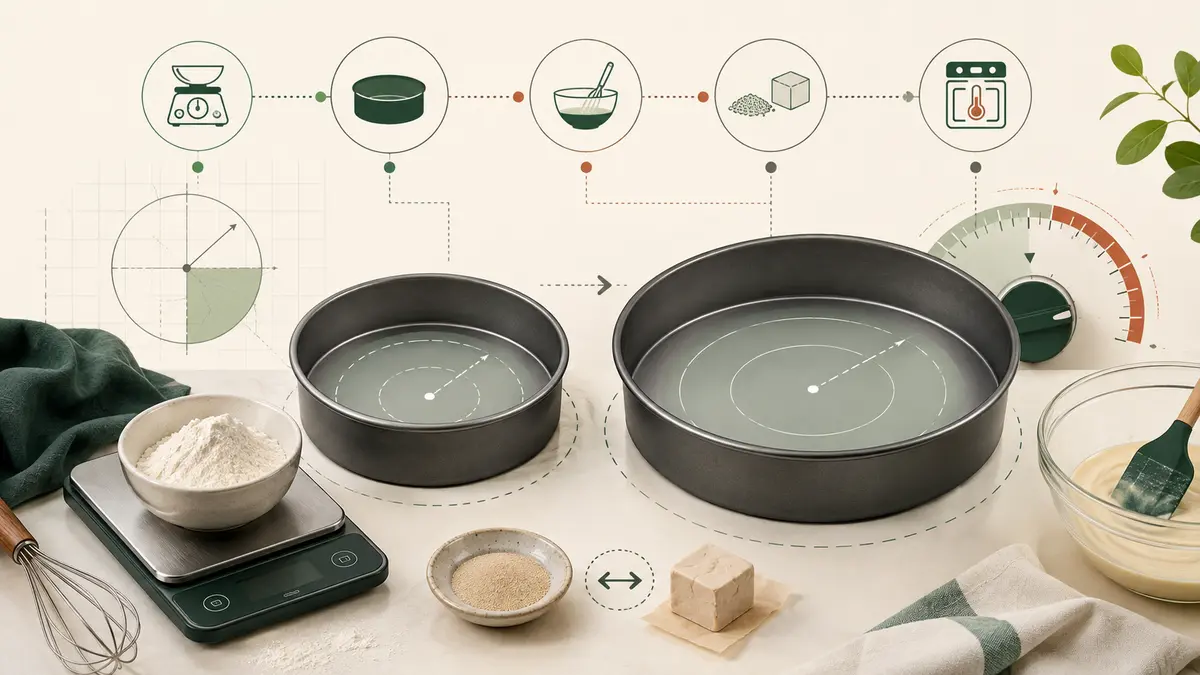
Baking calculators for pans, ingredients, yeast, and ovens
Cake Pan Conversion Calculator
Compare original and target pans, calculate the batter factor, and check depth and capacity concerns.
Best for resizing a cake recipe.Cake Pan Size Chart
Compare common round, square, and rectangular pan areas and close substitutions.
Best for a quick pan reference.Yeast Conversion Calculator
Convert fresh, active dry, instant, teaspoons, grams, ounces, and common packet amounts.
Best for yeast substitutions.Recipe Scaling Calculator
Apply a baking scale factor to a full ingredient list with practical fraction and egg handling.
Best after calculating a pan or yield factor.Cups to Grams Calculator
Convert flour, sugar, butter, cocoa, oats, and other supported ingredients into weights.
Best for weight based baking.Oven Temperature Converter
Translate Celsius, Fahrenheit, fan oven, and Gas Mark settings for recipes.
Best when baking instructions use another oven scale.Adjust baking formulas for elevation separately
The High Altitude Baking Calculator handles elevation as its own baking variable. For cakes, it scales published adjustment ranges for leavener, sugar, liquid, and oven temperature to the amounts in the recipe. Cookies, quick breads, and yeast breads receive more cautious guidance because they do not share one universal correction.
Keep altitude adjustments separate from pan conversion and ingredient conversion. A larger cake pan changes batter depth and area, while elevation changes pressure, evaporation, and gas expansion. Combining both changes without tracking them makes troubleshooting harder.
Baking math works best when each problem stays separate
A baking calculator should solve the part of the recipe that actually changed. Pan size affects batter depth and ingredient quantity. Ingredient conversion affects measurement units. Yeast conversion affects the type and amount of yeast. Oven conversion affects temperature settings. Cooking time depends on heat transfer and should not be treated as another ingredient multiplier.
Use one shared recipe factor for scalable ingredients, but do not apply it blindly to instructions. If a cake recipe grows by 1.27 because you move from an 8 inch round to a 9 inch round, flour, sugar, butter, and many other ingredients can use that factor. A 35 minute baking time does not automatically become 44 minutes.
Weight based baking can reduce measurement variation. Flour can compact in a cup, powdered ingredients can trap air, and packed brown sugar depends on how firmly it is filled. Ingredient specific gram references make these differences visible instead of pretending every cup has the same mass.
Cake pan conversion for round, square, and rectangular pans
Pan area is the best first comparison when you want a similar cake layer depth. A round pan uses the area of a circle. A square pan uses side multiplied by side. A rectangular pan uses length multiplied by width. When depth stays similar, the target area divided by the original area gives a useful batter scale factor.
An 8 inch round to 9 inch round cake conversion uses about 1.27 times the batter. The 8 inch round has about 50.3 square inches of area. The 9 inch round has about 63.6 square inches. That is a 26.6% increase even though the diameter increased by only one inch.
An 8 inch square is very close to a 9 inch round by baking area. The square has 64 square inches and the round has about 63.6. This is why pan shape matters as much as the printed size.
Use the Cake Pan Size Chart for common comparisons and the Cake Pan Conversion Calculator for custom dimensions, multiple pans, and a precise recipe factor.
Cake pan area, depth, capacity, and batter fit
Area and capacity answer different baking questions. Area tells you how widely batter spreads. Capacity tells you how much volume the pan can hold. A deeper pan with the same diameter has the same baking area but more headroom.
A deeper pan does not automatically require more batter. If you want the same cake height, the same batter amount can sit in a deeper version of the same diameter pan. The extra depth mainly lowers overflow risk.
Capacity becomes more important for Bundt, tube, tapered, and decorative pans. Their inside shapes are not simple rectangles or cylinders. A manufacturer listed capacity can be more useful than a rough outer diameter.
Do not fill a cake pan to its geometric maximum. Batter needs space to rise. Use recipe or pan guidance for safe fill levels and treat a shallow target pan with extra care.
How to scale a cake recipe after changing pan size
Apply the pan factor to the ingredient quantities before final rounding. If an 8 inch to 9 inch round conversion gives a factor of 1.265625, keep that raw factor while scaling the recipe. Round the display amounts after the math is complete.
Partial eggs need a practical method. A three egg cake multiplied by 1.265625 gives about 3.8 eggs mathematically. Instead of guessing, beat an extra egg and use the needed portion by weight or another repeatable method. The Recipe Scaling Calculator can surface a partial egg note.
Leaveners deserve review in a large baking scale change. The mathematically scaled amount is still useful, but very large or very small batches can behave differently. KitchenMathHub keeps the raw calculation visible and adds a caution rather than inventing a secret nonlinear adjustment.
Baking time remains a separate check. A similar batter depth may keep you near the original baking window, but pan material, cake type, oven calibration, and actual layer thickness can still change the finish time.
Yeast conversion for bread and baking recipes
Fresh yeast to dry yeast is source dependent. Different professional and manufacturer references can use slightly different ratios. KitchenMathHub stores conversion profiles rather than pretending there is one universal fresh to dry number.
Active dry and instant yeast can often use the same weight in ordinary dough recipes. That does not mean their preparation and rise speed are identical. Instant yeast can work faster, while some active dry methods include rehydration.
A standard dry yeast packet is commonly about 7 g and 2 1/4 teaspoons in US baking references. Specialty products can use different packet weights, so the product label should take priority when a packet is not standard.
Bread machine yeast deserves its own context. Bread machine cycles can use different recommendations from ordinary hand mixed doughs. Use the Yeast Conversion Calculator and follow the manufacturer when the package or machine instructions give a specific amount.
Baking ingredient conversions for flour, sugar, butter, and cocoa
Flour cups to grams should use a flour reference, not a generic cup value. KitchenMathHub uses about 120 g per US cup for its all purpose flour page. Granulated sugar, butter, brown sugar, powdered sugar, cocoa, oats, and honey each use their own culinary references.
Ingredient state can change the conversion. Packed brown sugar and unsifted powdered sugar are examples where preparation or packing belongs to the reference. Chopped, sliced, sifted, or melted states can also matter for other ingredients.
Use grams when repeatability matters more than familiar cup measures. A kitchen scale can be especially useful for flour, cocoa, sugar, butter, and small bread ingredients. The Ingredient Conversions hub links to both directions and the individual ingredient pages.
Oven temperature conversion for baking
350°F is about 176.7°C mathematically, but 180°C is a common practical recipe setting. Exact temperature conversion and culinary oven conventions answer slightly different questions. KitchenMathHub keeps both ideas separate.
A common conventional to fan recipe convention uses about 20°C less. For example, 200°C conventional often maps to about 180°C fan in common UK recipe tables. Individual ovens can behave differently, so appliance guidance should take priority when it gives a specific adjustment.
Gas Mark works better as a lookup table than as a fake decimal formula. Standard recipe settings use discrete marks. The Oven Temperature Converter can show the nearest practical Celsius, Fahrenheit, fan, and Gas Mark relationship.
Baking use cases that combine several calculators
Resize a layer cake and switch to grams
Calculate the pan factor first, then convert the scaled ingredients. This keeps the geometry from being affected by early rounding. Use the pan calculator, apply the factor to the recipe, and then convert supported cup measurements to grams.
Use a metric recipe with US measuring cups
Convert grams to cups only when cups are the tools you need. Keep the original metric amount visible because it is often the more repeatable measurement for baking.
Replace fresh yeast with instant yeast
Choose the actual yeast types before calculating the amount. “Dry yeast” can mean active dry or instant, and fresh to dry ratios can differ. Keep rise timing flexible because equalized yeast quantity does not guarantee equal fermentation speed.
Move a recipe from conventional to fan oven
Convert the temperature without scaling the ingredient list. Oven type is a cooking setting. It does not change how much flour or sugar belongs in the recipe.
Questions about baking calculations
What calculator should I use to change cake pan size?
Use the Cake Pan Conversion Calculator when you want the new pan to determine the batter scale factor.
How much bigger is a 9 inch round than an 8 inch round?
A 9 inch round has about 26.6% more baking area, so a similar cake depth needs about 1.27 times the batter.
Is an 8 inch square close to a 9 inch round?
Yes. Their baking areas are almost the same when pan depth is similar.
Does a deeper cake pan always need more batter?
No. A deeper pan can simply give the same batter more headroom if the baking area stays the same.
Should baking time scale with the batter factor?
No. Pan depth, cake thickness, material, and oven behavior affect time, so do not multiply the clock by the recipe factor.
Can I convert fresh yeast to instant yeast?
Yes. Use a source aware yeast conversion because fresh to dry ratios can differ by yeast type and manufacturer.
Can active dry and instant yeast be used 1 to 1?
For many ordinary dough recipes they can use the same weight, but rise speed and preparation method can still differ.
Can I scale a baking recipe after calculating pan size?
Yes. Apply the pan factor to the ingredient list with the Recipe Scaling Calculator or Recipe Converter.
Should flour be converted from cups to grams before baking?
It can improve repeatability when you have a scale, especially for flour and other ingredients that vary when packed into a cup.
Can I convert oven temperature for baking?
Yes. The Oven Temperature Converter handles Celsius, Fahrenheit, common fan settings, and Gas Mark references.
Calculation transparency
Read methodologyHow to interpret this result
Result typeReference resource
Calculation basisDeclared methods and cited culinary or measurement sources
Sources shown6
Latest source reviewAug 15, 2026
Sources and assumptions are shown so you can judge whether a reference fits your recipe or kitchen situation.
Sources and methodology
These are the references used for data, conventions, safety targets, or calculation context on this page. Review dates show when KitchenMathHub last checked the cited source.
King Arthur BakingWhy the size of your baking pan matters so muchUsed for established culinary measurements, baking methods, or formula guidance.
Open source ↗Red Star YeastYeast Conversion ChartUsed for product or appliance-specific guidance where the manufacturer is the relevant authority.
Open source ↗King Arthur BakingYeastUsed for established culinary measurements, baking methods, or formula guidance.
Open source ↗King Arthur BakingIngredient Weight ChartUsed for established culinary measurements, baking methods, or formula guidance.
Open source ↗Colorado State University ExtensionHigh Elevation Food Preparation GuideUsed for research-backed educational guidance from a university or extension service.
Open source ↗