National Institute of Standards and TechnologyMetric Kitchen: Cooking Measurement EquivalenciesUsed for defined measurement guidance or public food-safety guidance where applicable.
Open source ↗Cooking Measurement Chart
Use this cooking measurement chart for common kitchen volume, mass, and temperature relationships. Ingredient weight conversions stay separate because one cup of flour does not weigh the same as one cup of sugar or butter.
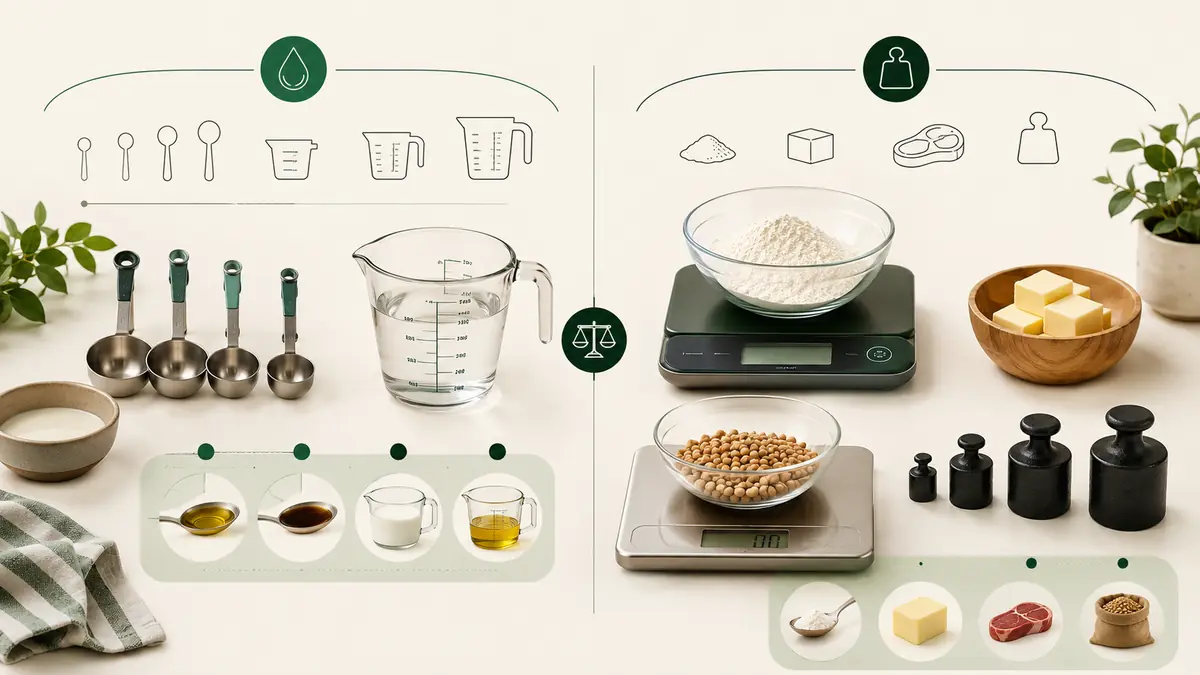
See kitchen volume relationships visually
Kitchen volume relationships
One US cup can be expressed in several volume units
These conversions work because every value below describes volume.
1 cupUS culinary volume
=16 tbsptablespoons
=48 tspteaspoons
≈240 mLpractical volume
US kitchen volume conversion chart
| Measure | Equivalent |
|---|---|
| 1 teaspoon | ≈ 5 mL |
| 1 tablespoon | 3 teaspoons ≈ 15 mL |
| ¼ cup | 4 tablespoons ≈ 60 mL |
| ⅓ cup | 5⅓ tablespoons ≈ 80 mL |
| ½ cup | 8 tablespoons ≈ 120 mL |
| 1 cup | 16 tablespoons ≈ 240 mL |
| 1 pint | 2 cups |
| 1 quart | 4 cups |
| 1 gallon | 16 cups |
Common cooking mass conversion chart
| Measure | Equivalent |
|---|---|
| 1 ounce | 28.35 g |
| 4 ounces | 113.4 g |
| 8 ounces | 226.8 g |
| 1 pound | 453.6 g |
| 1 kilogram | 1000 g ≈ 2.205 lb |
How to use a cooking measurement chart
Use a measurement chart when you are converting units that describe the same kind of quantity. Teaspoons, tablespoons, cups, and milliliters all describe volume. Grams, ounces, pounds, and kilograms describe mass. Temperature units describe heat settings.
This distinction prevents one of the most common kitchen conversion mistakes. A cup can convert to milliliters because both are volume units. A gram can convert to ounces because both are mass units. A cup cannot convert to grams without knowing what ingredient fills the cup.
Keep ingredient conversions separate from standard unit conversions. If a recipe says 2 cups flour and you need grams, use the Cups to Grams Calculator. If it says 8 ounces flour and you need grams, the mass relationship alone is enough.
Teaspoons, tablespoons, and cups
Three US teaspoons equal one US tablespoon. This relationship is useful when a recipe calls for a small amount and you only have one spoon size. For example, 2 tablespoons equal 6 teaspoons.
Sixteen US tablespoons equal one US cup. Half a cup is 8 tablespoons. One quarter cup is 4 tablespoons. These relationships are easy to use for sauces, dressings, oils, syrups, and other ingredients measured by volume.
One third cup is about 5⅓ tablespoons. This is less convenient to measure by spoon, so a marked measuring cup is usually easier. If accuracy matters, use the original unit instead of building a large volume from many small spoon measures.
Useful cup fractions
| Cup amount | Tablespoons | Approx. mL |
|---|---|---|
| ¼ cup | 4 tbsp | 60 mL |
| ⅓ cup | 5⅓ tbsp | 80 mL |
| ½ cup | 8 tbsp | 120 mL |
| ⅔ cup | 10⅔ tbsp | 160 mL |
| ¾ cup | 12 tbsp | 180 mL |
| 1 cup | 16 tbsp | 240 mL |
Cups to milliliters for cooking
KitchenMathHub uses about 240 mL for one practical US culinary cup. Half a US cup is therefore about 120 mL, and one quarter cup is about 60 mL.
A metric cup is commonly 250 mL, so it is not the same size as the practical US cup used here. This difference matters when you follow recipes from different countries. A recipe written with metric cups can produce slightly different quantities if you measure it with a US cup and assume the units are identical.
If the recipe gives milliliters, keep milliliters when you have a metric jug. Converting 250 mL to a US cup just to convert it back later adds unnecessary rounding.
Use the measurement system that matches your tools. The chart is most useful when the recipe and your kitchen use different systems.
US cups, metric cups, and regional differences
Household cooking measures can vary by region. US recipes often use a practical cup near 240 mL. Metric recipes may use a 250 mL cup. Some regions also use tablespoon conventions that differ from the standard US 15 mL tablespoon.
Check where the recipe was published when a baking formula depends heavily on precise volume. A small difference can be harmless in a soup but more noticeable in cake batter, bread dough, pastry, or a concentrated sauce.
Do not assume the word cup defines one exact international volume. The recipe source, measurement notes, and local convention can matter.
Ounces to grams cooking conversion
One ounce is about 28.35 g. Four ounces are about 113.4 g. Eight ounces are about 226.8 g. These values are mass conversions and do not depend on the food.
For example, 8 ounces of cheese and 8 ounces of flour both have the same mass of about 226.8 g. They do not have the same cup volume because their density and shape are different.
Use ounces to grams when the ounce is a weight unit. If the recipe says fluid ounces, you are working with volume instead. That needs a volume conversion, not a mass conversion.
Pounds to grams and kilograms
One pound is about 453.6 g. Two pounds are about 907.2 g. A 5 pound ingredient amount is about 2.268 kg.
There are 16 ounces in one pound. This is useful when a recipe or package mixes pounds and ounces. For example, 1 pound 8 ounces equals 24 ounces in total.
Large recipes are often easier to manage in kilograms rather than thousands of grams. One kilogram is 1,000 g and about 2.205 pounds.
Ounces and fluid ounces are different
An ounce measures mass, while a fluid ounce measures volume. The similar names can cause confusion, especially in American recipes and package labels.
Eight ounces of butter is a weight. Eight fluid ounces of milk is a volume. You cannot swap those unit types without extra information about the ingredient.
Look for the letters fl oz when the recipe means fluid ounces. If it only says oz next to a solid ingredient, it usually refers to mass. When the recipe is unclear, use the ingredient context and source notes rather than guessing.
Why cups do not have one grams conversion
There is no universal number of grams in one cup. A cup measures how much space an ingredient occupies. Grams measure how heavy that ingredient is.
A cup of all purpose flour may use a reference near 120 g, while a cup of granulated sugar is much heavier. Butter, cocoa powder, oats, honey, and brown sugar all have their own culinary relationships.
Ingredient state can also change the result. Packed brown sugar is different from loosely filled brown sugar. Sifted powdered sugar can occupy a different volume from unsifted powdered sugar. Chopped nuts, whole nuts, and sliced nuts can also differ.
Use a standard cooking conversion chart for volume to volume and mass to mass. Use an ingredient specific tool when the dimensions change from volume to mass.
Flour, sugar, and butter measurement examples
One cup of all purpose flour is not the same weight as one cup of granulated sugar. KitchenMathHub keeps ingredient reference data separate so the calculator does not apply a sugar weight to flour or a flour weight to butter.
For baking, this separation matters because flour to liquid ratio, sugar level, and fat level affect structure. If you convert an American recipe to metric, each dry ingredient should use its own reference rather than one cup to grams multiplier.
Use the Recipe Converter when a whole recipe mixes cups, tablespoons, grams, milliliters, and oven temperatures. It can keep those transformations together and preserve ingredient names and notes.
Fahrenheit and Celsius cooking temperatures
Temperature conversion is separate from ingredient measurement. Exact Fahrenheit to Celsius conversion uses a formula, but practical oven settings are often rounded to values that match common oven controls.
For example, 350°F is about 176.7°C mathematically, while 180°C is a common practical conventional oven setting. This is why a cooking temperature chart may show a rounded kitchen value instead of the exact decimal result.
Use the Oven Temperature Converter when you need Celsius, Fahrenheit, fan oven, or Gas Mark guidance. It keeps exact temperature math separate from practical oven conventions.
Liquid measurement conversion for everyday recipes
Volume conversion works best for liquids when the recipe already treats them as volume. Water, milk, stock, juice, and oil may be easier to move between cups and milliliters than between cups and grams.
If a recipe calls for ½ cup milk, about 120 mL is a practical US conversion. One quarter cup is about 60 mL. One tablespoon is about 15 mL.
Stay with milliliters when the recipe is already metric. A marked measuring jug can be more direct than converting every liquid amount into cups and spoons.
Baking measurement chart vs cooking measurement chart
Baking usually benefits more from weight measurements. Flour can compact, powdered ingredients can settle, and brown sugar can be packed. A scale reduces the variation caused by the way a cup is filled.
General cooking is often more flexible. A tablespoon more or less stock in a soup may not matter much, while a similar percentage change in flour or water can affect cake or bread structure.
Use the chart as a practical reference, not a reason to replace a precise measurement with a less precise one. If a trusted baking recipe gives grams and you have a scale, keep the grams.
How to convert a recipe from US to metric measurements
Convert standard units first
Move ounces to grams, pounds to kilograms, cups of liquid to milliliters, and Fahrenheit to Celsius where needed.
Convert ingredient volume with ingredient data
A cup of flour needs a flour reference and a cup of sugar needs a sugar reference. Do not use one universal cups to grams number.
Keep counts as counts
Eggs, apples, garlic cloves, and other counted items usually stay as counts unless the recipe needs a weight based formula.
Round for kitchen use
Use practical gram, milliliter, spoon, or cup values. Avoid long decimals that no normal kitchen tool can measure.
Check cooking method separately
Changing measurement units does not automatically change cooking time. Oven type, pan size, air fryer use, and food depth require their own guidance.
A simple kitchen measurement workflow
First identify what kind of unit you are converting. Is it mass, volume, temperature, length, time, or a count? Staying inside the correct unit dimension prevents most conversion mistakes.
Second check whether an ingredient is required. Volume to mass needs ingredient context. Mass to mass and volume to volume usually do not.
Third choose the output that is easiest to measure. Grams are useful for baking. Milliliters work well for liquids. Cups and spoons are useful when those are the tools you have.
Finally, keep the original recipe nearby. A conversion chart helps you translate the measurement system, but the recipe's method, pan, temperature, and doneness instructions still matter.
Questions about cooking measurements
How many teaspoons are in a tablespoon?
Three US teaspoons equal one US tablespoon.
How many tablespoons are in a cup?
There are 16 US tablespoons in one US culinary cup.
How many milliliters are in a teaspoon?
A practical kitchen teaspoon is about 5 mL.
How many milliliters are in a tablespoon?
A practical US tablespoon is about 15 mL.
How many milliliters are in a US cup?
KitchenMathHub uses about 240 mL for one practical US culinary cup.
Is a metric cup the same as a US cup?
No. A metric cup is commonly 250 mL, while the practical US culinary cup used here is about 240 mL.
How many grams are in one ounce?
One avoirdupois ounce is about 28.35 g.
How many grams are in one pound?
One pound is about 453.6 g.
How many ounces are in one pound?
There are 16 ounces in one pound.
Can I convert cups directly to grams?
Only when the ingredient is known. Cups measure volume and grams measure mass, so flour, sugar, butter, and other foods need separate references.
What is the difference between ounces and fluid ounces?
Ounces measure mass, while fluid ounces measure volume. They are not interchangeable units.
How do I convert Fahrenheit to Celsius for cooking?
Use the temperature formula for exact conversion, then use a practical oven setting when the recipe needs a normal dial value.
Calculation transparency
Read methodologyHow to interpret this result
Result typeDefined units + kitchen conventions
Calculation basisStandard measurement relationships and declared culinary equivalents
Sources shown1
Latest source reviewAug 11, 2026
Defined unit conversions are separated from ingredient-specific volume-to-weight values.
Sources and methodology
These are the references used for data, conventions, safety targets, or calculation context on this page. Review dates show when KitchenMathHub last checked the cited source.