National Institute of Standards and TechnologyMetric Kitchen: Cooking Measurement EquivalenciesUsed for defined measurement guidance or public food-safety guidance where applicable.
Open source ↗US vs Australian Cooking Measurements
US and Australian recipes can use the same words for different kitchen volumes. Compare cups, tablespoons, teaspoons, and practical metric equivalents before converting an imported recipe, especially when baking or measuring concentrated ingredients.
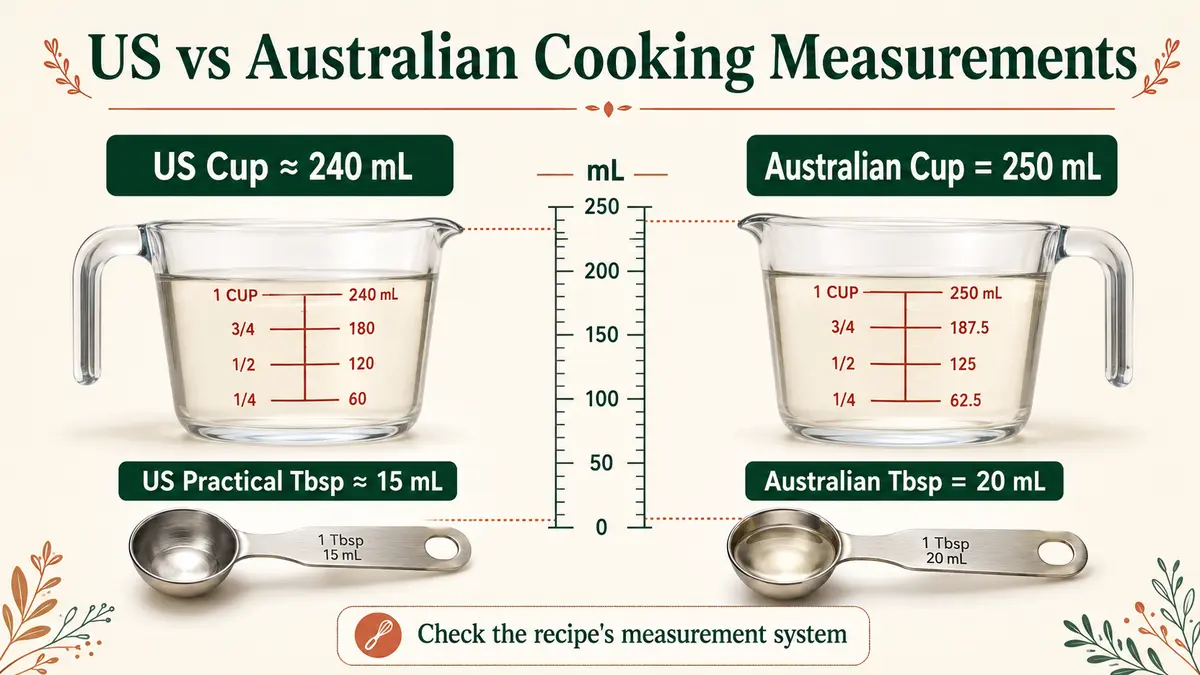
The biggest differences are the cup and tablespoon
A U.S. cup and an Australian metric cup are not exactly the same volume. NIST's practical kitchen table uses about 240 mL for a U.S. cup, while Food Standards Australia New Zealand uses 250 mL for one cup in its household-measure guidance.
The tablespoon difference can be even more important. U.S. practical cooking tables commonly treat a tablespoon as about 15 mL. Traditional Australian metric measurement uses a 20 mL tablespoon, so the same written “1 tablespoon” can represent a materially different amount.
These differences are most important when the ingredient has a strong functional role. A few extra milliliters of vanilla may not matter. A one-third difference in baking powder, salt, or a concentrated sauce can be much more noticeable.
US and Australian kitchen measures side by side
| Measure | US practical value | Australian metric value | Difference to notice |
|---|---|---|---|
| 1 cup | about 240 mL | 250 mL | AU cup is about 4% larger than 240 mL |
| 1/2 cup | about 120 mL | 125 mL | Small per measure, larger across repeated cups |
| 1 tablespoon | about 15 mL | 20 mL traditional AU | AU tablespoon is about 33% larger than 15 mL |
| 1 teaspoon | about 5 mL | 5 mL | Close enough for normal recipe use |
| 1 fluid ounce | about 29.6 mL | Not a standard modern AU metric recipe unit | Convert to mL when importing |
Why the US cup can appear as 236.6 mL or 240 mL
The exact U.S. customary cup is about 236.6 mL. NIST's exact conversion data derives from the U.S. fluid system. In practical home-cooking tables, that value is commonly rounded to 240 mL because four significant decimal places do not improve a normal recipe.
This is the same exact-versus-practical distinction used in oven temperatures. A scientific conversion can preserve more digits than a kitchen needs. The Cooking Measurement Chart therefore uses practical values while the methodology keeps the underlying convention clear.
Do not confuse a rounded 240 mL U.S. cooking cup with a 250 mL metric cup. They are close, but they are not the same declared standard.
Why the Australian tablespoon deserves special attention
A 20 mL tablespoon holds 5 mL more than a 15 mL tablespoon. For one spoonful the absolute difference is small. For four tablespoons, the difference becomes 20 mL, which is an entire extra 15 mL tablespoon plus another teaspoon compared with the smaller standard.
This matters most for ingredients used in small functional doses. Baking powder and baking soda affect gas production and pH. Salt affects taste and bread fermentation. Cornstarch affects thickening. Soy sauce, fish sauce, and other concentrated seasonings can become noticeably stronger.
When an Australian recipe is sensitive, convert the spoon amount to milliliters before measuring. That removes the ambiguity about which physical spoon set you own.
A worked example: three tablespoons in an Australian recipe
Three traditional Australian tablespoons equals 60 mL. If a cook uses three 15 mL tablespoons instead, the measured amount is 45 mL.
The missing amount is 15 mL, or 25 percent of the intended 60 mL total. That can be meaningful for a thickener, leavener, salt solution, or strong sauce.
A simple workaround with 15 mL and 5 mL spoons is four teaspoons for each 20 mL Australian tablespoon. Three Australian tablespoons therefore equals 12 metric teaspoons of 5 mL each.
Dry ingredients create a second conversion problem
Changing a cup from 240 mL to 250 mL is only the volume step. Turning that flour, sugar, oats, or cocoa into grams also requires an ingredient weight reference or density.
Food Standards Australia New Zealand demonstrates this explicitly in its Nutrition Panel Calculator guidance. It uses a 250 mL cup and a food density to estimate gram weight. KitchenMathHub usually prefers a direct published household-measure weight when one is available because it better reflects the actual culinary ingredient state.
Use the Ingredient Weight Database when volume becomes mass. It keeps the ingredient, state, source measure, gram value, and confidence visible.
How to identify the likely country of a recipe
The publisher location is the strongest clue. A recipe from an Australian food publication or government source is more likely to follow Australian metric conventions than a recipe from a U.S. test kitchen.
Temperature format helps. Australian recipes generally use Celsius. U.S. recipes commonly lead with Fahrenheit. Ingredient terminology can also help, such as icing sugar versus powdered sugar, capsicum versus bell pepper, or plain flour versus all purpose flour.
Do not rely on vocabulary alone when precision matters. Global publishers adapt recipes for international audiences, and some Australian cooks use 15 mL tablespoon measures. If a recipe states its measure definitions, use those declarations.
Why small regional differences can become large across a full recipe
A 10 mL difference between a 240 mL and 250 mL cup looks small until the recipe uses several cups. Four Australian 250 mL cups represent 1,000 mL. Four practical U.S. 240 mL cups represent about 960 mL. The difference is 40 mL, which is large enough to notice in a liquid-heavy batter or dough.
The tablespoon difference accumulates even faster because it is proportionally larger. Five 20 mL Australian tablespoons equal 100 mL, while five 15 mL tablespoons equal 75 mL. That 25 mL gap can materially change a sauce, glaze, leavener mixture, or seasoning blend.
This is why regional recipe conversion should preserve the source system before converting individual lines. Once every “cup” and “tablespoon” is treated as an unlabeled generic unit, the original context has been lost. A good recipe converter needs to know the starting convention first.
When the difference is unlikely to matter and when it deserves attention
A tiny teaspoon difference is usually less important than a large cup or tablespoon difference. The exact U.S. teaspoon is about 4.93 mL and the metric teaspoon is 5 mL, so ordinary cooking rarely needs a correction. The cup and Australian tablespoon differences are larger and accumulate more quickly.
Baking, bread formulas, preserves, concentrated seasonings, and chemical leaveners deserve the most care. These recipes can depend on ratios or functional ingredients. A flexible soup or salad dressing may tolerate a small regional volume difference more easily, especially when the final seasoning is adjusted to taste.
The safest way to convert a recipe between regions
Preserve grams when the recipe gives them
Mass does not depend on cup size. If the recipe gives 300 g flour, keep 300 g flour rather than converting it to one country's cups and back again.
Convert liquid cups and spoons through milliliters
Milliliters make the regional volume difference explicit. A 250 mL Australian cup stays 250 mL when transferred to another kitchen.
Convert dry volume to mass with the correct ingredient reference
A cup of flour and a cup of honey cannot share one grams-per-cup multiplier. Use the named ingredient and state.
Use the Recipe Converter for a full imported recipe
The Recipe Converter keeps servings, units, pan, and oven changes together so you do not have to perform disconnected conversions line by line.
Questions about US and Australian measurements
Is an Australian cup the same as a US cup?
No. Australian metric recipes commonly use a 250 mL cup, while NIST practical U.S. kitchen guidance uses about 240 mL for a U.S. cup.
How many milliliters are in an Australian cup?
An Australian metric cup is commonly 250 mL. Food Standards Australia New Zealand uses 250 mL for one cup in its household-measure conversion guidance.
How many milliliters are in a US cup?
NIST practical cooking guidance uses about 240 mL for one U.S. cup. The exact U.S. customary cup is about 236.6 mL, so practical kitchen charts often round it.
Is an Australian tablespoon 20 mL?
The traditional Australian metric tablespoon is 20 mL. That is larger than the common 15 mL practical tablespoon used in many U.S. and metric kitchen references.
Are Australian and US teaspoons the same?
They are very close in normal recipe use. A metric teaspoon is 5 mL, while the exact U.S. teaspoon is about 4.93 mL.
Will a 250 mL cup ruin a US recipe?
Not always, but the difference can accumulate. Several cups of flour, liquid, or sugar can shift a recipe more than one small spoon measure.
Why does the Australian tablespoon matter so much?
A 20 mL tablespoon is about one third larger than a 15 mL tablespoon. That can matter for baking powder, salt, concentrated sauces, and other small but powerful ingredients.
Should I convert an Australian recipe to grams?
Grams and milliliters can remove much of the cup and spoon ambiguity. Keep ingredient-specific density in mind when converting dry ingredients from volume to mass.
How can I tell which measurement system a recipe uses?
Check the publisher's country, whether temperatures are Celsius or Fahrenheit, spelling, package sizes, and any stated cup or tablespoon definitions.
What should I do if the recipe gives grams too?
Use the recipe's gram amount when practical. That value is clearer than trying to infer whether the author meant a 240 mL or 250 mL cup.
Calculation transparency
Read methodologyHow to interpret this result
Result typeSource comparison guide
Calculation basisPublished measurement standards, culinary references, and declared regional conventions
Sources shown3
Latest source reviewAug 15, 2026
Different values can be valid when they use different measurement methods, ingredient states, or regional standards. Use the reference that matches the recipe context.
Sources and methodology
These are the references used for data, conventions, safety targets, or calculation context on this page. Review dates show when KitchenMathHub last checked the cited source.
National Institute of Standards and TechnologyApproximate Conversions from U.S. Customary Measures to MetricUsed for defined measurement guidance or public food-safety guidance where applicable.
Open source ↗Food Standards Australia New ZealandNutrition Panel Calculator User GuideUsed for defined measurement guidance or public food-safety guidance where applicable.
Open source ↗