National Institute of Standards and TechnologyMetric Kitchen: Cooking Measurement EquivalenciesUsed for defined measurement guidance or public food-safety guidance where applicable.
Open source ↗Conventional to Fan Oven Converter
Convert a conventional oven temperature to a practical fan oven setting. The calculator also shows useful Fahrenheit and Gas Mark references so you can adapt UK, US, and metric recipes without guessing.
Fan oven starting setting
180°C
Fahrenheit: 400°F
Fan: 180°C
Closest Gas Mark: 6
Exact math: 200.0°C = 392.0°F
Fan setting is a cooking conventionThe fan result uses a common 20°C recipe adjustment. Follow your appliance manual if it gives a different conversion.
Show calculation
Exact temperature
200°C = 392°FPractical cooking setting
200°C conventional ≈ 400°F ≈ 180°C fan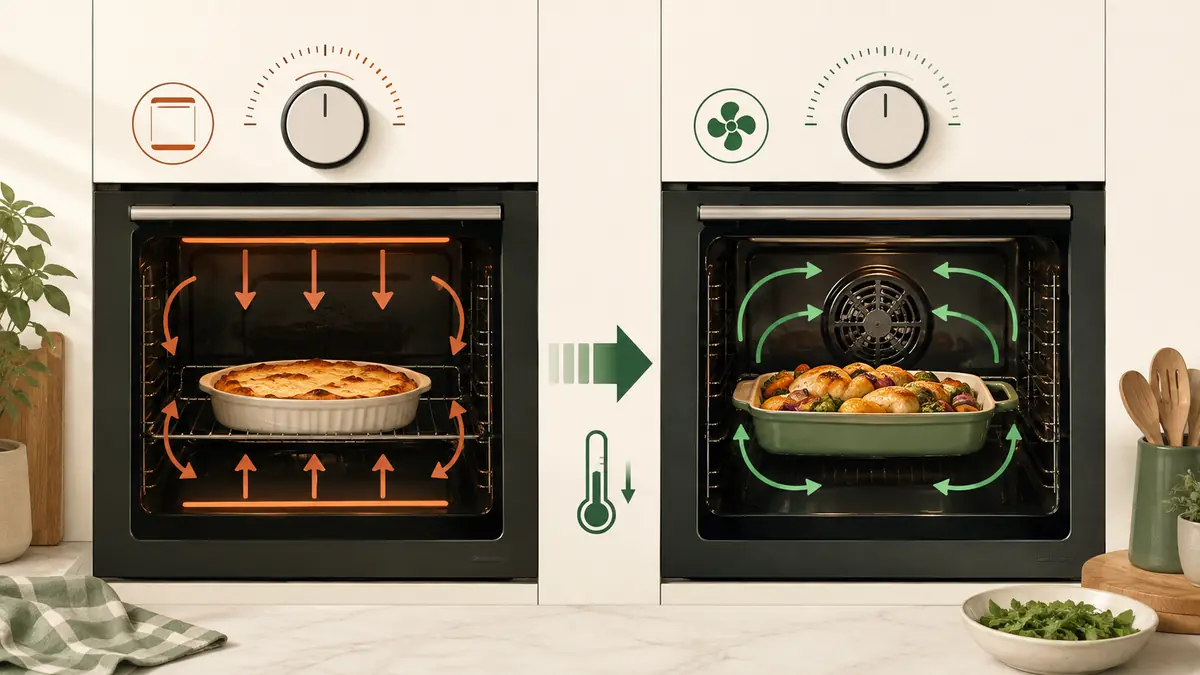
See conventional and fan oven settings visually
Oven temperature example
Exact temperature and practical oven settings are not the same thing
KitchenMathHub keeps the exact conversion visible, then shows practical recipe settings.
Recipe says350°FConventional oven
Exact conversion176.7°CFormula result
180°CConventional
160°CFan
Conventional to fan oven conversion chart
| Conventional oven | Common fan setting |
|---|---|
| 140°C / 275°F | 120°C fan |
| 150°C / 300°F | 130°C fan |
| 160°C / 325°F | 140°C fan |
| 180°C / 350°F | 160°C fan |
| 190°C / 375°F | 170°C fan |
| 200°C / 400°F | 180°C fan |
| 220°C / 425°F | 200°C fan |
| 230°C / 450°F | 210°C fan |
| 240°C / 475°F | 220°C fan |
How to convert a conventional oven to a fan oven
A common fan oven conversion starts 20°C lower than the conventional oven temperature. If a recipe says 200°C conventional, use about 180°C fan. If it says 180°C conventional, use about 160°C fan. This simple rule covers many everyday recipes and gives a clear starting point.
The 20°C reduction is a recipe convention, not an exact rule for every oven. Fan speed, cavity size, heating element position, calibration, and cookware can all change how the food behaves. If your oven manual recommends a different adjustment, follow the manufacturer for your appliance.
Convert the oven type before you change anything else in the recipe. Keep ingredient quantities, pan size, and cooking method the same at first. This lets you judge the effect of the fan setting without mixing several changes together.
200°C conventional to fan oven temperature
200°C conventional commonly becomes 180°C fan. This is one of the most searched fan oven temperature conversions because 200°C appears in roasting, baking, tray bakes, potatoes, vegetables, and many savory recipes.
200°C also commonly matches about 400°F in recipe charts. That means a US recipe written at 400°F can often be understood as about 200°C conventional, then about 180°C fan. The exact Fahrenheit to Celsius math differs slightly, but these are the normal cooking settings.
Do not assume the cooking time must drop by the same percentage for every food. A tray of vegetables, a loaf of bread, and a deep casserole all respond differently. Keep the recipe time as a starting point and begin checking based on the food's doneness cues.
180°C conventional to fan oven temperature
180°C conventional commonly becomes 160°C fan. This pairing is common in cakes, cookies, baked pasta, casseroles, and general baking recipes. It also matches the practical 350°F conventional setting used in many US recipes.
A fan oven can brown exposed surfaces faster even at a lower set temperature. Moving air helps carry heat across the food. This can improve even browning, but it can also dry thin edges or exposed toppings if the food stays in too long.
Use the original bake time as a range to watch, not a fixed promise. Start checking near the earlier part of the recipe window. If the cake, cookies, or bread are coloring too quickly, confirm the rack position and oven setting before changing several variables at once.
220°C conventional to fan oven temperature
220°C conventional commonly becomes 200°C fan. Recipes use this hotter range for roasting, pizza, pastry, bread, and foods that need strong browning or crisp edges.
Hot fan settings can color food quickly. Thin pastry, cheese toppings, exposed vegetables, and small pieces can brown before a thick center is fully heated. Keep the food visible when possible and check earlier than you would with a low temperature bake.
Use pan position and cookware as part of the result. Dark metal can absorb heat differently from light metal or glass. A tray close to the upper heating element can brown faster. Fan conversion changes the oven setting, but cookware and rack position still affect the food.
350°F and 400°F to fan oven settings
350°F conventional to fan oven
350°F commonly becomes about 180°C conventional and 160°C fan. The exact mathematical conversion of 350°F is about 176.7°C, but recipes normally round this to 180°C. The fan step then uses the common 20°C reduction.
Use 160°C fan when the original 350°F recipe is written for a conventional oven. If the US recipe already says convection, do not apply the same reduction again without checking the recipe notes.
400°F conventional to fan oven
400°F commonly becomes about 200°C conventional and 180°C fan. This is useful when adapting US roasting and baking recipes for a fan assisted oven.
The practical recipe conversion matters more than the exact 204.4°C mathematical value when setting the oven. Most recipes and oven dials use rounded temperature steps, so 200°C is the normal cooking anchor for 400°F.
Fan oven versus convection oven
Fan oven and convection oven usually mean the oven actively moves hot air. The exact technology can differ, but both terms tell you that airflow is part of the cooking method. This is why recipes often use a lower setting than a conventional oven.
Do not assume every convection setting behaves the same. Some ovens have several fan modes, such as true convection, fan bake, fan grill, or assisted cooking. Read the appliance manual when the mode changes which heating elements run with the fan.
Use the recipe's wording as your first clue. If it lists both conventional and fan temperatures, follow the fan value directly. If it lists only conventional, use the converter. If it lists only fan, do not lower the number again.
Gas Mark to fan oven conversion
Gas Mark 4 commonly converts to about 180°C conventional and 160°C fan. Gas Mark 6 commonly converts to about 200°C conventional and 180°C fan. Gas Mark 7 commonly converts to about 220°C conventional and 200°C fan.
Gas Mark is a set of cooking levels rather than a continuous decimal scale. Use a lookup chart instead of trying to create a formula that returns values such as Gas Mark 5.4. The practical goal is to select the nearest standard oven setting.
Older cookbooks often use Gas Mark while newer appliances use Celsius or fan Celsius. The converter lets you keep using the recipe without rewriting the whole method.
Should fan oven cooking time be shorter?
Fan ovens can cook some foods faster, but there is no one time reduction that fits every recipe. A shallow tray of vegetables can respond quickly to moving air, while a deep loaf, casserole, or roast still needs time for heat to reach the center.
Use doneness cues before you change the clock. Cakes need a set center. Cookies need the right edge color and texture. Bread needs structure and browning. Meat needs the applicable safe internal temperature. These checks are more useful than subtracting a fixed number of minutes from every recipe.
Start checking near the early end of the original time range. If a recipe says 25 to 30 minutes, look at the food around 25 minutes rather than automatically changing the instruction to 20 minutes. Your own oven will teach you how strongly its fan mode changes cooking speed.
Fan oven conversion for cakes and baking
For cakes, convert the temperature but keep the batter formula unchanged. Moving from 180°C conventional to 160°C fan does not mean you should change flour, sugar, eggs, or liquid.
Pan size can affect baking time more than the fan conversion itself. A wider pan makes a shallower layer, while a smaller pan makes a deeper one. If you also need to change pan size, use the Cake Pan Conversion Calculator so the ingredient scale and pan geometry are handled separately.
Fan airflow can dry exposed cake surfaces if the temperature or bake time is too high. Use the common reduced setting, avoid unnecessary door opening, and check the cake near the expected finish window.
Fan oven conversion for roasting and savory food
Fan heat can help roast vegetables and small pieces brown evenly. Space between pieces still matters because airflow cannot reach surfaces that are tightly covered by other food.
Large roasts still need internal doneness checks. A lower fan temperature can change surface browning, but the center must still reach the correct temperature for the food. Use a thermometer when food safety or a specific degree of doneness matters.
Covered dishes may respond less strongly to moving air. A lid or foil reduces direct airflow over the food. This is another reason one universal time reduction cannot describe every fan oven recipe.
Fan oven to air fryer conversion
A fan oven recipe should not receive the full conventional oven reduction again when you move it to an air fryer. Both appliances already use moving air. The air fryer still has a smaller chamber and different basket geometry, so time and food specific guidance can change.
Use the Oven to Air Fryer Calculator and select fan as the source oven. This tells the calculator that the recipe has already been written for moving air.
Keep an early check point after the appliance change. Even when the temperature stays close, an air fryer can brown food quickly because the food sits closer to the heating system and moving air.
How to avoid common fan oven conversion mistakes
Do not reduce a temperature twice. If a recipe already lists a fan setting, use it. A second 20°C reduction can leave the oven too cool and extend cooking unnecessarily.
Do not treat fan conversion as exact physics. The 20°C rule is a practical recipe convention. Your appliance may behave best with a slightly different adjustment.
Do not change temperature, pan size, and ingredient quantity without tracking each change. If several parts of the recipe need adapting, use the Recipe Converter so the transformations stay separate and easier to review.
Common questions about fan oven conversion
How do I convert conventional Celsius to fan Celsius?
Start about 20°C lower for a fan oven. This is a common recipe convention, so 200°C conventional becomes about 180°C fan.
What is 200°C conventional in a fan oven?
200°C conventional commonly converts to about 180°C fan. Follow your oven manual if the manufacturer gives a different adjustment.
What is 180°C conventional in a fan oven?
180°C conventional commonly converts to about 160°C fan. This pairing is widely used in recipe temperature charts.
What is 220°C conventional in a fan oven?
220°C conventional commonly converts to about 200°C fan. Keep the original recipe time as a starting point and check doneness rather than applying one universal time reduction.
What is 350°F conventional in a fan oven?
350°F commonly matches 180°C conventional, which becomes about 160°C fan. The Fahrenheit and Celsius values are practical recipe equivalents rather than exact equal temperatures.
What is 400°F conventional in a fan oven?
400°F commonly matches 200°C conventional, which becomes about 180°C fan. Use the practical fan setting when adapting the recipe.
Is fan oven the same as convection oven?
In everyday recipe language, fan oven and convection oven usually describe active hot air circulation. Actual appliance design can still differ by model and country.
Do I reduce cooking time in a fan oven?
Do not use one fixed time reduction for every recipe. Fan heat can change cooking speed, but food type, pan, thickness, and oven design still matter.
Do I reduce a recipe again if it already says fan?
No, do not apply the conventional to fan reduction twice. A stated fan temperature has already made that adjustment.
Can I convert Gas Mark to a fan oven setting?
Yes, convert Gas Mark to its common conventional Celsius value, then use the fan equivalent. For example, Gas Mark 4 commonly maps to 180°C conventional and about 160°C fan.
Calculation transparency
Read methodologyHow to interpret this result
Result typeExact math + cooking convention
Calculation basisDefined temperature formulas plus practical recipe settings
Sources shown2
Latest source reviewAug 12, 2026
Exact temperature equivalence and practical oven settings are shown separately when cooking convention requires rounding.
Sources and methodology
These are the references used for data, conventions, safety targets, or calculation context on this page. Review dates show when KitchenMathHub last checked the cited source.
North Lanarkshire CouncilChicken nuggets recipe oven temperature equivalenciesUsed for defined measurement guidance or public food-safety guidance where applicable.
Open source ↗