National Institute of Standards and TechnologyMetric Kitchen: Cooking Measurement EquivalenciesUsed for defined measurement guidance or public food-safety guidance where applicable.
Open source ↗Recipe Tools
Choose a recipe tool for scaling servings, converting measurements, changing pans, or adapting cooking settings. Start with one task, or use the Recipe Converter when several changes belong to the same recipe.
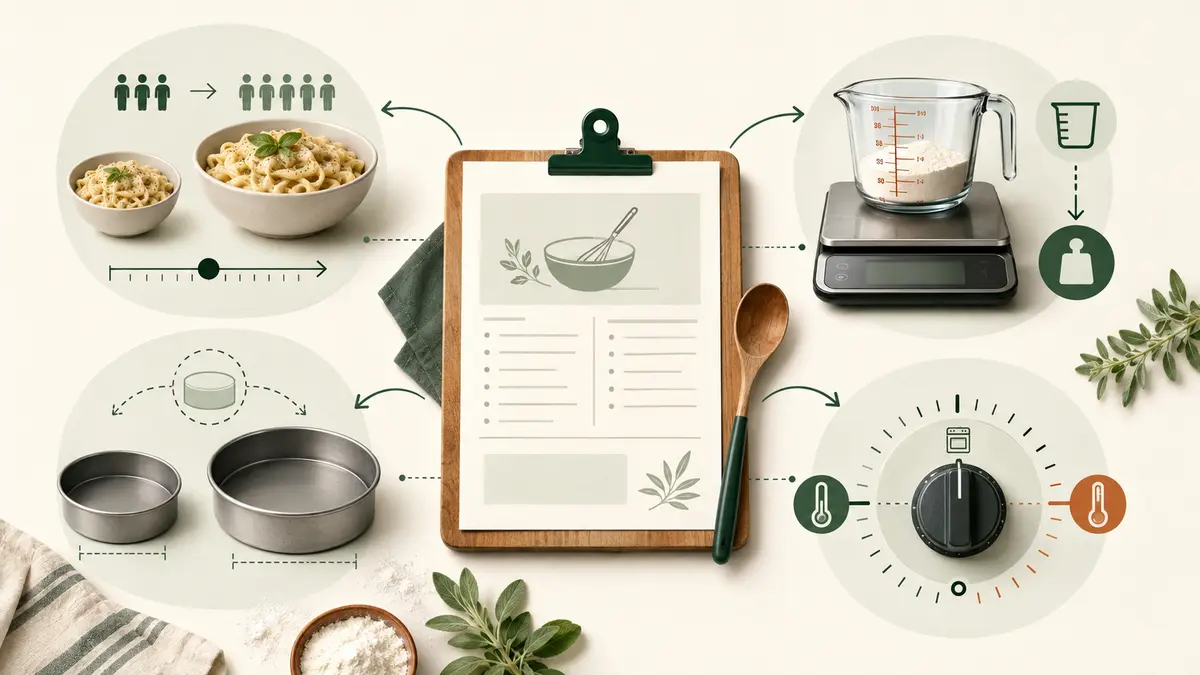
Recipe tools for the changes cooks make most often
Recipe Converter / Recipe Lab
Paste, type, or speak a recipe. Change servings, units, pan settings, oven style, air fryer settings, and review ingredient matches in one workspace.
Best for several recipe changes at once.Recipe Scaling Calculator
Adjust a recipe to more or fewer servings with practical fractions, ranges, and partial egg guidance.
Best for serving and batch changes.How to Scale a Recipe
Learn the recipe multiplier formula and see examples for halving, doubling, tripling, and changing yields.
Best when you want to understand the math.Cups to Grams Calculator
Convert individual ingredients from volume to weight with ingredient specific culinary references.
Useful before or after scaling a recipe.Cake Pan Converter
Resize a baking recipe when you move between round, square, rectangular, or oval pans.
Useful when pan size changes the batter amount.Oven to Air Fryer Calculator
Adapt an oven recipe to an air fryer starting temperature, time range, and early check point.
Useful when the cooking appliance changes.Choose a recipe calculator by the problem you need to solve
Use a recipe scaling calculator when the serving count is the main thing that changes. If a soup serves 4 and you need 10 portions, the ingredient factor is 10 divided by 4, which equals 2.5. Flour, stock, vegetables, spices, and other scalable ingredients can use that factor. Cooking time should still be judged separately because a larger pot or deeper food layer can change how the recipe cooks.
Use a recipe converter when measurements and servings need to change together. This is common when an American recipe lists cups and tablespoons but you prefer grams and milliliters. The converter can first normalize the ingredient quantities, apply the serving factor, and then convert the final amounts. That order helps avoid errors caused by rounding a quantity too early.
Use a pan calculator when the baking pan controls the recipe size. A cake made for an 8 inch round pan does not automatically fit a 10 inch round pan at the same depth. The pan area changes much faster than the diameter may suggest. The Cake Pan Conversion Calculator compares the original and target areas and gives you a batter scale factor.
Use an appliance converter when the oven or air fryer changes. Ingredient amounts may stay the same while temperature, cooking time, and check time need a new starting point. The Oven to Air Fryer Calculator handles that as a cooking method change instead of treating it like ordinary recipe scaling.
How recipe scaling works with servings and yield
A recipe scale factor is target yield divided by original yield. This formula works whether the yield is written as servings, cookies, loaves, portions, muffins, or another count. A recipe that makes 12 cookies and needs to make 30 cookies uses 30 divided by 12, which equals 2.5. Each scalable ingredient starts with the same factor.
Scale a recipe up for a larger group
Scaling a recipe from 6 servings to 9 servings uses a 1.5 multiplier. Two cups of an ingredient become 3 cups before any measurement conversion. One tablespoon becomes 1.5 tablespoons. Three eggs become 4.5 eggs, which needs a practical partial egg method rather than a guess.
Scale a recipe down for a smaller batch
Halving a recipe uses a 0.5 multiplier. A cup becomes half a cup, 300 g becomes 150 g, and 2 teaspoons become 1 teaspoon. Small amounts can become hard to measure by volume, so a kitchen scale may give a more repeatable result for tiny quantities.
Recipe scaling changes ingredient quantity, not every number in the instructions. A direction such as “knead for 8 minutes” should not become 12 minutes just because the recipe uses a 1.5 ingredient factor. Temperatures, times, mixer speeds, pan sizes, and step numbers have their own meaning.
Convert recipe measurements without treating every ingredient the same
Cups to grams requires ingredient context. A cup is a volume measure, while a gram is a mass measure. One cup of flour does not weigh the same as one cup of granulated sugar, butter, cocoa powder, oats, or honey. This is why KitchenMathHub uses ingredient specific culinary references instead of one universal cup to gram multiplier.
Standard unit conversions are different from ingredient conversions. Grams to kilograms, ounces to grams, milliliters to liters, and Celsius to Fahrenheit can use dimensional formulas. Cups of flour to grams need the identity and state of the ingredient. The Ingredient Conversions hub explains this difference and links to the individual converters.
Convert an American recipe to metric
A practical metric recipe usually uses grams for many dry ingredients and milliliters for many liquids. Flour, sugar, butter, cocoa, and oats often become easier to reproduce when weighed. Water, milk, juice, and similar liquids often remain easy to understand in milliliters. Eggs and whole foods usually remain counts unless a recipe has a reason to use weight.
Convert a metric recipe to cups
Metric to US conversion should return practical kitchen fractions, not long decimals. If 180 g of a supported flour converts to about 1.5 cups, the useful result is 1 1/2 cups. The Grams to Cups Calculator handles the reverse direction with the same ingredient reference used for cups to grams.
Recipe Converter and Recipe Lab for several changes in one workflow
Recipe Lab is the working space inside the Recipe Converter when the same recipe needs several changes. You can paste a recipe, type it, or use the speech button where browser speech recognition is available. The recipe parser then separates recognized ingredient lines and keeps the original recipe available while transformations are applied.
Speak ingredients as a list for the cleanest voice input. For example, you can say “two cups flour, one and a half cups sugar, three eggs, half a cup butter.” The speech normalizer converts common spoken quantities into recipe friendly numbers and places likely ingredients on separate lines before the recipe parser runs.
The original recipe remains the reference point. KitchenMathHub does not keep converting already rounded display values. If you change servings, switch units, and then undo the unit change, the working result can be derived from the normalized recipe rather than a chain of rounded copies.
Serving scaling and pan scaling need clear intent when both are selected. If you already doubled a cake for twice as many servings, you may only need the pan tool to check whether the selected pan can hold the batter. Applying a second pan multiplier without thinking about the goal could make far too much batter.
Use cases for recipe scaling, converting, and adapting
Dinner for more people
A recipe serving calculator is useful when guest count changes but the cooking method stays mostly the same. Scale the ingredients first, then decide whether the new quantity needs a larger pot, more pans, or separate batches. A stew that doubles in volume may take longer to heat through even though the ingredient math is simple.
Baking from a US recipe with a kitchen scale
A cups to grams recipe converter is useful when you want repeatable baking measurements. Convert supported dry ingredients to grams, keep liquid measurements practical, and retain the recipe author's own gram values whenever they are already supplied.
Changing cake pan size
A cake pan conversion should use geometry before ingredient rounding. Moving from an 8 inch round to a 9 inch round requires about 1.27 times the batter for a similar depth. Once the factor is known, the same scaling engine can adjust flour, sugar, butter, eggs, and other ingredients.
Moving an oven recipe into an air fryer
An oven to air fryer conversion changes the cooking environment rather than the recipe yield. Start with a sensible temperature and time adjustment, then use food type, thickness, frozen state, basket load, and early checking to refine the result.
Recipe math that should stay separate
Cooking time is not a serving multiplier. A recipe that changes from 4 portions to 8 portions does not automatically need twice the cooking time. If the food is divided into two equal pans, each pan may cook near the original window. If all the food becomes one deeper batch, the time may increase.
Oven temperature is not multiplied when servings increase. A cake baked at 350°F does not become 700°F when the batter doubles. Temperature belongs to the cooking method, while ingredient quantity belongs to the recipe formula.
Food safety targets stay independent from estimated cooking time. An air fryer may cook a food faster than an oven, but poultry still needs the appropriate safe internal temperature. Use a thermometer where food safety guidance calls for one.
Ingredient state can matter during conversion. Packed brown sugar, unsifted powdered sugar, rolled oats, chopped nuts, and sifted flour can have different volume to mass relationships. Choose the ingredient or state that matches the recipe instead of assuming the food name alone is enough.
A practical order for changing a recipe
Start by deciding what must stay the same. Do you want the same number of servings with metric measurements, the same cake height in a larger pan, or the same food cooked in a different appliance? A clear goal prevents two different calculators from changing the same quantity for different reasons.
1. Confirm the original recipe
Check the yield, ingredient quantities, units, pan size, oven type, temperature, and time. Keep any recipe specific weights that the author already provides.
2. Apply yield or pan scaling
Use servings when the number of portions controls the batch. Use pan geometry when the target cake or baking pan controls the batter amount.
3. Convert measurements
Change cups, grams, milliliters, ounces, or other units after the scalable quantities are normalized. Use ingredient specific references for volume to mass conversions.
4. Adapt the cooking method
Convert oven temperature, fan settings, or air fryer guidance separately. Keep cooking time as a cooking decision, not an ingredient equation.
5. Review awkward amounts
Check partial eggs, very small leavener quantities, pan fit, unknown ingredient conversions, and any instruction numbers that should remain unchanged.
Questions about recipe tools
What is the best tool for changing recipe servings?
Use the Recipe Scaling Calculator when you only need to make more or fewer servings. It applies one clear scale factor to the ingredient quantities and keeps awkward amounts visible.
What tool converts a full recipe to metric?
Use the Recipe Converter when you want to change cups and spoons into grams or milliliters across a full ingredient list. It can also scale servings in the same workflow.
How do I calculate a recipe scale factor?
Divide the target yield by the original yield. A recipe that goes from 4 servings to 10 servings uses a factor of 2.5.
Can I halve a recipe with KitchenMathHub?
Yes. A half batch uses a 0.5 scale factor, so each scalable ingredient is multiplied by one half.
Can I double a recipe and convert it to grams at the same time?
Yes. The Recipe Converter can apply the serving change first and then convert the normalized ingredient amounts into practical metric measurements.
Should cooking time double when I double a recipe?
No. Ingredient quantity can double, but cooking time depends on pan size, food depth, oven behavior, and cooking method.
How do I handle half an egg when scaling a recipe?
Beat the egg, weigh or measure the amount you need, and use the partial amount instead of guessing. The scaling tool can show a practical partial egg note.
Can I paste a recipe instead of entering every ingredient?
Yes. The Recipe Converter accepts a pasted, typed, or spoken recipe and organizes recognized ingredient lines for further conversion.
Can I change a cake recipe for a different pan?
Yes. Use the Cake Pan Conversion Calculator when the pan size should determine the ingredient factor, or use the Recipe Converter to keep the pan change with the rest of the recipe.
Can I convert an American recipe to metric?
Yes. KitchenMathHub can convert standard units and use ingredient specific references for dry ingredients such as flour, sugar, butter, cocoa, oats, and other supported foods.
Calculation transparency
Read methodologyHow to interpret this result
Result typeReference resource
Calculation basisDeclared methods and cited culinary or measurement sources
Sources shown3
Latest source reviewAug 11, 2026
Sources and assumptions are shown so you can judge whether a reference fits your recipe or kitchen situation.
Continue with KitchenMathHub
Sources and methodology
These are the references used for data, conventions, safety targets, or calculation context on this page. Review dates show when KitchenMathHub last checked the cited source.
King Arthur BakingIngredient Weight ChartUsed for established culinary measurements, baking methods, or formula guidance.
Open source ↗King Arthur BakingThe essential alternative baking pan sizesUsed for established culinary measurements, baking methods, or formula guidance.
Open source ↗