USDA Food Safety and Inspection ServiceAir Fryers and Food SafetyUsed for defined measurement guidance or public food-safety guidance where applicable.
Open source ↗Why Air Fryer Cooking Times and Results Differ
Air fryer time is a cooking estimate, not a fixed unit conversion. Learn how appliance design, food thickness, fresh or frozen state, basket load, airflow, and doneness targets change the finish time, and how to use check times more safely.
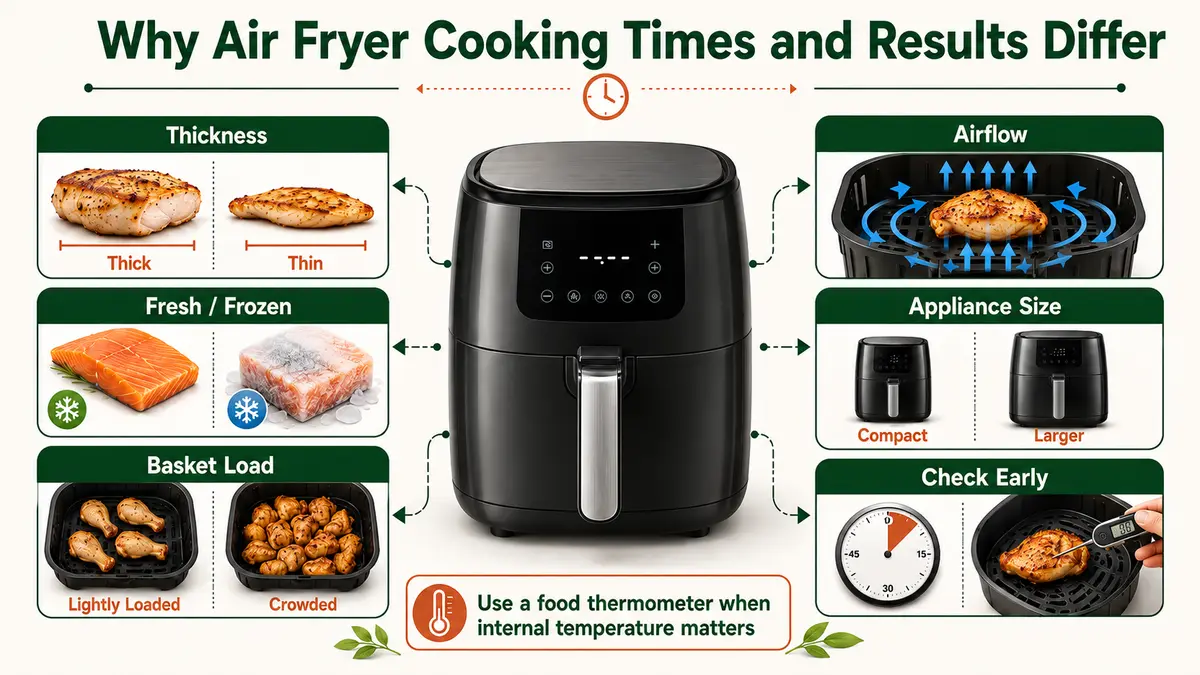
The short answer: an air fryer is a heat-transfer system, not a timer formula
An oven-to-air-fryer conversion can create a useful starting point, but it cannot know every variable in your kitchen. Air fryers move hot air rapidly around food. The speed of heating depends on how that air reaches the surface, how thick the food is, how cold it starts, and how the appliance cycles its heater and fan.
This is why two recipes for the same food can publish different times without one necessarily being wrong. One may use a compact 4-quart basket, another a large dual-zone unit. One chicken breast may be 1 inch thick and another 1.75 inches thick. The written food name is not enough to make the cooking conditions identical.
KitchenMathHub therefore gives a range and an earlier check point. Stage 14 also added food-specific inputs for thickness, fresh or frozen state, cut, basket load, and other attributes on supported food pages.
The main variables that change air fryer cooking time
| Variable | Why it matters | Typical effect |
|---|---|---|
| Food thickness | Heat must reach the center | Thicker pieces usually take longer |
| Frozen vs fresh | Frozen food starts much colder | Often increases time and moisture load |
| Basket load | Crowding reduces airflow | Can slow cooking and reduce crispness |
| Appliance size/design | Fan, heater, basket and element distance vary | Same setting can cook differently |
| Preheating | Changes starting cavity and basket temperature | Can shorten early heating phase |
| Food shape/cut | Surface area and thickness distribution change | Shoestring fries differ from steak fries |
| Target doneness | A higher internal target needs more heat input | Longer for more cooked results |
Food thickness often matters more than the total weight
The center of a thick piece is farther from the hot surface. A 250 g chicken breast that is thick and compact can take longer to reach a safe center temperature than 250 g split into two thin cutlets.
This is why the Chicken Breast and Salmon tools ask for thickness. Weight still matters because larger food contains more thermal mass, but thickness is often the more direct clue for center doneness.
Flattening or portioning food changes the problem. If a recipe writer tested 1-inch chicken breasts and your pieces are nearly 2 inches thick, copying the same minute value without an earlier thermometer check is weak guidance.
Basket load changes airflow and moisture removal
Air fryers depend on circulating hot air around exposed food surfaces. USDA warns that overfilling can prevent enough air circulation for even cooking. This is both a quality issue and a safety issue when raw meat is involved.
A crowded basket also traps more steam. Fries, wings, and breaded foods can become softer because moisture has less room to escape. The food may need extra time yet still brown less evenly.
Cooking in batches can be faster in quality terms even if the total clock time is longer. Two smaller batches may crisp more consistently than one overloaded basket that needs repeated stirring and extended cooking.
Fresh and frozen food do not start from the same thermal state
Frozen food first needs energy to warm and thaw before its center can approach a cooking temperature. Surface frost can also create extra steam. That is why a frozen chicken breast or thick frozen fillet should not simply inherit the fresh-food time.
Packaged frozen foods should follow manufacturer instructions when available. USDA specifically advises following package directions, and certain raw stuffed breaded chicken products should not be cooked in an air fryer unless the manufacturer instructions explicitly support it.
KitchenMathHub treats frozen state as a modifier, not a guarantee. The result remains a starting range with an earlier check point.
Why air fryer model and basket design matter
“Air fryer” describes a category, not one standardized cooking chamber. Appliances differ in wattage, fan speed, element position, basket geometry, cavity volume, venting, and control logic.
Food can sit much closer to the heating element in one model than another. A shallow basket can brown the top quickly. A larger oven-style air fryer may have more interior volume and multiple rack positions.
Temperature calibration also matters. A display reading of 400°F does not prove the food experiences the same heat history in every appliance. This is one reason manufacturer cooking tables are useful for calibrating a specific machine.
A generic oven-to-air-fryer percentage is only a first estimate
Rules such as “reduce the temperature and shorten the time” are useful because air fryers generally transfer heat efficiently. They are not universal equations like Fahrenheit to Celsius.
A dense casserole, a thin cookie, frozen fries, and a steak do not respond to the same time multiplier. Food structure, moisture, surface area, and doneness target all change the outcome.
Use the Oven to Air Fryer Calculator as the first pass, then use a food-specific profile when one exists. The Air Fryer Conversion Chart is best interpreted as a starting chart, not a promise that every recipe is finished at one exact minute.
Internal temperature is more important than a meat timer
Browning does not prove that meat or poultry is safe. USDA recommends using a food thermometer and cooking to the safe minimum internal temperature for the food.
Poultry needs 165°F, fish is commonly safe at 145°F, and whole cuts of beef, pork, veal, and lamb use 145°F with a 3-minute rest under USDA guidance. KitchenMathHub keeps these safety targets separate from preference guidance such as steak doneness.
A timer tells you when to check. The thermometer tells you whether the center has reached the required target.
Why crispness and safe doneness can point to different times
Surface crispness and internal doneness are separate outcomes. Fries can be fully heated but still pale because the basket was crowded. Chicken skin can brown quickly while a thick center still needs more time. A single timer cannot describe both surface texture and center temperature.
Moisture strongly affects the surface result. Wet marinades, frost, crowded food, and high-water vegetables release steam that slows crisping. Drying the surface, leaving space around pieces, or cooking in smaller batches can improve browning without simply extending the timer indefinitely.
This is why KitchenMathHub separates preference adjustments from food-safety targets. A user may choose extra-crisp bacon or more-cooked steak, but the calculator should not present a texture preference as the safety rule. Where internal temperature matters, the thermometer remains the stronger check.
What to do when your first batch finishes much earlier or later
Large differences are useful calibration information. If a food consistently finishes five minutes early, record the appliance, food thickness, basket load, and setting instead of assuming every published recipe is wrong. Your machine may run hotter, your portions may be smaller, or your basket may expose more surface area.
Change the next check time before changing several settings at once. Moving the check earlier is safer than immediately reducing both temperature and time. Once you know how your appliance behaves with that food, you can refine the temperature for browning and the time for doneness separately.
How to calibrate an air fryer recipe for your own appliance
Start with the published range
Use a tested manufacturer table, a food-specific KitchenMathHub page, or an oven conversion as your first estimate.
Set an early check time
Check before the upper end of the range. For meat, measure the thickest part. For fries and wings, inspect browning and redistribute the food if needed.
Record what worked
If your 1.25-inch chicken breasts consistently finish in 16 minutes at a certain setting, that is useful calibration data for your appliance.
Change one major variable at a time
A different thickness, frozen state, or crowded basket can invalidate the previous result. Treat the successful batch as a reference for similar conditions, not every future batch.
Questions about air fryer time differences
Why do air fryer cooking times differ between recipes?
Air fryer time changes with appliance power, basket shape, airflow, food thickness, load, and starting temperature. A time chart is a starting point, not an appliance-independent guarantee.
Do all air fryers cook at the same speed?
No. Air fryers vary in size, wattage, heating design, fan behavior, temperature calibration, and how close the food sits to the heating element.
Does a crowded air fryer take longer?
Often yes. Crowding blocks hot-air circulation and can create uneven browning, so USDA advises against overfilling the basket.
Why does food thickness matter more than weight sometimes?
Heat must travel to the center of the food. A thick chicken breast can take longer than two thinner pieces with a similar total weight.
Does frozen food take longer in an air fryer?
Usually, because the food starts colder and may contain surface ice. Follow package directions when they are provided.
Should I always reduce oven time by 20 percent?
No fixed percentage works for every food. Use a generic reduction only as a starting estimate, then check early and use food-specific guidance where available.
Why are fries more sensitive to basket load?
Fries need exposed surface and moving hot air for crispness. A deep pile traps steam and reduces direct airflow.
Why can two identical air fryer models still cook differently?
Food size, room temperature, preheating, voltage, basket cleanliness, and calibration can still differ. Appliance variation is only one part of the result.
How do I know when meat is safe in an air fryer?
Use a food thermometer and the safe internal temperature for that food. Time and browning alone are not reliable safety checks.
What is the best way to use an air fryer conversion chart?
Start with the chart, set an earlier check time, and adjust based on the actual food and appliance. Treat the first successful batch as a calibration point for your own air fryer.
Calculation transparency
Read methodologyHow to interpret this result
Result typeCooking variability guide
Calculation basisFood-safety guidance, appliance references, airflow, food geometry, and starting-state variables
Sources shown4
Latest source reviewAug 15, 2026
Air fryer times are starting ranges. Use an early check point and a food thermometer where safe internal temperature matters.
Continue with KitchenMathHub
Sources and methodology
These are the references used for data, conventions, safety targets, or calculation context on this page. Review dates show when KitchenMathHub last checked the cited source.
Instant PotCooking Time TablesUsed for product or appliance-specific guidance where the manufacturer is the relevant authority.
Open source ↗Ninja Test KitchenAir Fryer Recipes and Cooking GuidanceUsed for product or appliance-specific guidance where the manufacturer is the relevant authority.
Open source ↗FoodSafety.govCook to a Safe Minimum Internal TemperatureUsed for defined measurement guidance or public food-safety guidance where applicable.
Open source ↗