Instant PotCooking Time TablesUsed for product or appliance-specific guidance where the manufacturer is the relevant authority.
Open source ↗Air Fryer Conversion Chart
Use this air fryer conversion chart to turn common conventional oven temperatures and times into a practical air fryer starting point. Then check the food early and adjust for thickness, basket load, fresh or frozen state, and your appliance.
Air fryer starting point
375°F
190°C · about 24 min
Use this as a starting pointAir fryer model, food thickness, basket load, and starting temperature can change the real cooking time. Check food early.
Show calculation
Temperature starting point
400°F - 25°FTime starting point
30 min × 0.80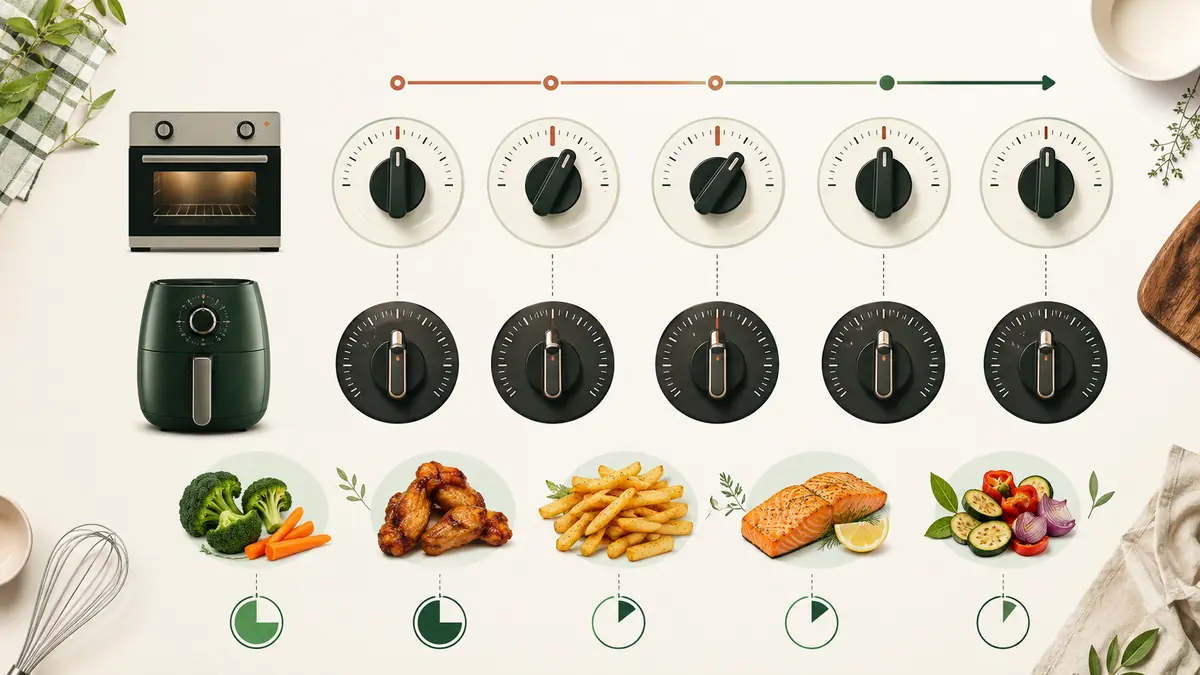
See the air fryer starting rule visually
Air fryer starting point
Convert oven temperature and time as a starting estimate
A conventional oven recipe can start lower and earlier in an air fryer, then be checked for the real finish point.
Conventional oven400°F30 minutes
Air fryer375°Fabout 24 minutes
Generic rule used400°F − 25°F30 min × 0.80 = 24 min
Oven to air fryer conversion chart
| Conventional oven | General air fryer start | 30 minute oven recipe |
|---|---|---|
| 300°F / 150°C | 275°F / 135°C | about 24 min |
| 325°F / 165°C | 300°F / 150°C | about 24 min |
| 350°F / 175 to 180°C | 325°F / 165°C | about 24 min |
| 375°F / 190°C | 350°F / 175°C | about 24 min |
| 400°F / 200°C | 375°F / 190°C | about 24 min |
| 425°F / 220°C | 400°F / 205°C | about 24 min |
| 450°F / 230°C | 425°F / 220°C | about 24 min |
These values are starting estimates for conventional oven recipes. Food specific guidance and appliance instructions can give a better result.
How to use an air fryer conversion chart
An air fryer conversion chart gives you a starting temperature and time, not a guaranteed finish. Start with the oven temperature in the recipe, lower it for a conventional oven conversion, then reduce the cooking time. The chart above uses about 25°F less heat and about 20% less time as a general rule. That rule is useful because an air fryer has a small cooking chamber and strong moving air.
The best air fryer conversion also uses the food itself as evidence. Chicken breast, chicken wings, salmon, steak, bacon, frozen fries, vegetables, and baked foods do not react in the same way. Thickness, moisture, fat, surface area, breading, and starting temperature all change how fast food heats and browns. Use the chart first, then use the food profile or recipe cues to decide when to stop cooking.
Early checking protects both texture and safety. A converted 24 minute time does not mean you should ignore the food until minute 24. Look at browning, turn or shake the food when needed, and measure internal temperature for meat and poultry. The check point is part of the conversion, not an optional extra.
400°F oven to air fryer conversion
400°F in a conventional oven usually starts near 375°F in an air fryer. This is one of the most common oven to air fryer temperature conversions. If the oven recipe calls for 30 minutes, the general time conversion gives about 24 minutes. Start checking before that point, especially when the food is thin or the basket is only lightly filled.
A 400°F oven recipe can still need a different air fryer setting when the food profile says so. Chicken wings may benefit from a hotter finish for crisp skin, while a thick chicken breast may need more controlled heat so the center cooks before the outside dries. A temperature chart cannot see those details, which is why the food selector in the calculator is useful.
Basket load changes the meaning of a 400°F conversion. Hot air needs room to move around the food. A single layer can cook faster than a crowded basket. When you fill the basket tightly, steam can build between pieces and reduce browning. You may need more time, extra shaking, or two smaller batches.
350°F oven to air fryer conversion
350°F in a conventional oven usually starts near 325°F in an air fryer. This lower heat range can work well for foods that need gentler cooking, but airflow can still brown edges quickly. Check pastries, reheated foods, breaded items, and small portions earlier than you would in a full oven.
A 350°F oven recipe does not always belong in an air fryer. Some cakes, custards, deep bakes, and delicate batters depend on a stable pan environment and a larger oven cavity. The food may physically fit in the basket but still cook unevenly. Use a dedicated air fryer recipe when the structure of the dish matters more than simple heat and time.
When you do convert 350°F, keep the pan size and food depth in mind. A shallow layer heats differently from a deep layer. If you move a recipe into a smaller, deeper container that fits the air fryer, the center may need longer even though the appliance itself cooks efficiently.
Air fryer time conversion for 20, 30, and 40 minute oven recipes
Twenty oven minutes becomes about 16 air fryer minutes with the general 20% time reduction. Start checking before 16 minutes when the food is small, thin, or already partly cooked.
Thirty oven minutes becomes about 24 air fryer minutes. This is a useful reference for many everyday recipes, but it is still only an estimate. A chicken breast may need a thermometer check, while fries need a texture and color check.
Forty oven minutes becomes about 32 air fryer minutes. Longer recipes deserve more caution because food depth and moisture become more important as cooking continues. A deep or dense food can stay cool in the center even when the surface looks done.
Very short oven times need careful checking. A 10 minute oven time becomes about 8 minutes, but a two minute difference is large for toast, thin bacon, small pastries, reheated pizza, or crisp toppings. Check these foods early instead of trusting a percentage by itself.
Conventional oven to air fryer versus fan oven to air fryer
Conventional oven recipes usually need the larger temperature change
A conventional oven recipe is the main use case for the 25°F temperature reduction. Conventional ovens rely more on heat from the oven cavity and heating elements, while an air fryer pushes hot air directly around exposed food. The compact chamber can speed surface browning and moisture loss.
Use the source oven type correctly before you convert. If the recipe says conventional, select conventional. If it says fan or convection, select fan. This simple choice prevents a double reduction that can leave the air fryer temperature too low.
Fan oven recipes already use moving air
A fan oven to air fryer conversion usually needs a smaller temperature adjustment. The source recipe has already been written for circulating air. KitchenMathHub treats this as a different starting condition rather than subtracting the full conventional oven reduction again.
Fan oven time can still change in an air fryer. A full size fan oven and a compact basket air fryer do not have the same chamber size, loading pattern, or heat exposure. Keep the early check even when the temperature stays close to the fan setting.
Frozen food air fryer conversion
Frozen food often needs food specific guidance more than a generic oven conversion. Frozen fries, breaded chicken, pizza, vegetables, and prepared snacks may already be designed for direct cooking from frozen. Check the package first. If it gives an air fryer time and temperature for the exact product, use that guidance before a general chart.
Frozen food starts with a colder center, so time can change even when the surface browns fast. Thin frozen fries may crisp quickly, while a thick frozen chicken portion can need much longer for the center to reach a safe temperature. Do not use outside color as the only doneness check for raw frozen meat.
Shaking frozen food can improve airflow and even browning. Fries and small breaded pieces can stick together or block hot air when first placed in the basket. Shake once the surfaces begin to heat, then continue checking as the food separates and browns.
Air fryer temperature conversion is only one part of the result
Temperature tells you how hot the air is, but food geometry tells you how long heat needs to reach the center. A thin salmon fillet and a thick steak can both cook at a similar temperature while needing very different times. The same principle applies to vegetables, chicken pieces, and frozen foods.
Fat and moisture affect browning. Bacon releases fat quickly. Chicken wings have skin and fat that can crisp. Lean chicken breast can dry if it stays in strong hot air after the center is done. A useful air fryer temperature chart should therefore be paired with food specific timing and checking.
Appliance design also matters. Basket depth, fan strength, wattage, heating element placement, and preheat behavior differ by model. Use your appliance manual when it gives a clear instruction for preheating, maximum load, accessories, or safe pan use.
When to flip, shake, or turn food
Shake small pieces when they need fresh exposure to moving air. Fries, small potatoes, vegetables, and bite size foods often brown more evenly after a shake. The action moves pieces that were touching the basket or sitting under other food.
Turn larger pieces when one side faces the basket for most of the cook. Chicken breast, steak, burgers, fish, and breaded cutlets may brown more evenly when flipped. Some air fryer designs circulate air well enough that turning matters less, so use the food profile and appliance guidance together.
Use the flip or shake point as a doneness check. Look at color, feel the surface, and use a thermometer when the food needs an internal temperature check. One quick inspection can tell you whether the estimated finish time still makes sense.
Air fryer safety, doneness, and internal temperature
Cooking time does not prove that meat or poultry is safe. Use a food thermometer for raw meat and poultry when a safe internal temperature applies. The calculator keeps safety guidance separate from the estimated cook time because two air fryers can reach the same food temperature at different times.
Check the thickest useful part of the food. A thin edge can be fully cooked while the center is still below the target temperature. For bone in pieces, avoid placing the thermometer against bone when that would give a misleading reading.
Stop cooking based on real doneness, not the chart alone. The chart helps you decide where to start. The actual food decides when you finish. This approach gives you a better chance of keeping food safe without drying it out.
When an oven recipe is a poor fit for the air fryer
Deep casseroles do not follow a simple oven to air fryer time conversion well. A deep layer traps heat and moisture differently from food spread across a basket. A smaller air fryer pan can also make the food deeper than it was in the original baking dish.
Wet batter needs a suitable container and enough stability. Loose batter can drip or move under strong airflow. Cakes and delicate bakes may also rise differently in a compact appliance. Use a tested air fryer baking method when structure matters.
Large roasts may be too bulky for useful airflow. A food can fit physically but still block circulation around its sides. Large poultry and long roasting recipes need more than a simple percentage reduction.
Use this chart with the rest of your recipe
The air fryer conversion chart works best when you keep the original recipe context. Keep the food amount, thickness, pan, and preparation method in mind. If you change several parts of the recipe at once, such as servings, measurements, and appliance, use the Recipe Converter so each change stays separate.
Use the Oven Temperature Converter when your first problem is Fahrenheit, Celsius, fan oven, or Gas Mark. Convert the oven setting first, then decide whether you also want to move the recipe into an air fryer.
If you want a second visual reference for common air fryer foods, Check out this chart. Use it as an extra planning aid, then rely on your appliance instructions, the food itself, and a thermometer when safety matters.
Common questions about air fryer conversion
What is the basic oven to air fryer conversion?
Start with about 25°F less heat and about 20% less time for a conventional oven recipe. Use that as a first estimate, then adjust for food type, thickness, basket load, and your appliance.
What is 400°F oven in an air fryer?
400°F in a conventional oven commonly starts near 375°F in an air fryer. Begin checking before the converted finish time because small foods and lightly loaded baskets can cook faster.
What is 350°F oven in an air fryer?
350°F in a conventional oven commonly starts near 325°F in an air fryer. Delicate foods may need an earlier check because moving air can brown exposed surfaces quickly.
What is 30 minutes in the oven in air fryer time?
Thirty oven minutes becomes about 24 air fryer minutes with a general 20% reduction. Treat 24 minutes as an estimate and start checking several minutes earlier.
Do I use the same rule for a fan oven?
No, a fan oven recipe usually needs a smaller temperature change. Fan ovens already circulate hot air, so applying the full conventional oven reduction again can lower the temperature too much.
Can I use the chart for frozen food?
Use the chart as a starting point, but frozen food often needs product or food specific guidance. Package directions should take priority when they give air fryer instructions for the exact food.
When should I check food in the air fryer?
Check before the estimated finish time. An early check helps you catch fast browning, crispness, tenderness, or a safe internal temperature before the food dries out.
Should I always preheat the air fryer?
No, preheating depends on the appliance and recipe. Follow the manual for your air fryer when it gives a specific preheat instruction.
Can I convert every oven recipe to an air fryer?
No, some recipes do not convert cleanly. Deep casseroles, large roasts, very wet batter, delicate souffles, and foods that depend on a covered vessel may need a different method.
Is air fryer cooking time exact?
No, air fryer time is always a practical range rather than one exact number. Basket size, wattage, food thickness, starting temperature, and crowding can change the real finish time.
Calculation transparency
Read methodologyHow to interpret this result
Result typeCooking estimate
Calculation basisFood profile, appliance conversion rules, and early check points
Sources shown5
Latest source reviewAug 12, 2026
Cooking time is a starting range. Food thickness, load, appliance airflow, and starting temperature can change the finish time.
Sources and methodology
These are the references used for data, conventions, safety targets, or calculation context on this page. Review dates show when KitchenMathHub last checked the cited source.
Instant PotInstant Vortex Plus Air FryerUsed for product or appliance-specific guidance where the manufacturer is the relevant authority.
Open source ↗Ninja Test KitchenAir Fryer Recipes and Cooking GuidanceUsed for product or appliance-specific guidance where the manufacturer is the relevant authority.
Open source ↗Mid and East Antrim Borough CouncilAir Fryer CookbookUsed for defined measurement guidance or public food-safety guidance where applicable.
Open source ↗FoodSafety.govCook to a Safe Minimum Internal TemperatureUsed for defined measurement guidance or public food-safety guidance where applicable.
Open source ↗