Instant PotCooking Time TablesUsed for product or appliance-specific guidance where the manufacturer is the relevant authority.
Open source ↗Chicken Wings Air Fryer Time & Temperature
Cook chicken wings in the air fryer with a personalized range based on fresh or frozen state, whole or split wings, and basket load. Keep the 165°F or 74°C safety target separate from crispness and give the wings enough airflow to brown.
Personalize this food estimate
Chicken Wings personalized starting point
390°F
200°C · 20 to 30 min
Use this as a starting pointAir fryer model, food thickness, basket load, and starting temperature can change the real cooking time. Check food early.
Verify safe internal temperatureUse a food thermometer. The safety target for this food is 165°F / 74°C.
Show calculation
Food-specific baseline
The Chicken Wings profile supplies the starting temperature, time range, and early check point.
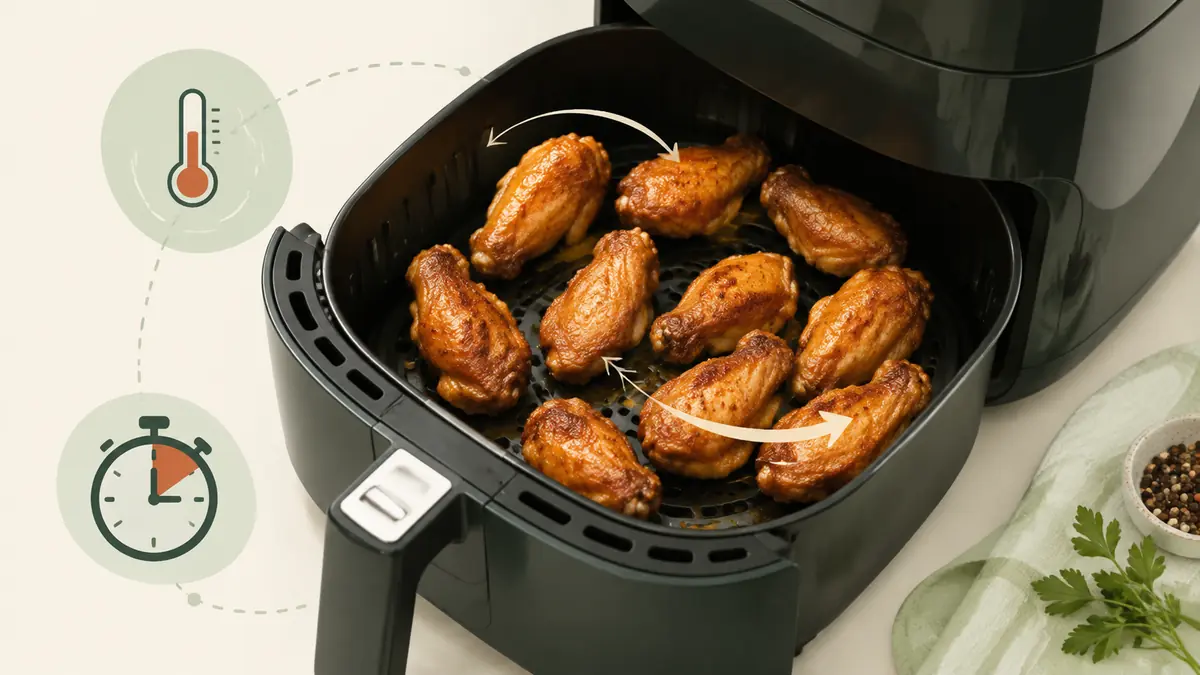
Chicken Wings starting guide
| Setting | Guidance |
|---|---|
| Temperature | 390°F / 199°C |
| Time range | 20 to 30 minutes |
| Start checking | 16 minutes |
| Turn / shake | Shake or turn halfway through so both sides crisp evenly. |
| Safety target | 165°F / 74°C |
Personalize the chicken wings air fryer estimate
The chicken wings calculator now reacts to the wing format, starting state, and basket load. The result remains a starting range because air fryer power, basket design, food geometry, and starting temperature can still change the real finish time.
- Choose fresh or frozen before you start the timer.
- Choose split flats and drumettes or whole wings because whole wings are larger pieces.
- Set the basket load to light, single layer, or crowded. Crowding can extend cooking time, but a smaller batch usually improves crispness more than simply adding minutes.
Use the early check as part of the calculation, not as an optional extra. A smart estimate is most useful when you check before the expected finish and then use temperature, browning, or texture to decide whether the food needs more time.
Chicken wings air fryer time and temperature guide
Chicken wings cook best in an air fryer when hot air can reach as much skin as possible. Start around 390°F, about 199°C, with a 20 to 30 minute range. Begin checking near 16 minutes, then turn or shake the wings so both sides can brown.
The safety target for chicken wings is 165°F or 74°C internally. Crisp skin is a texture goal, not a food safety measurement. Check a thick meaty area and avoid touching bone with the thermometer tip.
Basket space affects crispness as much as temperature. Wings packed tightly together trap moisture at contact points. A loose layer lets moving air reach more skin and usually gives better browning.
How long to cook chicken wings in an air fryer
Chicken wings commonly need about 20 to 30 minutes in this air fryer profile. Smaller split wings can finish near the lower end. Larger whole wings, frozen wings, or a fuller basket can move toward the upper end.
Start checking around 16 minutes instead of waiting for minute 30. At the check point, shake or turn the wings, look at the skin, and decide how much longer they need. The early check gives you control over crispness and prevents unnecessary overcooking.
Whole wings can take longer than separated flats and drumettes. A whole wing has more mass and a different shape. If your batch mixes sizes, smaller pieces may finish first.
Do not double the time when you double the number of wings. More food can slow airflow and change heat recovery, but cooking time does not scale directly with batch weight. Cook in batches when the basket becomes crowded.
Air fryer chicken wings at 390°F
390°F is the main starting temperature used by this chicken wing profile. The strong heat supports skin browning while giving you a 20 to 30 minute window to cook the meat through.
Turn or shake the wings during the cook at 390°F. The surfaces touching the basket or other wings can stay softer. Moving the pieces gives those areas fresh exposure to hot air.
Start checking before the wings look deeply brown. Some seasonings and sauces darken faster than plain skin. If the outside is coloring quickly, check the center and adjust the temperature rather than assuming more browning is always better.
Air fryer chicken wings at 400°F
400°F can produce crisp chicken wings in many air fryers. The extra heat can speed browning, so use an early check and watch wings coated with sugar, honey, barbecue sauce, or sweet seasoning.
High heat works best when the basket is not crowded. Air needs access to the skin. If wings overlap heavily, some areas can steam while exposed areas darken quickly.
Do not use 400°F as a reason to ignore internal temperature. Wings can look crisp before the meat next to the bone reaches 165°F or 74°C. Check a thick meaty section before serving.
Fresh chicken wings versus frozen chicken wings in the air fryer
Fresh chicken wings
Fresh chicken wings usually brown more predictably because they start without frozen surface ice. Pat them dry before seasoning when the recipe allows. Less surface water gives hot air a better chance to crisp the skin.
Fresh wings still vary by size. Large drumettes and whole wings can need more time than small flats. Check different pieces instead of assuming one wing represents the whole basket.
Frozen chicken wings
Frozen wings usually need more time and may release water early in cooking. Separate pieces once they loosen, then shake or turn them so hot air can reach the newly exposed surfaces.
Use package directions when frozen wings come with tested air fryer instructions. Breaded, pre cooked, sauced, and raw frozen products can have very different needs even when all are sold as chicken wings.
How to make crispy chicken wings in an air fryer
Dry skin, open basket space, and enough hot air are the main factors behind crisp wings. Pat fresh wings dry when possible. Avoid stacking a deep pile. Shake or turn them during cooking so more skin gets direct airflow.
Surface moisture can slow crisping. Water must evaporate before skin can brown well. This is why wet wings or thawing frozen wings may look pale early in the cook.
Sauce timing can change crispness. Thick or sugary sauce can make skin sticky and can darken quickly. Many cooks get better texture by crisping the wings first, then adding sauce near the end or after cooking when the recipe supports it.
Extra cooking time is not always the best fix for soft wings. If the basket is crowded, more time can dry the meat before the trapped contact areas become crisp. A smaller batch can solve the airflow problem more effectively.
Chicken wings internal temperature and food safety
Chicken wings should reach 165°F or 74°C internally. Insert the thermometer into a thick meaty part and avoid touching bone. Bone can affect the reading and may not represent the meat temperature you need to check.
Crisp skin does not prove the wing is safely cooked inside. Air fryers can brown skin fast. Use the thermometer when the wings are raw, especially with large whole wings or a crowded basket.
Check more than one wing in a mixed batch. A small flat may finish before a large drumette. If pieces vary, test the larger ones before deciding the whole batch is ready.
Should you shake or flip chicken wings in the air fryer
Shake or turn chicken wings around halfway through cooking. This is the guidance built into the wing profile because it helps expose different surfaces to moving hot air.
A shake works well for a basket of smaller split wings. It redistributes pieces quickly and can move wings away from damp contact spots.
Turning by hand works well when you want more control over large whole wings. You can place the paler side toward the strongest heat and inspect each piece at the same time.
Use the halfway action as a check point, not only a movement step. Look at browning, note how much fat has rendered, and decide whether the current temperature still suits the batch.
Oven to air fryer chicken wings conversion
You can convert oven baked chicken wings by entering the original oven temperature and time with chicken wings selected. The calculator combines the original recipe with the wing profile instead of relying on one generic percentage.
A conventional 400°F oven recipe commonly starts near 375°F in a general air fryer conversion, but wings may use a hotter food specific profile. This is why selecting the food matters. The wing profile uses 390°F as its starting point because crisp skin is part of the expected result.
Use the converted time as a check range. Oven recipes often spread wings across a large sheet pan, while an air fryer puts them in a smaller basket. Basket load can change the real time.
Use the Oven to Air Fryer Calculator when you want to enter the exact time and temperature from an oven wing recipe.
Air fryer wings with sauce, dry rub, or plain seasoning
Dry rub wings
Dry seasoning usually works well for crisp air fryer wings because it adds flavor without much surface liquid. Pat the wings dry first, season evenly, and watch spice blends that contain sugar because they can darken faster.
Sauced wings
Wet sauce can reduce crispness when it goes on too early. A thick sauce can block direct airflow and create a sticky surface. Crisp the wings first when your recipe allows, then toss with sauce after cooking or add it near the end.
Plain wings
Plain wings let you focus on skin texture and doneness. A small amount of oil may not be necessary because wings already contain fat in the skin. Use your recipe and appliance instructions for added oil.
Cooking a large batch of chicken wings
A large batch often cooks better in two rounds than in one crowded basket. When wings overlap heavily, the lower surfaces get less direct airflow and stay softer.
More wings do not require a simple double or triple cooking time. The main issue is basket geometry, not only total weight. A second batch can take close to the normal time because each batch gets better airflow.
Keep finished wings hot according to your serving plan instead of overcooking the first batch. Do not leave them in the air fryer for extra time just to wait for the second batch if that makes the meat dry.
Why air fryer chicken wings can come out soft
Overcrowding is one of the most common reasons air fryer wings stay soft. The skin touching another wing cannot receive the same moving air as an exposed surface.
Surface water can also reduce crispness. Fresh wings that are very wet or frozen wings releasing ice moisture need time for that water to evaporate before strong browning begins.
Too much sauce can make crisp wings soft again. If crispness matters, add sauce at the right stage and serve soon after tossing.
A low temperature can cook the meat before the skin becomes as crisp as you want. The wing profile starts at 390°F to balance cooking and browning. If your model runs cool, you may need a short hotter finish while watching the food closely.
Use chicken wing air fryer time as a range
The best chicken wings air fryer time is the time that gives you crisp skin and meat that has safely reached 165°F or 74°C. The 20 to 30 minute range gives you a useful window, while the 16 minute check point prevents you from waiting too long before looking at the batch.
Use food size and basket load to decide where you fall inside the range. Small separated wings in a loose layer can finish faster. Large whole wings and crowded baskets can take longer.
Keep notes from your own appliance when you cook wings often. Your usual basket load, preferred crispness, and wing size can make future batches easier to predict without treating the result as universal for every air fryer.
Common questions about air fryer chicken wings
How long do chicken wings take in an air fryer?
Chicken wings commonly start with a 20 to 30 minute range in this calculator. Begin checking around 16 minutes and continue until the skin is crisp and the meat reaches a safe temperature.
What temperature should I use for air fryer chicken wings?
Start chicken wings at about 390°F, which is about 199°C. This hotter starting profile supports browning and crisp skin while the wings cook through.
What internal temperature should chicken wings reach?
Chicken wings should reach 165°F or 74°C internally for safety. Check a thick meaty section and avoid placing the thermometer directly against bone.
Should I shake chicken wings in the air fryer?
Yes, shake or turn the wings around halfway through cooking. Moving them exposes more skin to hot air and helps both sides brown instead of leaving damp contact spots.
How do I make air fryer chicken wings crispy?
Give the wings space and keep excess surface moisture low. A crowded basket traps steam between wings, while a loose layer allows hot air to reach more of the skin.
Can I cook frozen chicken wings in the air fryer?
Yes, but frozen wings usually need a different time from fresh wings. Separate them as they loosen, drain excess liquid if needed, and follow package guidance when it gives a tested air fryer method.
Can I air fry wings at 400°F?
400°F can work well for crisp wings in many air fryers. Because the heat is strong, start checking early and adjust if the skin darkens before the meat is fully cooked.
Why are my air fryer wings not crispy?
Overcrowding and surface moisture are common reasons wings stay soft. Give the wings more space, turn them during cooking, and continue only as long as needed for safe doneness and the texture you want.
Can I convert oven baked wings to an air fryer?
Yes, use the oven temperature and time in the calculator with chicken wings selected. The wing profile can replace a generic percentage rule with a food specific starting temperature, time range, and shake guidance.
Do whole wings and split wings cook the same?
No, whole wings can need more time than smaller separated flats and drumettes. Piece size and basket load change airflow and the distance heat must travel to the center.
Calculation transparency
Read methodologyHow to interpret this result
Result typeCooking estimate
Calculation basisFood profile, appliance conversion rules, and early check points
Sources shown2
Latest source reviewAug 11, 2026
Cooking time is a starting range. Food thickness, load, appliance airflow, and starting temperature can change the finish time.
Sources and methodology
These are the references used for data, conventions, safety targets, or calculation context on this page. Review dates show when KitchenMathHub last checked the cited source.
FoodSafety.govCook to a Safe Minimum Internal TemperatureUsed for defined measurement guidance or public food-safety guidance where applicable.
Open source ↗