National Institute of Standards and TechnologyMetric Kitchen: Cooking Measurement EquivalenciesUsed for defined measurement guidance or public food-safety guidance where applicable.
Open source ↗Oven Temperature Converter
Convert oven temperatures between Fahrenheit and Celsius, then see the common fan oven setting and nearest Gas Mark. The calculator keeps exact math separate from the rounded temperatures cooks usually see in recipes.
Practical conventional setting
180°C
Fahrenheit: 350°F
Fan: 160°C
Closest Gas Mark: 4
Exact math: 176.7°C = 350.0°F
Fan setting is a cooking conventionThe fan result uses a common 20°C recipe adjustment. Follow your appliance manual if it gives a different conversion.
Show calculation
Exact temperature
176.7°C = 350°FPractical cooking setting
180°C conventional ≈ 350°F ≈ 160°C fan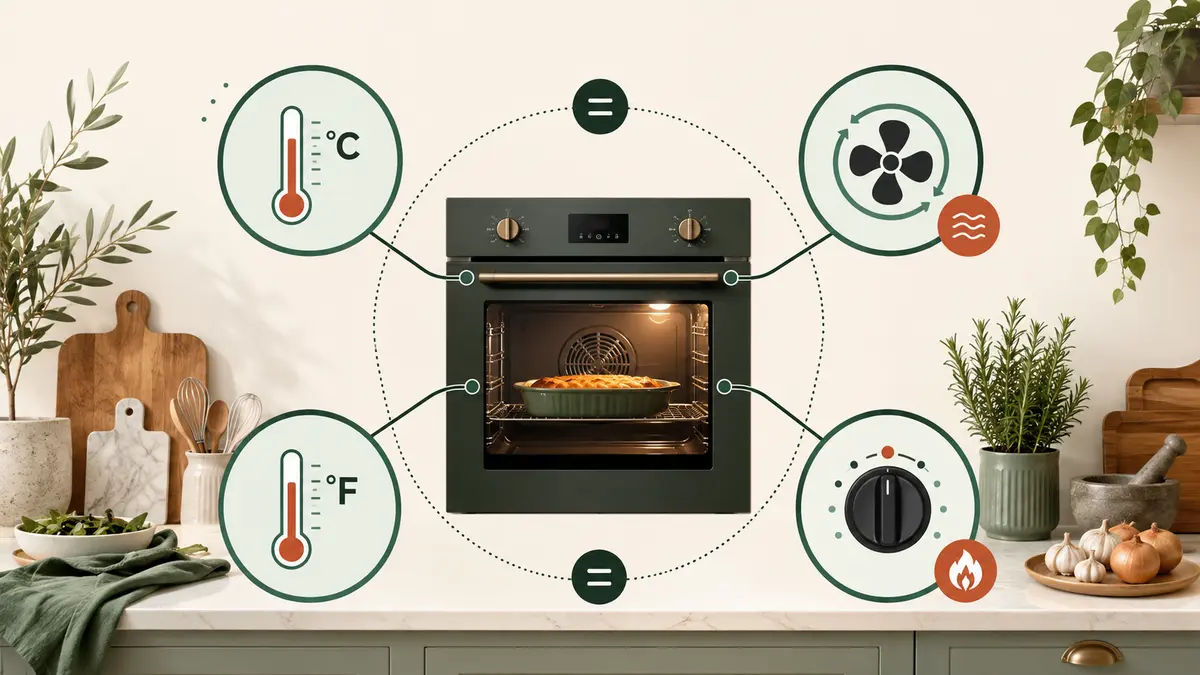
See oven temperature conversion visually
Oven temperature example
Exact temperature and practical oven settings are not the same thing
KitchenMathHub keeps the exact conversion visible, then shows practical recipe settings.
Recipe says350°FConventional oven
Exact conversion176.7°CFormula result
180°CConventional
160°CFan
Oven temperature conversion chart
| Conventional °C | Fan °C | °F | Gas Mark |
|---|---|---|---|
| 110 | 90 | 225 | ¼ |
| 120 | 100 | 250 | ½ |
| 140 | 120 | 275 | 1 |
| 150 | 130 | 300 | 2 |
| 160 | 140 | 325 | 3 |
| 180 | 160 | 350 | 4 |
| 190 | 170 | 375 | 5 |
| 200 | 180 | 400 | 6 |
| 220 | 200 | 425 | 7 |
| 230 | 210 | 450 | 8 |
| 240 | 220 | 475 | 9 |
How to use the oven temperature converter
An oven temperature converter helps you move between Fahrenheit, Celsius, fan oven settings, and Gas Mark without guessing. Enter the temperature exactly as it appears in the recipe. The calculator shows the mathematical Fahrenheit or Celsius conversion and a practical oven setting that matches common cooking charts.
Exact temperature and practical recipe temperature are not always the same number. For example, 350°F converts to about 176.7°C, but most recipes use 180°C. The recipe value is rounded to a setting that cooks can select easily on a real oven. KitchenMathHub keeps both values visible so the rounding does not look like a mistake.
Fan oven conversion is a separate step from Fahrenheit to Celsius conversion. A recipe can first move from 400°F to the common 200°C conventional setting, then to about 180°C fan. Keeping those steps separate makes the result easier to understand and reduces accidental double adjustments.
350°F to Celsius oven conversion
350°F is about 176.7°C exactly and 180°C as a practical oven setting. This is one of the most common baking temperature conversions. Cakes, cookies, bread, casseroles, and roasting recipes often use 350°F in US instructions and 180°C in metric instructions.
350°F also commonly lines up with Gas Mark 4. When the recipe needs a fan oven setting, a common conversion is about 160°C fan. This gives you a useful four way reference: 350°F, 180°C conventional, 160°C fan, and Gas Mark 4.
You usually do not need to chase the exact 176.7°C value on the oven dial. Home ovens cycle above and below the selected temperature, and many controls move in 5°C, 10°C, or 25°F steps. Use the practical setting unless the recipe or appliance gives a more specific instruction.
180°C to Fahrenheit oven conversion
180°C equals 356°F exactly, but 350°F is the common cooking equivalent. This can look confusing when one converter shows 356°F and a recipe chart shows 350°F. Both can be correct because they answer different questions.
Use 356°F when you want the exact mathematical conversion. Use 350°F when you are translating a recipe into a normal oven setting. Most ovens do not offer a 356°F button, and a six degree Fahrenheit difference is smaller than normal variation in many home ovens.
180°C conventional commonly becomes 160°C fan. If you are converting a European or UK recipe for a fan assisted oven, use the fan setting only when the original recipe is conventional. If the recipe already says 160°C fan, do not reduce it again.
200°C to Fahrenheit and 400°F to Celsius
200°C equals 392°F exactly, while 400°F is the common practical recipe setting. This temperature is widely used for roasting, baking, browning, and foods that need a stronger oven than the 180°C or 350°F range.
400°F equals about 204.4°C exactly, while 200°C is the normal rounded cooking equivalent. This means the common 200°C and 400°F pairing is not an exact mathematical equality. It is a practical recipe pairing.
200°C conventional commonly becomes about 180°C fan. If you later want to move the same recipe to an air fryer, use the Oven to Air Fryer Calculator rather than subtracting another fixed amount by hand.
Fahrenheit to Celsius oven conversion formula
To convert Fahrenheit to Celsius exactly, subtract 32 and divide by 1.8. For 350°F, the calculation is 350 minus 32, then divided by 1.8. The result is about 176.7°C.
The formula gives exact math, but recipes usually need practical rounding. A cook reading 176.7°C normally selects 180°C. That is why KitchenMathHub shows both the exact conversion and the common oven setting.
Use the formula for unusual temperatures as well as common ones. If a recipe says 365°F, the converter can preserve the exact Celsius value even though 365°F is not one of the usual chart anchors. You can then choose the nearest practical setting that suits your oven.
Celsius to Fahrenheit oven conversion formula
To convert Celsius to Fahrenheit exactly, multiply by 1.8 and add 32. For 180°C, the calculation gives 356°F. For 200°C, it gives 392°F.
Recipe charts often round those exact values to 350°F and 400°F. The goal is not to change the science. The goal is to match the temperature steps that recipes and ovens normally use.
Keep the exact result when precision matters to your comparison. Keep the practical result when you need to set the oven. The calculator gives you both so you do not have to choose between useful cooking guidance and correct math.
Conventional oven to fan oven temperature conversion
A common conventional to fan oven conversion is 20°C lower. This means 180°C conventional becomes about 160°C fan, 200°C becomes about 180°C fan, and 220°C becomes about 200°C fan.
The 20°C rule is a cooking convention, not an exact law for every fan oven. Fan strength, oven size, heating element design, and manufacturer calibration can change the best adjustment. Follow the appliance manual when it gives a clear conversion for your model.
Do not reduce a recipe twice when it already gives a fan setting. A recipe that says 180°C fan has already made the fan adjustment. Enter it as a fan temperature instead of treating it as 180°C conventional.
Gas Mark conversion for common oven temperatures
Gas Mark works best as a standard cooking lookup. Gas Mark 4 commonly matches 180°C conventional and 350°F. Gas Mark 6 commonly matches 200°C conventional and 400°F. Gas Mark 7 commonly matches 220°C conventional and 425°F.
Do not expect a meaningful Gas Mark for every exact decimal temperature. Gas Mark uses named steps. If the mathematical conversion lands between two marks, use the nearest practical setting that matches the recipe context rather than inventing a value such as Gas Mark 4.37.
Use the chart above when you are translating older UK recipes. Gas Mark still appears in cookbooks and family recipes, while many newer ovens use Celsius or fan Celsius. The converter lets you move between those systems without losing the original cooking intent.
Baking temperature conversion needs more than one number
Baking temperature controls both heat transfer and surface browning. A cake at 180°C and a cake at 200°C will not simply finish at different times. The higher setting can change how quickly the outside sets, how the crust colors, and how the center rises.
Convert the temperature first, then keep the recipe method the same unless you have a reason to change it. Do not automatically change pan size, baking time, or ingredient amounts just because you moved from Fahrenheit to Celsius.
When you also change the pan, use the Cake Pan Conversion Calculator. Pan area and batter depth can affect bake time in ways that a temperature converter cannot predict.
Why home ovens can differ from the selected temperature
The number on the oven control is a target, not proof of the exact air temperature at every second. Home ovens cycle as heating elements turn on and off. Rack position, preheating, door opening, cookware, and calibration can also affect the heat around the food.
An oven thermometer can help when baking results are consistently too pale, dark, slow, or fast. If several recipes behave differently from their stated time even after correct temperature conversion, oven calibration may be part of the problem.
Use recipe doneness cues with the converted temperature. A cake may need a clean skewer or set center. Bread may need color, structure, or an internal temperature target. Meat needs the applicable food safety check. Temperature conversion sets the oven, while doneness tells you when to finish.
Choose the right converter for the next step
Use the Fan Oven Converter when your main task is conventional to fan temperature. It focuses on the practical fan setting and explains why a common 20°C reduction is only a starting convention.
Use the Oven to Air Fryer Calculator when you are changing appliances. Air fryer conversion changes more than the display unit. It can affect heat, time, check point, and food specific guidance.
Use the Cooking Measurement Chart when the recipe also contains cups, tablespoons, milliliters, ounces, or grams. Keeping unit conversion separate from oven conversion makes the recipe easier to audit.
Common questions about oven temperature conversion
What is 350°F in Celsius for an oven?
350°F is about 176.7°C exactly, and 180°C is the common practical oven setting. Recipes usually round to settings that real oven controls use.
What is 180°C in Fahrenheit?
180°C equals 356°F exactly, while 350°F is the common recipe equivalent. The small difference comes from practical cooking conventions rather than exact temperature math.
What is 200°C in Fahrenheit?
200°C equals 392°F exactly, and recipes commonly pair it with 400°F. Use the practical setting when you are following a cooking recipe.
What is 400°F in Celsius?
400°F equals about 204.4°C exactly, while 200°C is the common recipe setting. The calculator shows both so you can see the math and the cooking convention.
What is 200°C conventional in a fan oven?
200°C conventional commonly converts to about 180°C fan. This 20°C reduction is a common recipe convention, not a promise for every appliance.
What is 180°C conventional in a fan oven?
180°C conventional commonly converts to about 160°C fan. Check your oven manual when the manufacturer gives a different adjustment.
What is Gas Mark 4?
Gas Mark 4 commonly matches about 180°C conventional, 160°C fan, and 350°F. Gas Mark is best treated as a cooking lookup rather than an exact decimal temperature formula.
Why does an oven chart round temperatures?
Oven charts round because real recipes use practical control settings. Exact Fahrenheit and Celsius conversions often produce values such as 176.7°C that do not match a normal oven dial.
Is fan oven temperature always 20°C lower?
No, 20°C lower is a common recipe rule rather than a universal appliance rule. Some ovens and manufacturers may use a different adjustment.
Can I convert an unusual oven temperature?
Yes, you can convert any valid Fahrenheit or Celsius value. The calculator keeps the exact mathematical result and then gives a practical cooking setting when useful.
Calculation transparency
Read methodologyHow to interpret this result
Result typeExact math + cooking convention
Calculation basisDefined temperature formulas plus practical recipe settings
Sources shown2
Latest source reviewAug 12, 2026
Exact temperature equivalence and practical oven settings are shown separately when cooking convention requires rounding.
Sources and methodology
These are the references used for data, conventions, safety targets, or calculation context on this page. Review dates show when KitchenMathHub last checked the cited source.
North Lanarkshire CouncilChicken nuggets recipe oven temperature equivalenciesUsed for defined measurement guidance or public food-safety guidance where applicable.
Open source ↗