Instant PotInstant Vortex Plus Air FryerUsed for product or appliance-specific guidance where the manufacturer is the relevant authority.
Open source ↗Oven to Air Fryer Conversion Calculator
Convert oven temperature and cooking time to an air fryer starting point. Choose the source oven type and food when possible, then use the suggested check time, turning guidance, and food safety target to finish the food based on real doneness.
Air fryer starting point
375°F
190°C · about 24 min
Use this as a starting pointAir fryer model, food thickness, basket load, and starting temperature can change the real cooking time. Check food early.
Show calculation
Temperature starting point
400°F - 25°FTime starting point
30 min × 0.80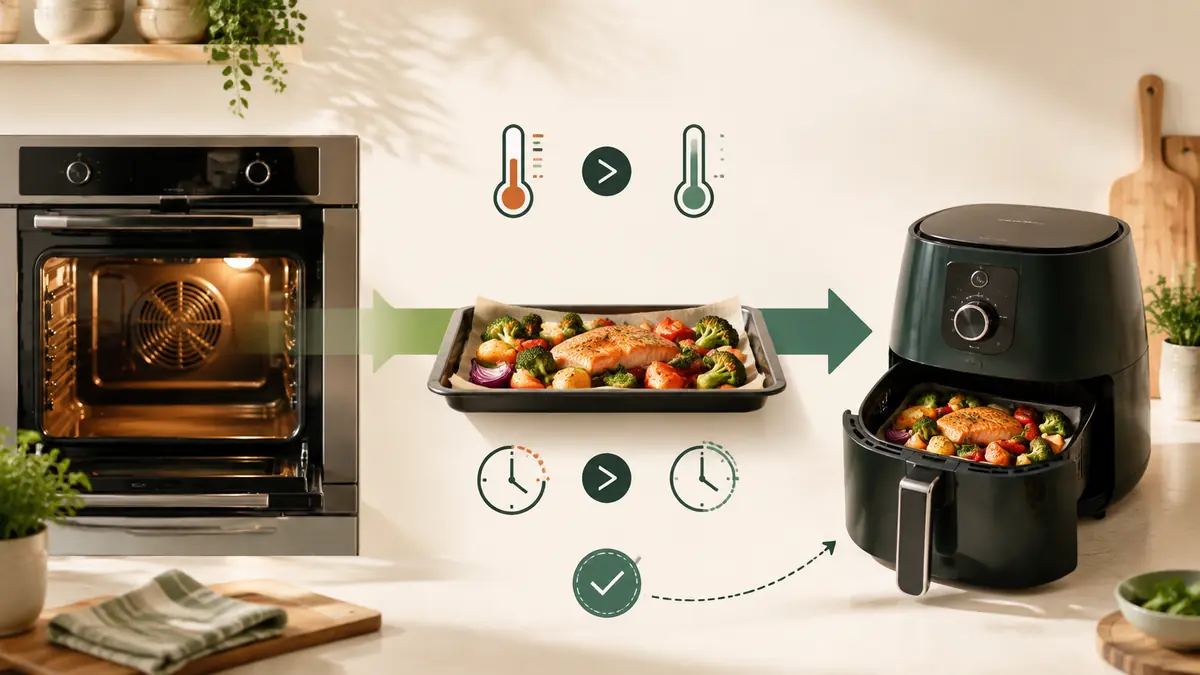
See an oven to air fryer conversion visually
Air fryer starting point
Convert oven temperature and time as a starting estimate
A conventional oven recipe can start lower and earlier in an air fryer, then be checked for the real finish point.
Conventional oven400°F30 minutes
Air fryer375°Fabout 24 minutes
Generic rule used400°F − 25°F30 min × 0.80 = 24 min
How to convert an oven recipe to an air fryer
A practical oven to air fryer conversion starts with lower heat and less time. For a conventional oven recipe, KitchenMathHub uses about 25°F less and roughly 20% less cooking time as a general starting rule before a food specific profile is applied. This does not mean every recipe needs the same reduction. The rule gives you a sensible place to start when the original instructions were written for a larger conventional oven.
The check time matters as much as the estimated finish time. Air fryers move hot air quickly around a small cooking chamber. Food can brown, crisp, or dry faster than expected, especially when pieces are small or the basket is lightly loaded. Start checking before the estimated finish, then use color, texture, tenderness, and internal temperature where relevant.
Food type improves an air fryer conversion. Chicken wings, chicken breast, salmon, steak, bacon, fries, vegetables, and frozen foods have different thickness, fat content, moisture, surface area, and doneness targets. A food profile can give a more useful time range, a turn or shake note, and a safety temperature instead of relying only on one generic percentage.
Oven to air fryer temperature and time examples
| Conventional oven | General air fryer start | 30 minute oven time |
|---|---|---|
| 350°F | about 325°F | about 24 min |
| 375°F | about 350°F | about 24 min |
| 400°F | about 375°F | about 24 min |
| 425°F | about 400°F | about 24 min |
400°F oven to air fryer conversion
400°F in a conventional oven commonly starts near 375°F in an air fryer. If the oven recipe says 30 minutes, a general 20% time reduction gives about 24 minutes. That number is not a promise that the food is done at exactly 24 minutes. A useful plan is to start checking several minutes earlier, especially for thin foods or small portions.
Food thickness can matter more than the original oven time. A thick chicken breast and thin chicken tenders can both appear in recipes written for 400°F, but they should not receive the same final air fryer time. Thickness changes how quickly heat reaches the center. A selected food profile gives the calculator more context than temperature and time alone.
Basket crowding can increase cooking time. Air needs space to move around the food. A single layer of fries can crisp faster and more evenly than a tightly packed basket. If you increase the batch, you may need to shake more often, cook longer, or split the food into two batches rather than forcing everything into one load.
350°F oven to air fryer conversion
350°F in a conventional oven commonly starts near 325°F in an air fryer. This is useful for foods that were written for moderate oven heat, but the actual air fryer setting still depends on the recipe. A baked food, a reheated dish, and a piece of meat can all respond differently at the same nominal temperature.
Lower temperature does not mean the food will always cook gently. Air fryer airflow can dry exposed surfaces and brown edges quickly. Check delicate foods early. If a food is becoming too dark before the center is ready, lower the temperature, protect the surface when appropriate, or use a cooking method better suited to that recipe.
30 minutes in the oven to air fryer time conversion
Thirty oven minutes becomes about 24 air fryer minutes under a general 20% reduction. The simple math is 30 multiplied by 0.8. For 40 oven minutes, the same general rule gives about 32 minutes. For 20 oven minutes, it gives about 16 minutes. These values are starting estimates, not exact cooking times.
An air fryer check time should come before the estimated finish. If the starting estimate is 24 minutes, you may want to inspect the food several minutes earlier. Turn wings, shake fries, or check the internal temperature of meat when the selected food profile calls for it. Early checking is one of the easiest ways to avoid overcooking during oven to air fryer conversion.
Short oven recipes need extra care with percentage reductions. Removing 20% from a 10 minute recipe gives 8 minutes, but a two minute difference can be large for thin toast, small pastries, bacon, or reheated food. Start checking early and watch surface browning closely.
Conventional oven to air fryer conversion versus fan oven conversion
Conventional oven recipes usually need the larger adjustment
A conventional oven does not move hot air the same way as an air fryer. This is why the general conversion can lower the temperature and shorten the time. The compact chamber and strong airflow of an air fryer can transfer heat to exposed food surfaces efficiently.
The basic conventional oven rule is only the first layer. Food state, food geometry, basket style, and appliance model can move the best setting up or down. Use the calculator as a starting point, then adjust from what the food actually does.
Fan oven to air fryer conversion needs a smaller temperature change
A fan oven recipe has already been adjusted for moving air. Subtracting the full conventional oven temperature reduction again can overcorrect the recipe. KitchenMathHub treats fan oven input separately and keeps the air fryer temperature closer to the original fan setting.
Fan oven time can still change in an air fryer. The smaller chamber, basket design, and food exposure are different from a full fan oven. Keep an early check point even when the temperature adjustment is small.
Fresh and frozen food need different air fryer expectations
Frozen food often needs a food specific conversion instead of the generic rule alone. Frozen fries, breaded foods, pizza, vegetables, and prepared products can be designed for direct cooking from frozen. Package directions may already include air fryer instructions, and those instructions should take priority when they are written for the exact product.
Fresh meat needs thickness and safe temperature context. A fresh chicken breast can vary greatly in weight and thickness. Steak doneness also depends on thickness and preferred final temperature. Use estimated time as a check window, then verify the center with an appropriate thermometer.
Starting temperature changes cooking speed. Refrigerator cold food, room temperature food, and frozen food do not heat at the same rate. The calculator uses fresh or frozen state where the food profile supports it, but the actual starting temperature can still shift the finish time.
When to shake, flip, or turn food in the air fryer
Shaking is useful when many small pieces need even exposure to hot air. Fries, small potatoes, vegetables, and bite size foods can benefit from redistribution during cooking. A crowded lower layer may brown less until the basket is shaken.
Flipping is useful for larger pieces with two main sides. Chicken pieces, burgers, steak, fish, or breaded cutlets may brown more evenly when turned. The exact need depends on the basket design and airflow, so follow food profile guidance and your appliance instructions.
Opening the basket briefly is also a chance to check doneness. You can look at browning, measure internal temperature, or test texture while you turn or shake the food. This is more useful than waiting for one exact timer value and hoping every appliance behaves the same way.
Air fryer food safety and internal temperature
Estimated cooking time is not a food safety measurement. Raw poultry, meat, and seafood should be checked with a food thermometer where safe internal temperature guidance applies. Time can tell you when to begin checking. Internal temperature tells you whether the center has reached the required safety target.
Poultry should reach the safe internal temperature shown by the calculator. KitchenMathHub keeps food safety guidance separate from estimated cook time so a faster air fryer does not create a false sense of certainty. Check the thickest relevant part and avoid measuring against bone when that would distort the reading.
Resting and carryover heat can still matter for some foods. Follow the applicable food safety guidance and recipe method. The calculator provides the safety target where the food profile supports it, but your thermometer and the actual food decide whether the target has been reached.
Foods that do not convert cleanly from oven to air fryer
Deep casseroles and covered dishes may not suit a simple air fryer conversion. Their cooking depends on depth, retained moisture, and a different heat environment. A shallow air fryer basket is not a direct replacement for a deep covered casserole dish.
Very wet batter can behave poorly in strong airflow. Loose batter can drip, blow, or set unevenly if it is not contained in a suitable pan. Foods that rely on a large oven cavity, steam, delicate rise, or slow covered cooking may need a dedicated air fryer recipe instead of a converted oven time.
Large roasts can exceed the useful geometry of an air fryer. Even when the food physically fits, air circulation around a large item may be limited. Long oven recipes for large poultry, large joints of meat, or bulky dishes should not be reduced by one percentage without considering the appliance capacity and food thickness.
How to get a better result from the air fryer conversion calculator
Select the source oven type correctly. Conventional and fan oven recipes do not start from the same airflow conditions. Choosing the correct source prevents an unnecessary second temperature reduction.
Select the closest food profile when one is available. A food aware profile can use a more useful temperature range, time range, check point, flip or shake note, and safe internal temperature than the generic conversion alone.
Use your appliance manual when it gives specific instructions. Air fryer brands differ in power, basket size, heat placement, preheat behavior, and recommended maximum loads. Manufacturer guidance for your exact appliance should take priority over a general conversion rule.
Use the Recipe Converter when appliance change is only one part of the job. You can first adjust servings or measurements, then apply an oven or air fryer transformation without rebuilding the ingredient list from scratch.
Common questions about oven to air fryer conversion
What is the basic oven to air fryer rule?
Start with about 25°F less heat and about 20% less time for a conventional oven recipe. Treat that as a starting point, then use food type, thickness, basket load, and an early check to refine the result.
What if the source recipe already uses a fan oven?
Use a smaller adjustment when the recipe already uses a fan oven. A fan oven already moves hot air, so applying the full conventional oven reduction again can lower the temperature too far.
What is 400°F oven in an air fryer?
A common starting point is about 375°F in the air fryer. Food specific guidance can use a different setting when the selected food cooks better at another temperature.
What is 350°F oven in an air fryer?
A common starting point is about 325°F in the air fryer. Check the food before the converted finish time because compact airflow can brown food faster than a conventional oven.
What happens to a 30 minute oven time?
A general 20% reduction changes 30 minutes to about 24 minutes. Begin checking earlier than 24 minutes because food size, appliance power, and basket crowding can change the real cooking time.
When should I check food in the air fryer?
Check before the estimated finish. The calculator gives a check point so you can respond to browning, crispness, tenderness, and internal temperature before the food overcooks.
Do all air fryers need preheating?
No, preheating depends on the appliance and recipe. Follow your air fryer manual when it gives a specific preheat instruction, especially for foods that depend on quick browning or a hot basket.
Can I convert raw meat using time alone?
No, time alone is not a food safety check. Use a food thermometer for meat, poultry, and seafood, and follow the safe internal temperature guidance shown for the selected food when available.
Can I convert casseroles and large roasts the same way?
No, large or covered foods may not follow the simple conversion well. Deep casseroles, long roasts, wet batters, and foods that depend on a covered cooking environment can behave very differently in an air fryer.
Is the air fryer conversion exact?
No, the result is a practical starting estimate. Air fryer wattage, basket shape, airflow, food thickness, starting temperature, and load size vary too much for one exact universal conversion.
Calculation transparency
Read methodologyHow to interpret this result
Result typeCooking estimate
Calculation basisFood profile, appliance conversion rules, and early check points
Sources shown3
Latest source reviewAug 11, 2026
Cooking time is a starting range. Food thickness, load, appliance airflow, and starting temperature can change the finish time.
Sources and methodology
These are the references used for data, conventions, safety targets, or calculation context on this page. Review dates show when KitchenMathHub last checked the cited source.
Instant PotCooking Time TablesUsed for product or appliance-specific guidance where the manufacturer is the relevant authority.
Open source ↗FoodSafety.govCook to a Safe Minimum Internal TemperatureUsed for defined measurement guidance or public food-safety guidance where applicable.
Open source ↗