King Arthur BakingIngredient Weight ChartUsed for established culinary measurements, baking methods, or formula guidance.
Open source ↗Why Does a Cup of Flour Weigh Different Amounts?
A cup is a volume measure, not a fixed mass of flour. Learn why flour cup weights differ between publishers, how measuring technique changes the amount in the cup, and which gram value to use when a recipe gives only volume.
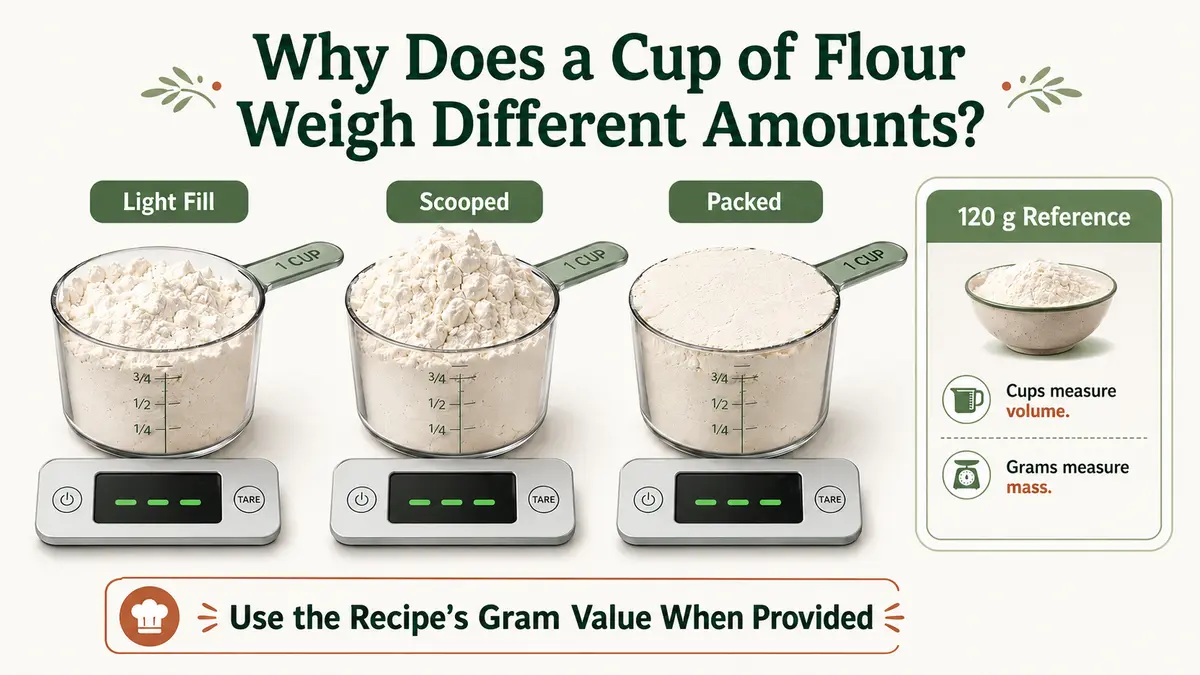
The short answer: the cup stays the same, but the flour inside it does not
A measuring cup defines volume, while grams define mass. The cup itself does not become larger or smaller when two websites disagree about flour. What changes is the amount of flour packed into that volume and the reference method the publisher chose.
KitchenMathHub uses 120 g for one US cup of all purpose flour as its general reference. King Arthur Baking also lists 120 g for one cup of all purpose flour and recommends weighing ingredients for the most repeatable results. That does not mean every recipe on the internet was developed with 120 g. Another publisher may use 125 g, 130 g, or another tested house standard.
The recipe author's own gram value should take priority when it is provided. If a cake recipe says “1 cup all purpose flour (125 g),” use 125 g for that cake. A general conversion database is most useful when the original recipe gives only cups or when you need a consistent reference for your own recipe work.
Why a cup of flour can become heavier or lighter
| What changes | Effect on the cup | Practical result |
|---|---|---|
| Light spoon and level | More air remains between particles | Usually a lighter cup |
| Scooping from the bag | Flour can be compressed by the cup | Often a heavier cup |
| Packing or tapping | Air spaces shrink | Heavier cup |
| Sifting | Particles are aerated and redistributed | Volume can change for the same mass |
| Different flour product | Particle size and composition can differ | Reference weight may change |
Measuring technique is one of the biggest reasons flour conversions disagree
Flour is easy to compact accidentally. Push a dry measuring cup into a flour bag and the pressure can force more particles into the cup. Shake the cup or tap it against the counter and the flour can settle further. The top may still be perfectly level, yet the cup can contain more mass than a lightly filled cup.
A spoon and level method reduces that compaction. Loosen the flour, transfer it gently into the cup, then sweep the excess from the top without pressing it down. King Arthur describes a similar light measuring approach and notes that the same nominal cup can contain substantially different amounts depending on technique.
A digital scale removes most of this particular uncertainty. If the target is 120 g, the flour is 120 g whether it looks fluffy or settled. This is especially useful in cakes, bread, pastry, and cookies where flour controls hydration, structure, spread, tenderness, and dough stiffness.
Volume is still useful when a recipe was designed around volume. The point is not that cups are unusable. The point is that a cup-to-gram conversion needs a declared reference instead of pretending that “1 cup flour” is a universal physical constant.
Why 120 g, 125 g, and other flour standards can all appear
Recipe publishers establish house standards so their recipes remain internally consistent. A test kitchen may decide that its standard cup of flour represents 120 g because that matches its measuring procedure. Another publisher can develop recipes around a different amount. If each organization consistently tests its recipes with its own standard, both systems can produce successful recipes.
The mistake is mixing standards inside the same recipe without realizing it. Suppose a recipe was developed with 125 g per cup and calls for 4 cups. That recipe's flour target is 500 g. Replacing it with a 120 g standard produces 480 g, a 20 g difference. In a wet dough that difference may be minor. In a low hydration pastry or a delicate cake it can be more noticeable.
KitchenMathHub therefore treats the reference as data, not as an eternal truth. The Ingredient Weight Database exposes the source, reference measure, ingredient state, confidence, and review date. That makes the assumption visible instead of hiding it behind a calculator button.
Flour type matters as well as measuring method
All purpose flour is not a safe substitute reference for every flour in a database. Bread flour, cake flour, whole wheat flour, rye flour, almond flour, coconut flour, and gluten free blends can have different particle sizes and compositions. Even products that share a broad name can be milled differently.
A named product can also have a publisher-specific cup standard. King Arthur's ingredient chart lists its own tested household measures for many flours. KitchenMathHub keeps ingredient identity in the calculation so an almond flour query does not silently reuse the all purpose flour value.
Preparation state matters for some ingredients even more than flour type. This same principle explains why packed brown sugar, unsifted powdered sugar, rolled oats, sliced nuts, and mashed foods need state-aware references. Volume conversion is always stronger when the ingredient and state are explicit.
A worked example: four cups of flour
At 120 g per cup, four cups of flour equals 480 g. At 125 g per cup, the same written four cups equals 500 g. The mathematical difference is 20 g, or about 4.2 percent relative to the 480 g reference.
That difference also changes baker's percentage calculations if the flour weight becomes the formula base. If water remains at 360 g, then 480 g flour gives 75 percent hydration. With 500 g flour, the same 360 g water gives 72 percent hydration. A small cup-weight choice can therefore affect how bread dough feels and how a formula is described.
This is why the Baker's Percentage Calculator works best with actual gram weights. Once flour becomes the 100 percent reference, mass is the useful language for comparing formulas.
When to use the KitchenMathHub flour value and when not to
Use the KitchenMathHub reference when the recipe gives cups only
If a general recipe lists “2 cups all purpose flour” and provides no gram amount or publisher standard, the Flour Cups to Grams page gives you a consistent conversion based on the declared 120 g reference.
Use the recipe author's grams when both units are supplied
If the recipe gives 1 cup and 125 g together, use 125 g. The author has already told you the intended mass, so replacing it with a general database reference would remove useful recipe-specific information.
Use manufacturer instructions when a specialty mix defines its own measure
A proprietary gluten free blend, baking mix, or specialty flour may have a package weight-per-cup instruction. That product-specific instruction is stronger for that product than a generic flour value.
Use a scale when repeatability matters
If you are testing a bread formula, scaling a bakery batch, or trying to reproduce a cake exactly, grams make it easier to compare one batch with the next.
Why this matters beyond a single conversion
Flour weight changes the relationship between dry and wet ingredients. In bread it changes hydration. In cookies it can affect spread. In cakes it changes batter thickness and structure. In pastry it can alter how much liquid is needed to bring the dough together.
It also explains why two reputable recipe sites can publish slightly different conversions without one of them necessarily being careless. The better question is: what standard did the recipe use? Once you know that, the conversion becomes interpretable.
KitchenMathHub's goal is to keep that context visible. Use the Cups to Grams Calculator for a practical answer, then inspect the reference when precision or disagreement matters.
Questions about flour cup weight
Why does one cup of flour have different gram values online?
A cup of flour can weigh differently because publishers use different flour products and measuring methods. A lightly filled cup contains less flour than a cup that is scooped or packed more firmly.
How many grams is one cup of all purpose flour?
KitchenMathHub uses 120 g per US cup as its general all purpose flour reference. If your recipe author supplies a tested gram value, use that recipe specific value first.
Can one cup of flour really vary by 10 or 20 grams?
Yes. Volume measures contain air as well as flour, so the way the cup is filled can change the mass without changing the cup size.
Is scooping flour from the bag less accurate?
Direct scooping can compact flour and produce a heavier cup. A spoon and level or sprinkle and level method is generally more repeatable for volume recipes.
Should I use 120 g or 125 g for a cup of flour?
Use the standard tied to the recipe when you know it. If the recipe has no weight standard, choose one consistent reference rather than switching values mid recipe.
Does bread flour weigh the same as all purpose flour?
Not every flour product should be assumed to have the same cup weight. Product, milling, particle size, and publisher standards can differ, so use the named flour reference when available.
Why is weighing flour better for baking?
A gram measures mass directly and removes most of the variation caused by how a measuring cup is filled. This makes repeated batches easier to compare.
Does sifting flour change its cup weight?
Sifting can change how loosely flour occupies a cup. Follow the recipe wording carefully because “1 cup sifted flour” and “1 cup flour, sifted” can describe different measuring sequences.
Can I convert every flour cup with one density formula?
No single flour density is ideal for every recipe and flour type. Ingredient specific culinary references are more useful than pretending every flour is physically identical.
What should I do when a recipe gives both cups and grams?
Use the gram amount supplied by the recipe author when practical. It is the clearest statement of the amount used when that recipe was developed.
Calculation transparency
Read methodologyHow to interpret this result
Result typeSource comparison guide
Calculation basisPublished measurement standards, culinary references, and declared regional conventions
Sources shown3
Latest source reviewAug 15, 2026
Different values can be valid when they use different measurement methods, ingredient states, or regional standards. Use the reference that matches the recipe context.
Sources and methodology
These are the references used for data, conventions, safety targets, or calculation context on this page. Review dates show when KitchenMathHub last checked the cited source.
King Arthur BakingRecipe Success GuideUsed for established culinary measurements, baking methods, or formula guidance.
Open source ↗National Institute of Standards and TechnologyMetric Kitchen: Cooking Measurement EquivalenciesUsed for defined measurement guidance or public food-safety guidance where applicable.
Open source ↗