King Arthur BakingFeeding and Maintaining Your Sourdough StarterUsed for established culinary measurements, baking methods, or formula guidance.
Open source ↗Sourdough Starter Feeding Calculator
Calculate exactly how much flour and water to add when feeding sourdough starter. Use common ratios such as 1:1:1, 1:2:2, or 1:5:5, or enter your own ratio and starter hydration.
Feed ratio by weight: starter : flour : water
A 1:1:1 feed uses equal starter, flour, and water by weight. The calculator also works with 1:2:2, 1:5:5, or unequal flour/water feeds.
Feed this retained starter
50 g
Add flour: 50 g
Add water: 50 g
Final starter: 150 g
Discard / set aside: 100 g
Final hydration: 100.0%
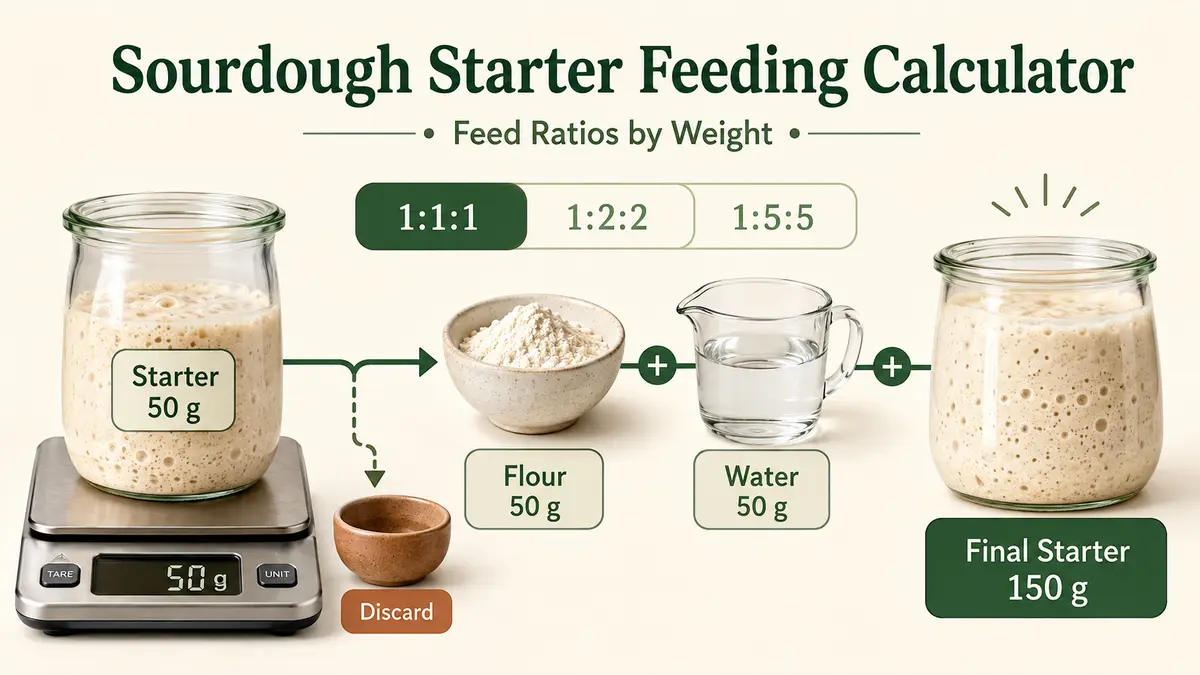
Sourdough starter feeding ratio examples
| Retained starter | Feed ratio | Flour to add | Water to add | Final starter |
|---|---|---|---|---|
| 50 g | 1:1:1 | 50 g | 50 g | 150 g |
| 25 g | 1:2:2 | 50 g | 50 g | 125 g |
| 20 g | 1:5:5 | 100 g | 100 g | 220 g |
How the sourdough starter feeding calculator works
A feeding ratio compares retained starter, fresh flour, and fresh water by weight. In a 1:1:1 feed, 50 g starter receives 50 g flour and 50 g water. In a 1:2:2 feed, the same 50 g starter receives 100 g flour and 100 g water.
The calculator begins with the starter currently in your jar and the amount you want to keep. The difference is shown as discard or starter you can set aside for another use. It then multiplies the retained starter by the flour and water parts of your chosen feed ratio.
The calculator also tracks starter hydration. If the retained starter is not 100% hydration, it is first separated into its existing flour and water. New flour and water are added to those totals, which lets the tool calculate the final hydration after feeding.
What 1:1:1 means for sourdough starter
A 1:1:1 sourdough feeding means equal starter, flour, and water by weight. King Arthur Baking uses equal parts starter, flour, and water by weight as a standard maintenance example. That does not make 1:1:1 the only valid method. It is simply a clear, repeatable ratio.
If you keep 50 g starter, a 1:1:1 feed adds 50 g flour and 50 g water. The jar then contains 150 g total starter. If you keep 100 g starter, the same ratio adds 100 g flour and 100 g water, producing 300 g total.
Ratio notation is about relative amounts, not fixed grams. You can use 10 g, 25 g, 50 g, or another retained amount. The ratio remains the same as long as each part is scaled consistently.
What 1:2:2 and 1:5:5 starter feeds mean
A 1:2:2 feeding gives the starter more fresh flour and water relative to the retained inoculum. With 25 g starter, add 50 g flour and 50 g water. Total starter becomes 125 g.
A 1:5:5 feeding is larger. With 20 g retained starter, add 100 g flour and 100 g water. The resulting starter weighs 220 g. This can be useful when you need to build more starter or want a larger refreshment relative to the amount of mature starter.
Do not assume a bigger ratio has one fixed fermentation time. A larger feed can change how long the starter takes to peak, but room temperature, flour choice, starter condition, water temperature, and microbial activity matter too. Watch the starter rather than treating the ratio as a timer.
How much sourdough starter should you keep?
You only need to maintain as much starter as fits your baking routine. Keeping a huge jar can create unnecessary flour use if you repeatedly discard most of it. A smaller maintained starter can be built up before baking.
The calculator separates current starter from retained starter for this reason. If your jar contains 200 g and you decide to keep 40 g, the tool shows 160 g as discard or set-aside starter. The chosen feed ratio is then applied only to the 40 g you retained.
King Arthur Baking's maintenance guidance provides examples of discarding to a chosen amount and feeding equal flour and water by weight. Your own successful routine can differ. The useful principle is to measure what you retain and what you add so the feeding remains repeatable.
Sourdough discard and starter build calculations
Discard is simply starter you choose not to carry into the next feeding. It is not automatically spoiled. Healthy sourdough discard is often used in recipes that do not rely on it as the only leavening source. If starter shows mold or other signs of contamination, it should not be treated as normal discard.
If you need a specific amount of ripe starter for a bread recipe, you can use the feeding calculator as a build planner. Suppose a recipe needs 200 g starter and you want some left for maintenance. Retain enough mature starter and choose a feeding ratio that produces more than 200 g total.
Plan the amount before feeding to avoid accidental waste. If the calculator shows a final starter amount much larger than you need, reduce the retained starter or use a smaller ratio. If it produces too little, increase the retained amount or feeding ratio.
Starter hydration after feeding
Starter hydration is total water divided by total flour. A 100% hydration starter has equal flour and water by weight. That does not mean the starter is 100% water. It means the water weighs the same as the flour.
If a 100% hydration starter receives equal flour and water, it stays at 100% hydration. If you add more flour than water, the starter becomes stiffer. If you add more water than flour, it becomes more liquid.
The current hydration field matters when the retained starter is already stiff or liquid. For example, 60% hydration starter contains more flour than water. The calculator accounts for that existing composition before it adds the new feed.
For the hydration of the final bread dough, use the Sourdough Hydration Calculator. It includes both the starter and the flour and water added directly to the dough.
Feeding starter by weight instead of cups
Weight is the better unit for starter feeding ratios. Sourdough starter can be full of gas at one moment and stirred flat at another. The same cup can therefore contain very different weights depending on fermentation and handling.
Flour also varies by how it is scooped and packed. A digital kitchen scale removes much of that variation. Put the jar or bowl on the scale, tare it to zero, then weigh the retained starter, flour, and water.
Small feeds benefit from a scale that reads at least to the gram. If you maintain very small starters or use tiny seed amounts, finer resolution can help. The goal is not laboratory precision. It is consistent enough measurement that your ratio means the same thing from one feeding to the next.
How feeding ratio affects fermentation
The feed ratio changes how much fresh food is available relative to the mature starter. A small inoculum with a large flour and water feed starts with fewer mature organisms relative to the new mixture than a 1:1:1 feed.
That relationship can influence the time to visible activity or peak, but it does not determine it alone. Warm temperatures can accelerate fermentation. Cooler temperatures can slow it. Whole grain flour may behave differently from refined flour. Starter health and acidity also matter.
Use the ratio calculator for quantities, not as an exact proofing clock. Record how a particular ratio behaves in your kitchen. If 1:2:2 at your room temperature consistently peaks around the schedule you need, that observation is more useful than a universal time claim.
Feeding starter for a bread or pizza recipe
Build enough ripe starter for the recipe plus the amount you want to keep. If a bread recipe needs 150 g starter and you want 30 g left for maintenance, plan for at least 180 g. A little extra can provide a margin for starter left on the jar or spoon.
Once the starter goes into a bread formula, its flour and water become part of the dough. This matters for true hydration and baker's percentage. The Baker's Percentage Calculator and sourdough hydration tool help analyze those relationships after the feeding stage.
If you are making sourdough pizza, do not enter the whole starter weight as if it were commercial yeast in the Pizza Dough Calculator. First account for the flour and water carried by the starter.
Common sourdough feeding mistakes
Reading 1:1:1 as volume
Feeding ratios are most repeatable when the parts are weights. Equal cups of starter, flour, and water are not equal weights.
Ignoring current starter hydration
If the retained starter is stiff, adding equal flour and water does not instantly make the final mixture exactly the same as starting with a 100% hydration starter.
Keeping too much starter without a reason
A smaller maintained starter can reduce discard and still be built to a larger amount before baking.
Using the calculator as a fermentation timer
The tool calculates mass and hydration. Starter activity still needs observation.
A practical sourdough feeding workflow
1. Weigh the starter in the jar
Know how much mature starter you have before deciding what to retain.
2. Choose how much starter to keep
Keep enough for your maintenance or build plan and set aside the rest.
3. Choose the feed ratio
Use 1:1:1, 1:2:2, 1:5:5, or your own tested ratio.
4. Add the calculated flour and water
Weigh both ingredients rather than estimating by volume.
5. Observe and record the fermentation
Note temperature, flour, feed ratio, and how long the starter takes to become active. Those records turn the calculator's precise quantities into a reliable personal routine.
Questions about feeding sourdough starter
What does a 1:1:1 sourdough feeding ratio mean?
A 1:1:1 feed uses equal weights of retained starter, flour, and water.
How much flour and water do I add to 50 g starter at 1:1:1?
Add 50 g flour and 50 g water. The final starter weighs 150 g.
What does a 1:2:2 starter feeding mean?
For every one part retained starter, add two parts flour and two parts water by weight.
How much do I feed 25 g starter at 1:5:5?
Add 125 g flour and 125 g water, producing 275 g starter before any later use.
Should sourdough feeding ratios be measured by weight?
Yes. Weight is more consistent because starter volume changes with bubbles, stirring, flour type, and hydration.
Does a 1:1:1 feed make a 100% hydration starter?
It maintains 100% hydration when the retained starter is already 100% hydration and equal flour and water are added by weight.
Can the calculator use a stiff starter?
Yes. Enter the current starter hydration and an unequal flour-to-water feeding ratio when you want a stiffer or more liquid starter.
How much starter should I discard?
Choose how much starter you want to retain. The calculator shows the difference between the amount currently in the jar and the retained amount.
Does a larger feed ratio ferment more slowly?
Often it changes the timing because there is more fresh food relative to retained starter, but temperature, flour, starter strength, and acidity also affect fermentation.
Can I build the exact amount of starter needed for a recipe?
Yes. Choose a retained starter amount and feeding ratio that produces at least the amount your recipe needs, while leaving enough starter to maintain if desired.
How often should I feed sourdough starter?
Feeding frequency depends on storage temperature and your maintenance method. Follow the routine that keeps your starter active and healthy rather than relying on one universal schedule.
How do I calculate starter hydration after feeding?
The calculator decomposes the retained starter into flour and water, adds the new flour and water, then divides total water by total flour.
Calculation transparency
Read methodologyHow to interpret this result
Result typeFormula + culinary reference
Calculation basisBread formula arithmetic with published baking references
Sources shown2
Latest source reviewAug 15, 2026
Formula math is deterministic. Product-specific yeast instructions and recipe-specific flour standards should take priority when supplied.
Continue with KitchenMathHub
→
Sourdough Hydration Calculator
Calculate the true hydration of a final dough with starter flour and water included.
→
Baker's Percentage Calculator
Analyze flour, water, salt, and other bread ingredients as baker's percentages.
→
Pizza Dough Calculator
Build a target pizza dough batch from baker's percentages and dough ball weight.
Sources and methodology
These are the references used for data, conventions, safety targets, or calculation context on this page. Review dates show when KitchenMathHub last checked the cited source.
King Arthur BakingThe complete guide to hydration in bread doughUsed for established culinary measurements, baking methods, or formula guidance.
Open source ↗