Scale, convert and adapt any recipe.
Use KitchenMathHub when a recipe has the wrong serving size, measurement system, pan size, oven setting, or dough formula. The tools keep each calculation clear, so you can change what matters without guessing at the rest of the recipe.
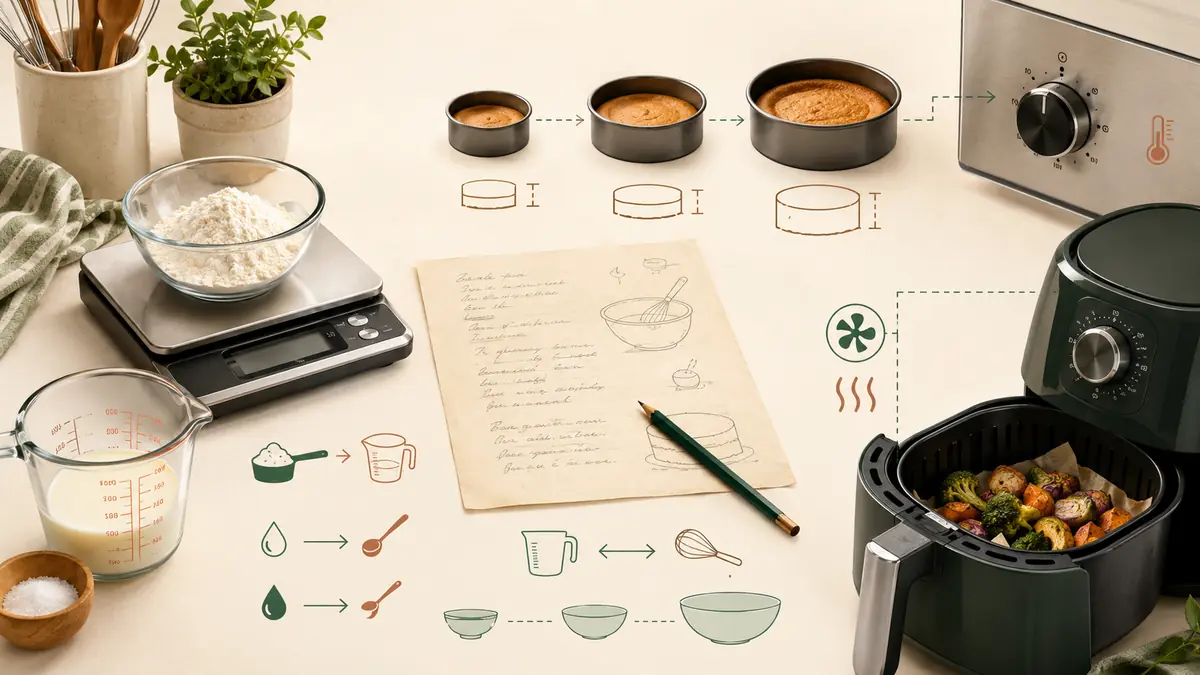
Recipe math should solve the exact problem in front of you
A recipe calculator should make the next kitchen decision easier. You may need to turn 4 servings into 7, change cups into grams, use a 9 inch cake pan instead of an 8 inch pan, or convert a conventional oven recipe for an air fryer. KitchenMathHub separates these tasks because they use different types of math. Ingredient quantity can scale with a simple ratio. Cooking time, pan depth, appliance airflow, and food safety need their own context.
You can use one tool or keep working with the same recipe. The Recipe Converter opens Recipe Lab, where several common jobs stay in one workspace. You can paste an ingredient list, adjust the yield, switch from US measurements to metric, review a pan change, and convert oven settings without typing the recipe again. If you only need one answer, the focused calculators stay quick and simple.
Scale recipe servings with a clear multiplier
Recipe scaling starts with target yield divided by original yield. A recipe that serves 4 and needs to serve 10 uses a scale factor of 2.5. Two cups of stock become 5 cups. Three tablespoons of oil become 7.5 tablespoons before practical formatting. The Recipe Scaling Calculator also handles mixed fractions, quantity ranges, and partial eggs, which are the parts that usually slow people down when they scale ingredients by hand.
Convert cups to grams with the ingredient in mind
One cup does not have one universal weight in grams. A cup measures volume, while a gram measures mass. All purpose flour, granulated sugar, butter, cocoa powder, oats, and honey have different culinary weight references for the same cup volume. That is why the Cups to Grams Calculator asks for the ingredient instead of using a single multiplier. The result is more useful for baking, where a small weight difference can change dough or batter consistency.
Change a cake pan without treating bake time as ingredient math
Pan area is the main comparison when you want a similar batter depth. An 8 inch round pan has about 50.3 square inches of area, while a 9 inch round has about 63.6 square inches. The area ratio is about 1.27, so a cake recipe can be scaled by roughly 1.27 when the goal is a similar layer height. The Cake Pan Conversion Calculator also checks pan depth and capacity because a wider or shallower pan can change how the batter fits. Bake time is kept separate because heat transfer does not scale with the ingredient multiplier.
Convert oven settings with practical cooking values
350°F is about 176.7°C by exact temperature math, but 180°C is a common cooking setting. Both numbers can be useful, but they answer different questions. The Oven Temperature Converter shows practical recipe settings for Fahrenheit, Celsius, fan ovens, and Gas Mark. The Oven to Air Fryer Calculator goes further by changing both temperature and estimated time, then adding an earlier check point when food specific guidance is available.
Use KitchenMathHub for everyday cooking, baking, and bread formulas
Use case: a family recipe serves 6 but you need 9 portions
Six servings to nine servings uses a 1.5 multiplier. A 400 g ingredient becomes 600 g, 2 cups become 3 cups, and 2 eggs become 3 eggs. This is a simple scaling case because the count ingredients stay practical. If the same recipe needs 10 portions, the factor becomes 1.6667 and some quantities become less convenient. The recipe scaler keeps the raw math accurate, then formats the kitchen facing result at the end.
Use case: an American baking recipe needs metric measurements
A useful US to metric recipe converter treats dry and liquid ingredients differently. Flour and sugar are often easier to reproduce in grams when a validated ingredient weight is available. Water and milk are usually practical in milliliters. Eggs stay as counts unless the recipe needs a partial egg or a weight based formula. A mixed recipe can also contain grams, cups, tablespoons, milliliters, ounces, and whole items at the same time. The converter normalizes each line instead of forcing the original recipe into one system first.
Use case: the recipe calls for an 8 inch cake pan but you own a 9 inch pan
An unchanged 8 inch cake recipe will usually make a thinner layer in a 9 inch pan. If you want a similar cake height, compare the baking areas and scale the batter. If you prefer to keep the original batter amount, the larger pan can still be usable, but the cake may bake faster because the batter is shallower. Pan shape, pan depth, batter amount, and recipe type all affect the final result, so the pan tool explains the difference instead of giving one unexplained number.
Use case: a conventional oven recipe needs an air fryer starting point
Air fryer conversion should give you a starting point and an early check time. A common general approach lowers a conventional oven temperature and shortens the time, but actual cooking still depends on food thickness, basket load, airflow, fresh or frozen state, and appliance style. A 30 minute oven recipe may start near 24 air fryer minutes under a general 20% reduction, but the safer habit is to check before the estimated finish and use food specific doneness cues.
Use case: sourdough starter changes the true hydration
Sourdough starter contributes both flour and water to the dough. If you mix 500 g flour, 350 g water, and 100 g starter at 100% hydration, the starter adds 50 g flour and 50 g water. Total flour becomes 550 g and total water becomes 400 g, which gives about 72.7% hydration. The Sourdough Hydration Calculator handles this automatically, including starters that are stiffer or more liquid than 100% hydration.
Use case: build bread from baker's percentages
Baker's percentage sets total flour at 100%. A formula with 500 g flour and 375 g water has 75% hydration. Ten grams of salt is 2% of the flour weight. The Baker's Percentage Calculator can work in both directions. You can enter ingredient weights to see percentages, or enter percentages and a target dough weight to calculate the grams needed for loaves, rolls, or pizza dough.
How KitchenMathHub keeps conversions useful in a real kitchen
Exact math and practical cooking guidance are not always the same thing. An ounce to gram conversion is a fixed unit relationship. A cup of flour to grams needs an ingredient reference. An oven to air fryer conversion is an estimate because appliance performance varies. KitchenMathHub keeps those result types separate so a precise unit conversion does not look the same as an estimated cooking window.
Unknown recipe details are better left visible than guessed. A line such as “salt to taste” does not need a fake teaspoon amount. “Oil for frying” can stay unchanged. An unfamiliar package size should remain available for review. This approach protects the meaning of the original recipe and makes the converted result easier to trust.
Cooking time should follow food depth and doneness, not serving count alone. Doubling soup in a larger pot, doubling cake batter across two identical pans, and doubling a casserole in one deep dish create different heat transfer conditions. The ingredient multiplier can be the same while the cooking time behaves differently. This is why KitchenMathHub treats serving size, pan geometry, oven settings, and appliance conversion as separate attributes.
Source context matters most when published values can differ. Ingredient weights can change with measuring method, packing, ingredient state, or reference standard. Yeast substitution can also vary by product. The methodology area shows the reference used for important values and labels estimates when there is no single exact answer.
Questions people often ask about recipe math
How do I scale a recipe to more servings?
Divide the target servings by the original servings. The result is your recipe multiplier. Multiply each scalable ingredient by that number, then format fractions and count ingredients into practical amounts.
Can I convert cups to grams without choosing an ingredient?
No, a reliable cups to grams conversion needs the ingredient. Cups measure volume and grams measure mass, so flour, sugar, butter, oats, and honey do not share one gram value per cup.
How do I convert a US recipe to metric?
Use grams for suitable dry ingredients and milliliters for practical liquid volumes. Keep eggs and other count ingredients as counts unless a weight is needed. Ingredient specific reference weights improve baking conversions.
Does doubling a recipe double the cooking time?
No, cooking time does not automatically double with the ingredients. Food depth, pan size, batch layout, appliance power, and doneness all affect the time needed.
Can I use a different cake pan size?
Yes, compare pan area when you want a similar batter depth. Then check depth and capacity so the new pan can safely hold the batter.
How do I convert an oven recipe to an air fryer?
Start with a lower temperature and shorter time, then check the food early. Select a food profile when available because chicken, salmon, fries, vegetables, and baked dishes do not all respond the same way.
Is 350°F exactly 180°C?
No, 350°F is about 176.7°C exactly. Many recipes use 180°C as the practical oven setting because cooking temperatures are commonly rounded.
Does sourdough starter count toward dough hydration?
Yes, starter flour and starter water both count. The starter hydration tells you how that starter weight splits between flour and water.
What does 75% baker's hydration mean?
It means total hydration liquid weighs 75% as much as total flour. In a simple 500 g flour formula, 75% hydration equals 375 g water.
Why do some cooking results use a range?
A range is more useful when real cooking conditions vary. Food thickness, appliance airflow, ingredient packing, pan material, and starting temperature can all change the result, so false precision can be less helpful than a clear starting range.
Where the measurement and safety references come from
KitchenMathHub uses primary and established culinary references for important values. Practical US kitchen volume relationships are checked against NIST cooking measurement equivalencies. Ingredient weight references for common baking ingredients use sources such as the King Arthur Baking Ingredient Weight Chart. Food safety targets are kept separate from estimated cooking time and use guidance such as the FoodSafety.gov safe minimum internal temperature chart.
A source does not turn every kitchen result into an exact physical constant. Flour weight can change with measuring method, air fryer time can change with food thickness and appliance airflow, and pan changes can alter batter depth. The source tells you where the reference value comes from. The calculator still explains the assumptions and limits that matter for the result.
Popular kitchen tools
Recipe Scaling Calculator
Adjust servings and get practical fractions, ranges, and partial egg guidance.
Oven to Air Fryer Calculator
Convert oven time and temperature to a practical air fryer starting point.
Cups to Grams Calculator
Use ingredient specific culinary references instead of one universal cups to grams number.
Cake Pan Converter
Resize round, square, rectangular, and oval baking recipes by pan area.
Oven Temperature Converter
Translate Celsius, Fahrenheit, fan settings, and Gas Mark conventions.
Sourdough Hydration
Include starter flour and water when calculating true dough hydration.
What do you need to change?
Change servings
Scale a recipe up or down while preserving ingredient relationships.
Change measurements
Turn US recipe measures into practical metric quantities or convert metric values back to US units.
Change baking pan
Compare pan area and scale batter while keeping approximate cake depth consistent.
Change appliance
Start with an oven recipe and get an air fryer temperature, time, and check point.
Work with dough
Calculate hydration, baker's percentages, starter contribution, and target dough weight.
Convert one ingredient
Search more than 100 ingredient references and convert the quantity you actually need.
Explore KitchenMathHub by topic
Recipe Tools
Scale servings, convert full recipes, and keep several recipe changes in one workflow.
Ingredient Conversions
Convert cups, grams, spoons, milliliters, and ingredient specific weights.
Baking Calculators
Resize cake pans, convert yeast, and solve common baking measurement problems.
Appliance Tools
Convert oven settings, fan temperatures, air fryer time, microwave wattage, and food specific guidance.
Bread & Dough
Calculate hydration, baker's percentages, yeast, flour blends, and target dough weight.
Numbers you can inspect
Ingredient weights, food safety targets, appliance guidance, and baking conventions keep their source references. Where a result is an estimate, KitchenMathHub says so.
Read the methodology