King Arthur BakingThe complete guide to hydration in bread doughUsed for established culinary measurements, baking methods, or formula guidance.
Open source ↗Bread and Dough Calculators
Calculate sourdough hydration, baker's percentages, yeast conversions, flour blends, prefermented flour, and target dough weight. These tools use flour weight as the common base so bread formulas can be compared and scaled clearly.
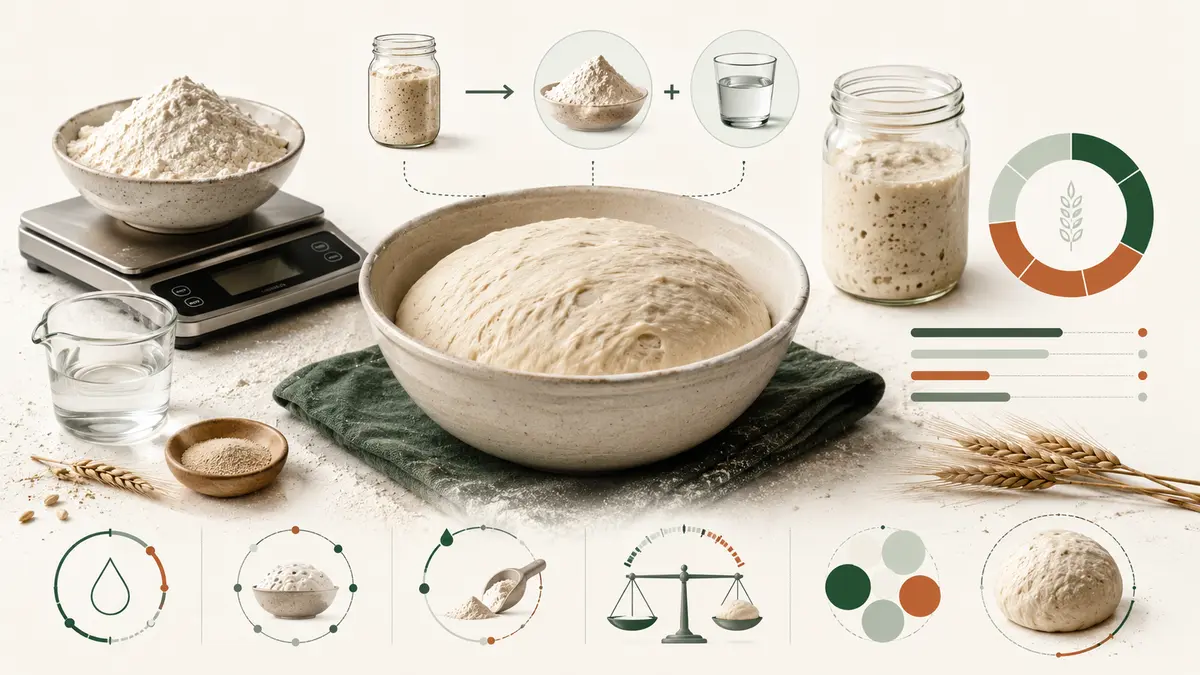
Bread and dough calculators for hydration, formulas, and yeast
Sourdough Hydration Calculator
Calculate true dough hydration with starter flour and water included, plus prefermented flour and salt percentage.
Best for sourdough and levain formulas.Baker's Percentage Calculator
Turn ingredient weights into baker's percentages or build a formula from percentages and target dough weight.
Best for scalable bread formulas.Pizza Dough Calculator
Build a pizza batch from dough ball weight, hydration, salt, yeast, oil, and sugar percentages.
Best for planning pizza dough by ball weight.Sourdough Starter Feeding Calculator
Calculate 1:1:1, 1:2:2, 1:5:5, or custom starter feeds by weight.
Best for starter maintenance and builds.Dough Scaling Calculator
Scale an existing dough recipe to a target number and weight of dough pieces.
Best for rolls, loaves, buns, and pizza balls.Yeast Conversion Calculator
Convert fresh, active dry, instant, grams, teaspoons, ounces, and standard packet amounts.
Best when the yeast type changes.Recipe Scaling Calculator
Scale dough ingredients to a larger or smaller yield while preserving the original proportions.
Best for simple batch multiplication.Grams to Cups Calculator
Convert ingredient weights into practical volume measures when a scale is not available.
Useful for supported bread ingredients.Cooking Measurement Chart
Check common mass and volume relationships used in bread and kitchen formulas.
Useful for standard unit conversion.Bread formula research guide
Plan pizza dough, feed starter, and scale dough by weight
Use the Pizza Dough Calculator when you know the number of pizzas and target dough ball weight. It builds the flour, water, salt, yeast, oil, and sugar weights from baker's percentages instead of forcing one pizza style.
Use the Sourdough Starter Feeding Calculator before mixing when you need a controlled 1:1:1, 1:2:2, 1:5:5, or custom feed. It separates retained starter, discard, flour, water, and final hydration.
Use the Dough Scaling Calculator when the formula already works and only the batch size needs to change. Choose the number of loaves, rolls, buns, or pizza balls and the target grams per piece, then scale every ingredient with one factor.
Bread math starts with flour, water, and a clear formula
Hydration tells you how much hydration liquid is present relative to total flour. A dough with 500 g flour and 350 g water has 70% hydration. When a sourdough starter is included, the starter's flour joins the flour total and its water joins the water total.
Baker's percentage treats total flour as 100%. Water, salt, yeast, sugar, fat, inclusions, and other ingredients are expressed relative to flour weight. This lets a small home batch and a large bakery batch share the same formula even when their gram amounts are very different.
Yeast conversion solves a different problem from baker's percentage. Baker's math tells you the amount of yeast relative to flour. Yeast conversion tells you how that amount changes when you replace fresh yeast with active dry, instant, or another supported product.
Keep these calculations connected but separate. A 75% hydration target should not secretly change because you switched from active dry to instant yeast. A yeast substitution should not change the flour blend unless the actual recipe formula calls for it.
Sourdough hydration with starter included
Sourdough hydration must include the flour and water inside the starter or levain. Suppose a dough contains 500 g added flour, 350 g added water, and 100 g starter at 100% hydration. The starter contains about 50 g flour and 50 g water. Total flour becomes 550 g and total water becomes 400 g.
That example is about 72.7% total hydration, not 70%. Dividing only 350 by 500 ignores the starter contribution. The Sourdough Hydration Calculator performs the decomposition automatically.
Starter hydration can be lower or higher than 100%. A stiff 60% hydration starter contains more flour than water. A liquid 125% hydration starter contains more water than flour. Dividing every starter weight in half is only correct for a 100% hydration starter.
Hydration above 100% can be valid. Highly absorbent flours and some bread styles can hold large amounts of water. KitchenMathHub does not treat 100% as a hard maximum.
Starter hydration and prefermented flour are different percentages
Starter hydration describes the water to flour ratio inside the starter itself. Equal flour and water by weight gives 100% starter hydration. A 60% starter uses 60 g water for every 100 g flour inside the starter.
Prefermented flour percentage describes how much of the total formula flour is already inside the preferment. If total flour is 550 g and 50 g of that flour is in the levain, prefermented flour is about 9.1%.
Starter weight percentage is another number again. A 100 g starter in a formula with 550 g total flour is about 18.2% of flour weight, but only 50 g of that starter is flour at 100% hydration. This is why a vague phrase such as “20% starter” can be confusing.
Use prefermented flour when you want a fermentation related percentage that remains meaningful across different starter hydrations. It compares flour with flour instead of mixing starter water into the percentage.
Baker's percentage for bread formulas
Every baker's percentage is calculated against total flour weight. If total flour is 500 g, then 375 g water is 75%, 10 g salt is 2%, and 3 g instant yeast is 0.6%.
Formula percentages can add to more than 100%. Flour remains the 100% reference while the other ingredients are added on top. A lean dough with 100% flour, 75% water, 2% salt, and 0.6% yeast totals 177.6%.
Multiple flour percentages should add to 100% within the flour blend. A formula can use 80% bread flour, 15% whole wheat flour, and 5% rye flour. Those flour components together define the total flour basis.
Use the Baker's Percentage Calculator to analyze ingredient weights, build a formula from percentages, or calculate a target batch.
Calculate target dough weight from baker's percentages
Target dough weight can be calculated from the total formula percentage. Suppose the formula is 100% flour, 72% water, 2% salt, and 0.7% instant yeast. The total is 174.7%, which becomes 1.747 as a decimal.
A 1,000 g target dough needs about 572.4 g total flour in that example. Divide 1,000 by 1.747. Then calculate each remaining ingredient from the flour weight. Water is about 412.1 g, salt about 11.4 g, and yeast about 4.0 g.
Piece count can define the target batch too. Three loaves at 850 g each require 2,550 g of dough before any optional handling allowance. Rolls, baguettes, pizza dough balls, and buns can use the same idea.
Use fine precision for tiny yeast amounts. A long fermented dough may use less than 1 g yeast. Rounding 0.4 g down to zero would destroy the formula, so small ingredients need a scale and display precision that match their size.
Yeast conversion for fresh, active dry, and instant yeast
Fresh to dry yeast conversion is not one universal constant. Professional references and manufacturers can use different equivalencies. KitchenMathHub keeps source specific rules so a generic fresh to instant factor does not overwrite a manufacturer instruction.
Active dry and instant yeast can often use the same weight in ordinary bread recipes. Preparation method and fermentation speed may still differ, so equal grams should not be interpreted as identical behavior.
A standard dry packet is commonly about 7 g and 2 1/4 teaspoons. Specialty packets can weigh more, so the product package should take priority. The Yeast Conversion Calculator keeps packet type and yeast type visible.
Bread machine context can change the recommendation. Short cycles and manufacturer specific methods may use different yeast guidance from a traditional hand mixed dough.
Flour blends, whole grains, and dough hydration
All flour types belong in the total flour denominator. Bread flour, whole wheat flour, rye flour, and other flour components are added together before hydration is calculated.
Dough feel depends on flour as well as hydration percentage. A 75% dough made with strong bread flour can feel very different from a 75% dough made with a lower protein flour. Whole grains and rye can also absorb water differently.
Hydration is a formula description, not a universal difficulty score. Higher hydration often creates a wetter dough, but technique, flour choice, temperature, and fermentation all affect handling.
There is no single ideal sourdough hydration. Choose a hydration that suits the flour, bread style, mixing method, shaping ability, and crumb you want rather than chasing one percentage because it appears in another recipe.
Inclusions, salt, sugar, and fat in baker's math
Salt percentage is normally calculated against total flour. A 2% salt formula with 500 g flour uses 10 g salt. The salt does not belong in the hydration numerator.
Nuts, seeds, cheese, dried fruit, and similar inclusions can use baker's percentages too. If walnuts are 20% and flour is 500 g, the formula uses 100 g walnuts.
Do not automatically count every ingredient's natural water content as dough hydration. Eggs, butter, fruit, honey, and dairy contain water, but ordinary baker's hydration usually focuses on declared hydration liquids and preferment water. Trying to calculate laboratory water content for every ingredient can create a number that bakers do not use in normal formulas.
Keep enriched dough context separate from lean dough assumptions. Sugar and fat change dough behavior and fermentation. A brioche formula and a lean country loaf can share baker's math while behaving very differently.
A practical bread formula workflow
1. Decide whether you are analyzing or building
If you already have gram weights, calculate baker's percentages from them. If you know the percentages and target dough weight, build the gram formula in reverse.
2. Add all flour components
Make total flour the 100% reference. Keep the flour blend percentages visible if you use several flours.
3. Account for preferment flour and water
Decompose starter or levain according to its hydration before calculating total hydration and prefermented flour.
4. Calculate water, salt, yeast, and inclusions
Use percentages relative to flour. Preserve enough decimal precision for small ingredients.
5. Scale to the batch you need
Use target dough weight or piece count. The percentages stay the same while ingredient grams change.
6. Ferment by dough condition, not only the clock
Formula math can describe the dough, but fermentation also depends on starter strength, yeast, temperature, flour, salt, enrichment, and environment.
Questions about bread and dough calculations
How do I calculate bread hydration?
Divide total hydration liquid by total flour and multiply by 100. In sourdough, include the flour and water inside the starter or levain.
What is a 100% hydration starter?
A 100% hydration starter contains equal flour and water by weight.
Does sourdough starter count toward dough hydration?
Yes. Break the starter into its flour and water contributions before calculating total dough hydration.
What is baker's percentage?
Baker's percentage expresses each ingredient relative to total flour weight, with total flour set to 100%.
Can baker's percentages add to more than 100%?
Yes. Every ingredient is compared with flour, so the total formula percentage commonly exceeds 100%.
How do I calculate target dough weight?
Add the formula percentages, convert the total to a decimal, and divide target dough weight by that decimal to find total flour.
What is prefermented flour percentage?
It is the flour inside the preferment divided by total flour in the formula, multiplied by 100.
Can I convert fresh yeast to instant yeast?
Yes. Use the Yeast Conversion Calculator because fresh to dry ratios depend on the yeast type and reference profile.
Can hydration be over 100%?
Yes. Some highly absorbent flours and bread styles can use hydration above 100%, so the calculator should not block that value.
Does more starter always mean faster fermentation?
It can change fermentation, but starter strength, dough temperature, flour, salt, enrichment, and room conditions also matter.
Calculation transparency
Read methodologyHow to interpret this result
Result typeReference resource
Calculation basisDeclared methods and cited culinary or measurement sources
Sources shown5
Latest source reviewAug 15, 2026
Sources and assumptions are shown so you can judge whether a reference fits your recipe or kitchen situation.
Sources and methodology
These are the references used for data, conventions, safety targets, or calculation context on this page. Review dates show when KitchenMathHub last checked the cited source.
King Arthur BakingBaker's PercentageUsed for established culinary measurements, baking methods, or formula guidance.
Open source ↗King Arthur BakingYeastUsed for established culinary measurements, baking methods, or formula guidance.
Open source ↗Red Star YeastYeast Conversion ChartUsed for product or appliance-specific guidance where the manufacturer is the relevant authority.
Open source ↗King Arthur BakingFeeding and Maintaining Your Sourdough StarterUsed for established culinary measurements, baking methods, or formula guidance.
Open source ↗