Colorado State University ExtensionHigh Elevation Food Preparation GuideUsed for research-backed educational guidance from a university or extension service.
Open source ↗High Altitude Baking Calculator
Get a source-based starting range for baking at elevation. Choose cake, quick bread, cookies, or yeast bread, enter your elevation, and see which adjustments are worth testing instead of applying one rule to every recipe.
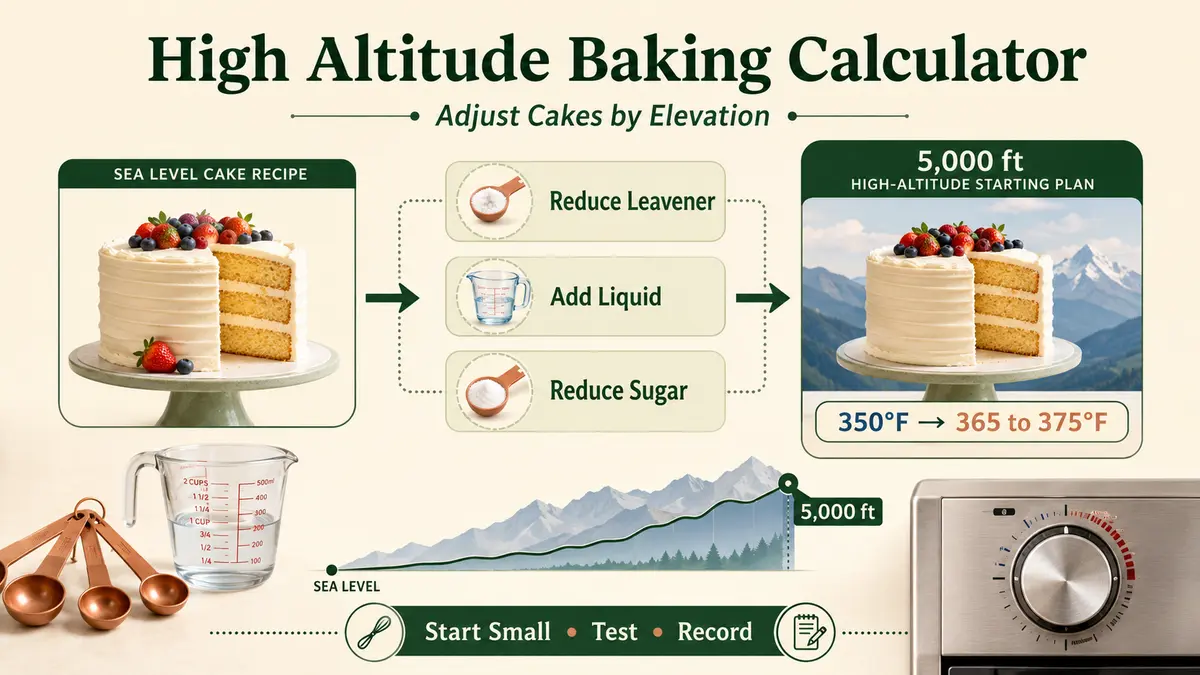
Starting guidance at 5000 ft
365 to 375°F
Suggested oven range for this recipe type
Reduce leavener: 0.25 tsp
Reduce sugar: 0 to 1.5 tbsp
Add liquid: 1 to 2 tbsp
High altitude cake adjustment reference
| Elevation | Leavener reduction per 1 tsp | Sugar reduction per cup | Liquid increase per cup |
|---|---|---|---|
| 3,500 to 6,500 ft | 1/8 tsp | 0 to 1 tbsp | 1 to 2 tbsp |
| 6,500 to 8,500 ft | 1/8 to 1/4 tsp | 0 to 2 tbsp | 2 to 4 tbsp |
| 8,500 to 10,000 ft | 1/4 tsp | 1 to 3 tbsp | 3 to 4 tbsp |
How the high altitude baking calculator works
The calculator uses elevation bands rather than pretending every foot of elevation has an exact baking correction. Colorado State University Extension publishes practical cake adjustment ranges for 3,500 to 6,500 feet, 6,500 to 8,500 feet, and 8,500 to 10,000 feet. KitchenMathHub applies those ranges to the amount of leavener, sugar, and liquid you enter.
For example, if a cake at 5,000 feet contains 2 teaspoons of baking powder, the published 1/8 teaspoon reduction per teaspoon becomes a 1/4 teaspoon total reduction. If the same recipe uses 2 cups of liquid, a 1 to 2 tablespoon increase per cup becomes 2 to 4 tablespoons additional liquid.
The result is a starting range, not a guaranteed corrected recipe. The source itself recommends trying the smaller adjustment first and keeping notes. Different cakes have different structures, fat levels, sugar levels, flour absorption, and leavening systems.
Why altitude changes baking
Lower atmospheric pressure changes how water and leavening gases behave. At elevation, water boils at a lower temperature and moisture can evaporate faster. Gas bubbles in cakes and breads can also expand more readily.
Those changes can create familiar high altitude problems. A cake may rise too quickly and then collapse. The crumb may become coarse. Cookies may spread too far. Yeast dough may ferment and expand faster than expected. Batter can also become effectively more concentrated as water leaves more quickly.
Altitude does not mean the oven itself becomes colder. CSU notes that oven temperature settings are not reduced simply because of elevation. For cakes, a somewhat higher baking temperature can actually help set the structure before expanding gas stretches it too far.
High altitude cake adjustments
Cakes are among the baked goods most likely to need coordinated changes. Above about 3,000 feet, excessive expansion can weaken the cell structure. The result can be a cake that rises dramatically, develops a coarse texture, or falls before the structure sets.
CSU's cake guidance combines several adjustments rather than relying on one variable. Leavener can be reduced. Sugar can be reduced. Liquid can be increased. The oven can be raised about 15 to 25°F. These changes address different parts of the problem: gas expansion, moisture loss, sugar concentration, and structural setting.
Do not change everything to the maximum on the first test. Start at the smaller end of the suggested range. If the cake still collapses or dries out, make another controlled adjustment and record it.
Baking at 5,000 feet
Five thousand feet falls in the 3,500 to 6,500 foot cake band. For each teaspoon of baking powder, the source table suggests about a 1/8 teaspoon reduction. Sugar may be reduced by up to 1 tablespoon per cup, and liquid may be increased by 1 to 2 tablespoons per cup.
If a cake uses 2 teaspoons of baking powder, 1.5 cups sugar, and 1 cup liquid, the calculator can turn those per-unit ranges into recipe totals. That makes the guidance easier to apply without manually multiplying fractions.
The oven may also start 15 to 25°F hotter for a cake. If the sea-level recipe uses 350°F, a starting test range would be about 365 to 375°F. Because the hotter oven can shorten baking time, begin checking before the original finish time.
Baking at 7,000 or 8,000 feet
Seven thousand and eight thousand feet fall in the 6,500 to 8,500 foot band. Cake adjustments become broader: reduce each teaspoon of leavener by about 1/8 to 1/4 teaspoon, reduce sugar by up to 2 tablespoons per cup, and add about 2 to 4 tablespoons liquid per cup.
This wider range reflects the need for testing. A sturdy loaf-style cake can behave differently from a delicate layer cake. A humid day can differ from a very dry day. Flour protein and absorption also affect how much extra liquid is useful.
Use the smallest effective change. The objective is not to make the recipe as different as possible. It is to restore a stable structure and useful moisture balance at your elevation.
High altitude cookies
Cookies often need smaller changes than cakes. CSU notes that many sea-level cookie recipes are acceptable at elevation. When problems occur, helpful changes can include slightly less baking powder or soda, slightly less fat or sugar, slightly more liquid or flour, and a slightly hotter oven.
If cookies spread too far, chilling the dough and using a room-temperature baking sheet can also help. These are practical process changes rather than formula conversions.
The calculator therefore does not invent exact cookie gram adjustments. It shows a hotter oven starting range when elevation is high enough and provides the source-based direction of change. That is more honest than pretending every cookie recipe needs the same tablespoon reduction.
High altitude muffins and quick breads
Muffin-style quick breads are often structurally strong enough to need only modest changes. A slight reduction in baking powder or soda can help when the recipe tastes alkaline or rises too aggressively.
Cake-like quick breads are more delicate. CSU specifically notes that these can benefit from the cake recommendations. If your banana bread or sweet loaf behaves more like cake than a firm muffin batter, the cake adjustment table can be a useful test reference.
Classify the recipe by behavior, not only by name. A loaf baked in a bread pan can still be cake-like. Use the structure and leavening system to decide whether the more detailed cake guidance makes sense.
High altitude yeast bread
Yeast bread can rise faster at elevation because lower pressure lets gases expand more readily. CSU recommends watching carefully to prevent over-rising. Less yeast may be useful, or the dough can be punched down and given another rise.
Dry high-elevation climates can also make flour absorb more liquid. If dough feels too firm, additional liquid or less flour may be needed. Judge the dough's consistency instead of forcing it to accept a sea-level flour amount.
Use dough expansion rather than a fixed clock as the main fermentation signal. If your bread formula is in grams, the Baker's Percentage Calculator can help you track hydration and yeast changes from one test to the next.
High altitude baking temperature and time
Cake temperature commonly moves upward, while baking time may move downward. This is why a fixed time multiplier is not appropriate. A hotter oven can set cake structure more quickly, so checking earlier is safer than calculating a precise new finish time.
If your recipe is written in Celsius or uses a fan oven, first decide the altitude adjustment in the recipe's intended oven mode, then use the Oven Temperature Converter for unit conversion. Do not accidentally apply both a fan adjustment and an altitude adjustment as if they were the same thing.
Write down the final temperature and actual bake time that worked. Once a recipe is successful in your kitchen, that tested version is more useful than recalculating from scratch every time.
Common high altitude baking mistakes
Assuming every recipe must change
Some recipes work with little or no modification. Try the original when practical and safe.
Making every adjustment at the maximum
Start with the smaller published change so you can see what the recipe actually needs.
Changing pan size and altitude at the same time
Pan geometry changes heat transfer and batter depth. If possible, stabilize one variable before changing another. Use the Cake Pan Conversion Calculator separately.
Using time alone to judge yeast bread
Fermentation can accelerate at elevation. Watch dough volume, strength, and proofing state.
A practical high altitude baking workflow
1. Enter your elevation and recipe type
Use the elevation where you are actually baking.
2. Try the original recipe when appropriate
Record the exact failure before changing the formula.
3. Use the smallest relevant adjustment
For cakes, begin near the lower end of the source-based ranges.
4. Check baked goods earlier
A higher cake temperature can shorten the finish time.
5. Keep recipe-specific notes
Elevation guidance gets you to a sensible starting point. Your tested notes turn that guidance into a reliable local recipe.
Questions about high altitude baking
When does high altitude start affecting baking?
Colorado State University Extension notes that recipes may need changes at about 3,000 feet and above because lower air pressure changes evaporation and gas expansion.
How do I adjust a cake at 5,000 feet?
A practical starting point is to reduce leavener, reduce some sugar, add liquid, and increase oven temperature. The calculator scales CSU's published ranges to your recipe amounts.
How much should I reduce baking powder at high altitude?
For cakes from 3,500 to 6,500 feet, CSU suggests reducing each teaspoon of baking powder by about 1/8 teaspoon. Higher bands can require a larger reduction.
Should I add more liquid when baking at altitude?
Often yes. Faster evaporation can make some batters and doughs drier, so high altitude cake guidance commonly adds liquid.
Should I increase oven temperature at high altitude?
For cakes, CSU suggests increasing the baking temperature by about 15 to 25°F so the structure sets sooner.
Does high altitude change baking time?
It can. A hotter oven may shorten cake baking time, so check earlier rather than multiplying the original time by a fixed altitude factor.
How do I adjust cookies at high altitude?
Cookies often need smaller changes than cakes, such as slightly less leavener, fat, or sugar, slightly more liquid or flour, and sometimes a modestly hotter oven.
How do I adjust yeast bread at high altitude?
Yeast dough can rise faster. Use less yeast if necessary, watch dough expansion instead of the clock, and adjust flour or liquid if the dough is too dry.
Do all recipes fail above 3,000 feet?
No. Try the original recipe first when practical. High altitude guidance is a starting point, and some recipes need little or no change.
Can I use high altitude cake adjustments for muffins?
Cake-like quick breads may benefit from cake guidance, while firmer muffin-style quick breads often need only small leavener changes.
Why does sugar sometimes need to be reduced?
Faster moisture loss can concentrate sugar, which can weaken cake structure. Reducing sugar and adding liquid can help rebalance the batter.
Is this calculator exact?
No. It converts published elevation bands into recipe-specific starting ranges. Flour, humidity, recipe structure, oven behavior, and local conditions still require testing.
Calculation transparency
Read methodologyHow to interpret this result
Result typeSource-based baking guidance
Calculation basisPublished elevation bands plus recipe-specific arithmetic
Sources shown1
Latest source reviewAug 15, 2026
High altitude adjustments are starting ranges. Recipe structure, flour, humidity, oven behavior, and local conditions still require testing.
Continue with KitchenMathHub
→
Oven Temperature Converter
Convert Fahrenheit, Celsius, fan oven settings, and Gas Mark.
→
Cake Pan Conversion Calculator
Resize cake batter for a different pan while keeping pan geometry separate from altitude changes.
→
Yeast Conversion Calculator
Convert yeast type if your high altitude bread formula also changes yeast form.
Sources and methodology
These are the references used for data, conventions, safety targets, or calculation context on this page. Review dates show when KitchenMathHub last checked the cited source.