King Arthur BakingThe essential alternative baking pan sizesUsed for established culinary measurements, baking methods, or formula guidance.
Open source ↗Cake Pan Size Chart
Compare common cake pan sizes by baking area, shape, and depth. Use the chart to find a close pan substitute, then use the calculator when you need an exact recipe scale factor.
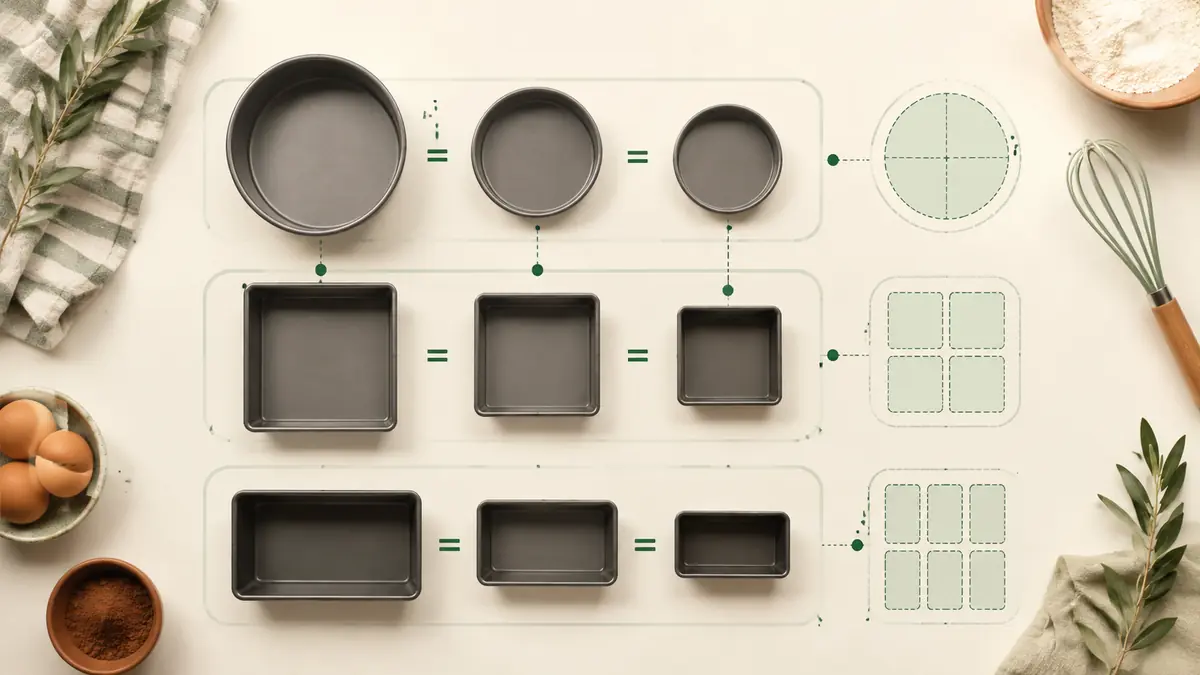
Compare cake pan shapes visually
Shape comparison
An 8 inch square is almost the same area as a 9 inch round
Different pan labels can hide very similar usable baking areas.
8 inch square64.0 in²
9 inch round63.6 in²
Cake pan size chart for common baking pans
| Pan | Shape | Depth | Baking area (in²) |
|---|---|---|---|
| 6" round | round | 2" | 28.3 |
| 7" round | round | 2" | 38.5 |
| 8" round | round | 2" | 50.3 |
| 9" round | round | 2" | 63.6 |
| 10" round | round | 2" | 78.5 |
| 12" round | round | 2" | 113.1 |
| 8" square | square | 2" | 64.0 |
| 9" square | square | 2" | 81.0 |
| 10" square | square | 2" | 100.0 |
| 9" × 13" rectangle | rectangle | 2" | 117.0 |
| 11" × 7" rectangle | rectangle | 2" | 77.0 |
| 10" × 15" rectangle | rectangle | 2" | 150.0 |
| 12" × 18" rectangle | rectangle | 2" | 216.0 |
| 13" × 18" rectangle | rectangle | 2" | 234.0 |
How to read a cake pan size chart
Start with baking area when you want the new cake to have a similar layer depth. A cake pan size chart is more useful than comparing only the number printed on the pan. Shape changes how much surface area the batter covers, so an 8 inch square can hold batter at nearly the same depth as a 9 inch round when both pans have similar usable depth.
The main attributes to compare are shape, inside dimensions, depth, baking area, and practical capacity. Round pans use diameter. Square pans use side length. Rectangular pans use length and width. A deeper pan adds headroom, but it does not automatically mean you need to make more batter.
Use the chart for a quick substitution and use the Cake Pan Conversion Calculator for a precise recipe factor. The calculator compares the total area of the original and target pans, includes pan count, and can warn when the new pan is too shallow for the amount of batter you plan to use.
8 inch vs 9 inch cake pan size
A 9 inch round pan is about 26.6% larger than an 8 inch round by baking area. An 8 inch round has about 50.3 square inches of area. A 9 inch round has about 63.6 square inches. That difference is larger than it may look when you place the pans side by side.
Use the same batter or scale it?
If you put an 8 inch cake recipe into a 9 inch round pan without changing the batter amount, the batter spreads over more surface. The finished cake will usually be a little shorter. It may also bake sooner because the layer is thinner.
Use about 1.27 times the original recipe when you want a similar cake height. This is a geometric scaling target, not a promise that every cake will behave exactly the same. Cake type, pan material, oven behavior, and batter structure still affect the final bake.
For example, a recipe with 200 g flour would need about 253 g flour at a 1.266 scale factor. The other scalable ingredients should use the same factor. If eggs become awkward, the Recipe Scaling Calculator can show a practical partial egg method.
8 inch square vs 9 inch round cake pan
An 8 inch square and a 9 inch round are almost the same size by baking area. The square has 64 square inches. The round has about 63.6 square inches. The difference is less than 1%, so these two pans are often a useful substitution pair when their depth is similar.
This is a good example of why shape matters. A square pan uses its corners, while a round pan does not. The 8 inch measurement sounds smaller, but the square shape gives it almost exactly the same surface area as a 9 inch circle.
When this substitution works best
This swap works best for standard cakes, brownies, bars, and similar batters that do not depend on a special pan shape. A chiffon cake, angel food cake, cheesecake, or decorative molded cake may need more specific pan guidance. A close area match does not remove recipe specific needs.
9 by 13 pan equivalent sizes
A 9 by 13 inch pan has 117 square inches of baking area. That makes it much larger than one 8 or 9 inch round pan. It is often compared with two round cake layers rather than one.
Two 9 inch rounds have about 127.2 square inches of total area. That is about 8.7% more than a 9 by 13 pan. If you divide the original 9 by 13 batter between two 9 inch rounds, the round layers will usually be slightly thinner than the original rectangular layer.
Two 8 inch rounds have about 100.6 square inches of total area. That is less than a 9 by 13 pan, so the same amount of batter would sit deeper in the two smaller rounds. Check depth carefully before assuming all the batter will fit.
If layer height matters for stacking or decorating, use the calculator instead of choosing a pan only because the dimensions look close. A cake batter scaling calculator turns these area differences into an ingredient factor that is easier to use.
Round cake pan sizes and area growth
Round cake pan area grows faster than diameter. A 10 inch pan is not just 25% larger than an 8 inch pan because area depends on the square of the radius. The 10 inch round has about 78.5 square inches compared with about 50.3 square inches for the 8 inch round.
An 8 inch to 10 inch cake conversion needs about 1.56 times the batter for a similar depth. This is a much larger change than the 8 inch to 9 inch conversion. If a recipe was designed for an 8 inch layer, simply moving it into a 10 inch pan without scaling will create a much thinner cake.
Common round pan sizes include 6, 7, 8, 9, 10, and 12 inches. Each step changes baking area by a different percentage. This is why a cake pan conversion chart is more reliable than adding a fixed amount of batter every time the diameter increases by one inch.
Square and rectangular baking pan sizes
Square pan area is side multiplied by side. An 8 inch square has 64 square inches. A 9 inch square has 81 square inches, so moving from 8 to 9 inches increases area by about 26.6%, the same ratio as moving from an 8 inch round to a 9 inch round.
Rectangular pan area is length multiplied by width. An 8 by 8 pan has 64 square inches. A 9 by 9 pan has 81 square inches. A 9 by 13 pan has 117 square inches. These simple area values help you compare brownies, tray cakes, snack cakes, and casseroles even when the shapes are different.
If your recipe uses a square pan and you only have a rectangle, compare total area first. Then check depth. A close area match can preserve batter depth, but a shallow target pan may still overflow if the sides do not give the batter enough room to rise.
Cake pan area and cake pan capacity are not the same
Area tells you how widely the batter spreads, while capacity tells you how much volume the pan can contain. Both attributes matter, but they answer different questions. Area is the best starting point when you want similar cake height. Capacity matters more when pan depth changes or the shape is complex.
A 9 inch round pan that is 3 inches deep has the same top area as a 9 inch round pan that is 2 inches deep. If you use the same amount of batter, the deeper pan does not make the cake taller by itself. It mainly gives you more headroom.
Use capacity for Bundt, tube, decorative, tapered, or novelty pans when a reliable capacity is available. These pans contain curves, center tubes, slopes, or molded details that a simple diameter formula cannot describe well. A listed cup or liter capacity is more meaningful than a rough outer dimension.
How much batter should go in a cake pan
Do not fill a cake pan to its geometric maximum. Cake batter needs room to rise. The usable batter amount depends on cake style, pan depth, leavening, and the guidance that comes with the recipe or pan.
A pan capacity chart may tell you how much liquid the pan can physically hold, but that is not the same as a safe cake batter fill level. Leave headroom and follow tested recipe guidance when available. If the calculated batter seems too deep for the target pan, divide it between more pans or reserve some batter for cupcakes.
A shallow target pan deserves extra care even when the area looks correct. The same surface area does not protect against overflow. This is one reason KitchenMathHub keeps depth as a separate pan attribute rather than treating every equal area pan as identical.
Cake baking time after changing pan size
Do not multiply baking time by the cake pan scale factor. Ingredient scaling and heat transfer follow different rules. A recipe factor of 1.27 does not mean a 30 minute bake should become 38 minutes.
If you scale the batter so the new pan keeps a similar depth, the original bake window is often a useful place to begin checking. The exact time can still change because of pan material, oven calibration, batter formula, pan color, and the way heat moves through the cake.
A thinner cake often finishes earlier. If you move the same batter into a larger pan without scaling, start checking before the original recipe's final time. A deeper layer can take longer. Use visual cues, touch, internal structure, or another doneness method appropriate to the recipe instead of relying only on the clock.
How to measure a cake pan correctly
Measure the inside baking space. For a round pan, measure the inside diameter from one inner wall to the opposite inner wall. For a square or rectangle, measure the usable inside length and width.
Measure depth from the inside base to the usable top edge. Do not include a decorative outer rim that does not hold batter. Small measurement errors can matter more on smaller pans because the area changes with the dimensions.
If the pan has sloped sides, a center tube, or a highly decorative shape, use a manufacturer capacity when possible. The simple area chart is strongest for straight sided pans with clear inside dimensions.
A practical cake pan substitution workflow
Step 1: identify the original pan
Write down its shape, inside dimensions, depth, and number of pans. If the recipe says two 8 inch rounds, the count of two is part of the original baking area.
Step 2: identify the pan you have
Measure the target pan the same way. If it is a specialty pan, look for a stated capacity instead of estimating from the outside shape.
Step 3: compare total area
A close total area often means the original batter amount can work with only a small change in layer height. A large difference means recipe scaling becomes more important.
Step 4: check depth and headroom
Make sure the target pan can safely contain the batter as it rises. Area tells you spread. Depth tells you available vertical space.
Step 5: scale the full recipe if needed
Use the Cake Pan Conversion Calculator to get the factor, then apply it to the ingredients. If you are also changing servings or units, the Recipe Converter can keep those changes together without making you repeat the math.
Questions about cake pan sizes
What pan is close to a 9 inch round?
An 8 inch square is a very close match by baking area. It has 64 square inches, while a 9 inch round has about 63.6 square inches.
How much larger is a 9 inch round than an 8 inch round?
A 9 inch round has about 26.6% more baking area. Use about 1.27 times the batter for a similar layer depth.
How much larger is a 10 inch round than an 8 inch round?
A 10 inch round has about 56.3% more area. A similar depth needs about 1.56 times the batter.
Is an 8 inch square the same as a 9 inch round?
They are almost equal by surface area when their depth is similar. That makes them useful substitutes for many standard cakes.
What is the area of a 9 by 13 pan?
A 9 by 13 inch rectangle has 117 square inches of baking area.
Can I replace a 9 by 13 pan with two 9 inch rounds?
Yes, but the two rounds have about 8.7% more total area. The same batter will usually make slightly thinner layers.
Should I compare cake pans by area or capacity?
Use area first when you want a similar batter depth in straight sided pans. Use capacity when depth or pan shape changes a lot.
Does a deeper pan need more batter?
Not always. A deeper pan can simply give the same batter more headroom if the footprint stays the same.
Can I compare more than one cake pan?
Yes. Add the area of all original pans and compare it with the total area of all target pans.
Does pan size change baking time?
It can. A thinner layer often bakes faster, while a deeper layer can take longer, so do not multiply time by the batter scale factor.
Should I measure the inside of a cake pan?
Yes. Measure the usable inside dimensions where the batter sits, not the outside rim or handles.
Are Bundt pans compared by diameter?
Capacity is usually more useful for Bundt and decorative pans because their internal shapes are not simple cylinders.
Calculation transparency
Read methodologyHow to interpret this result
Result typeGeometry + baking guidance
Calculation basisPan area, depth, count, and practical capacity checks
Sources shown2
Latest source reviewAug 11, 2026
Pan area can scale batter for similar depth. Baking time is reviewed separately because heat transfer does not scale by the same factor.
Sources and methodology
These are the references used for data, conventions, safety targets, or calculation context on this page. Review dates show when KitchenMathHub last checked the cited source.
King Arthur BakingWhy the size of your baking pan matters so muchUsed for established culinary measurements, baking methods, or formula guidance.
Open source ↗