King Arthur BakingIngredient Weight ChartUsed for established culinary measurements, baking methods, or formula guidance.
Open source ↗Cups to Grams Calculator
Convert cups to grams with ingredient specific culinary references. Choose the ingredient first because a cup of flour, sugar, butter, oats, or honey does not have the same mass.
All-Purpose Flour
Ingredient-specific culinary reference. Volume-to-weight values are not universal across foods.
Result
120 g
1 cup all-purpose flour
Reference usedhigh confidence
Published measure1 US cup = 120 gSourceKing Arthur BakingMethodPublished culinary volume/weight equivalencyReviewedAug 11, 2026
Show calculation
Reference
1 cup-us = 120 gConverted amount
1 cup-us → 120 g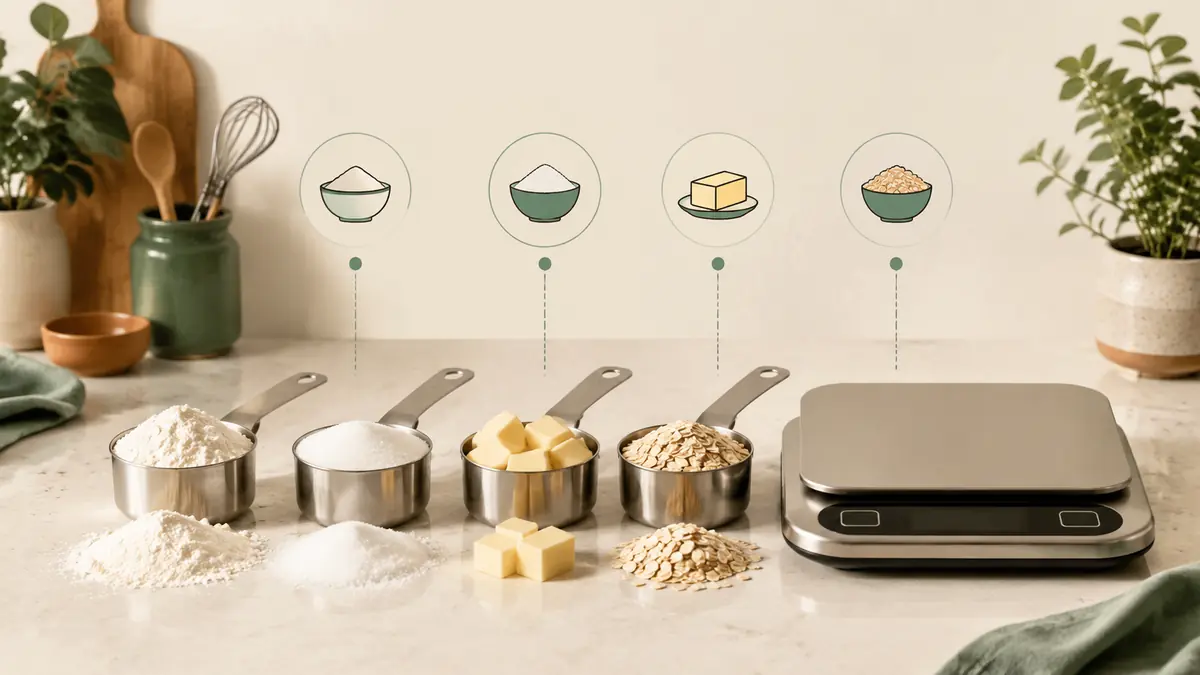
See why cups need ingredient specific gram values
Volume versus mass
The same cup volume can hold very different gram weights
Cups measure space. Grams measure mass. The ingredient decides the relationship.
1 US cupAll-purpose flour120 g
1 US cupGranulated sugar198 g
1 US cupRolled oats89 g
1 US cupHoney336 g
Cups to grams conversion starts with the ingredient
A cups to grams calculator must know the ingredient before it can give you a useful answer. Cups measure how much space an ingredient takes up. Grams measure how much that ingredient weighs. Those are different properties, so there is no honest rule such as “1 cup always equals 200 grams.”
1 cup of all purpose flour is about 120 g in the KitchenMathHub default reference, while 1 cup of granulated sugar is about 198 g. The cup volume is the same, but sugar has more mass inside that volume. Butter, cocoa powder, oats, brown sugar, and honey all need their own values too.
This ingredient first method is useful when you convert baking cups to grams. Baking recipes often mix ingredients with very different textures. Flour is light and can trap air. Brown sugar is often packed. Honey is dense and flows into the whole measuring space. A universal cup to gram conversion would ignore these differences.
Choose the ingredient, then enter the cup amount
Start by selecting the exact ingredient that matches your recipe. Then enter 1 cup, 1/2 cup, 1 1/2 cups, or another amount. The calculator uses the selected culinary weight reference to calculate the result.
If your recipe says “2 cups all purpose flour,” choose all purpose flour rather than a generic flour category. If it says “1 cup packed brown sugar,” use the brown sugar reference that matches that state. The ingredient name and preparation can both affect the final weight.
Common cup to gram conversion examples
| Ingredient | 1 US cup | Useful context |
|---|---|---|
| All purpose flour | 120 g | Light, compressible ingredient |
| Granulated sugar | 198 g | Denser than flour |
| Packed brown sugar | 213 g | Packing state matters |
| Butter | 226 g | Derived from 113 g per 1/2 cup |
| Powdered sugar, unsifted | 113 g | Sifting changes volume |
| Unsweetened cocoa powder | 84 g | Derived from 42 g per 1/2 cup |
| Rolled oats | 89 g | Loose dry ingredient |
| Honey | 336 g | Derived from 21 g per tablespoon |
These examples show why cup weight by ingredient matters. One cup of honey is much heavier than one cup of rolled oats. One cup of sugar is also much heavier than one cup of flour. The calculator uses the ingredient record instead of treating all cups as equal in mass.
Use the table as a quick reference, but use the calculator for fractions and unusual amounts. If you need 2 1/3 cups flour or 3/4 cup cocoa powder, enter that quantity rather than trying to scale the table in your head.
How to convert flour cups to grams
To convert flour cups to grams, multiply the cup quantity by the flour reference used for that flour type. KitchenMathHub uses 120 g per US cup for its default all purpose flour reference.
For example, 2 cups of all purpose flour becomes 240 g. A half cup becomes 60 g. One and a half cups becomes 180 g. The arithmetic is simple once you have the correct ingredient value.
The measuring method can still change how much flour is physically inside your cup. Flour can compress when you scoop directly into a bag or push it firmly into the measuring cup. A volume measurement that contains more packed flour will weigh more than the reference amount.
Why flour converters can disagree
Two flour cups to grams converters can disagree because they may use different published standards. One source may define its recipe cup of flour at 120 g, while another recipe developer may use a different value based on its own measuring method. KitchenMathHub does not hide that issue. It uses a declared source and keeps the reference visible.
If you bake from a recipe publisher that gives its own gram measurements, use those gram values when possible. They reflect the way that recipe was developed. Use this calculator when the recipe only gives cups or when you need to convert a quantity that is not already listed by weight.
How to convert sugar, butter, and other baking cups to grams
Sugar cups to grams use a different reference from flour because granulated sugar is denser. The KitchenMathHub default uses 198 g per US cup of granulated sugar. Two cups therefore become about 396 g.
Butter cups to grams are especially easy when the source gives a standard half cup weight. The reference used here is 113 g per half cup, which gives about 226 g per full cup. This also makes quarter and three quarter cup conversions simple to calculate.
Brown sugar needs its own conversion because recipes often call for it packed. Packing removes more air spaces and puts more sugar into the same cup volume. The default packed brown sugar reference is 213 g per cup.
Powdered sugar needs a state label because sifted and unsifted sugar can occupy volume differently. KitchenMathHub keeps ingredient variants separate when a useful source distinguishes them. That is more reliable than placing every form of one ingredient under a single number.
Cocoa powder and oats
Cocoa powder and oats show how light dry ingredients can have very different cup weights. The default unsweetened cocoa reference works out to about 84 g per cup, while rolled oats use about 89 g per cup. Both are much lighter by volume than granulated sugar.
US cups to grams and metric cups to grams are different
A US cup and a metric cup do not represent the same volume. KitchenMathHub uses a practical US culinary cup of about 240 mL as its default for US recipe conversions. A metric cup is commonly 250 mL.
A 250 mL metric cup holds about 4 percent more volume than a 240 mL US cup. That difference can matter when you convert several cups of a dense ingredient. The advanced cup setting exists so the calculator does not silently treat both standards as identical.
Australian recipes can also use a 20 mL tablespoon, which differs from the common 15 mL tablespoon used in many other systems. This matters when a recipe mixes cups and tablespoons. Kitchen measurements look simple on the page, but regional standards can change the actual volume.
If you are converting an American recipe to metric, start with the US setting. If you are working from a recipe that clearly uses metric cups, choose the metric standard. The source recipe should decide the measurement system, not your current location.
Use cups to grams when a scale gives you a better result
Weight is often easier to repeat for dry baking ingredients. You can place a bowl on a kitchen scale, tare it to zero, and add flour until the display reaches the required grams. This avoids filling and leveling several cups.
Grams are especially useful when you scale a recipe up or down. A quantity such as 1 5/8 cups is measurable, but 195 g may be quicker to weigh and easier to repeat. This is one reason recipe scaling and cups to grams conversion work well together.
A scale also helps with ingredients that pack differently each time. Flour and powdered sugar can settle. Brown sugar can be loosely filled or tightly packed. Weight gives you one clear target once the recipe standard is known.
When volume is still useful
Volume can still be practical for water, milk, oil, vanilla, and other liquids. A metric recipe may convert a cup of milk to milliliters rather than grams because the user can measure that liquid directly in a jug. KitchenMathHub keeps mass and volume as separate dimensions so the result stays practical for the ingredient.
Convert recipe cups to grams without losing ingredient meaning
A full recipe should not convert every cup with the same multiplier. If a recipe contains 2 cups flour, 1 cup sugar, 1 cup milk, and 1/2 cup butter, each line needs its own conversion logic.
Flour and sugar usually benefit from ingredient specific gram references. Butter can use its standard culinary weight. Milk may be clearer as milliliters in a practical metric recipe. Eggs should remain a count unless recipe scaling creates a partial egg.
The Recipe Converter handles these differences across a complete ingredient list. It can recognize common ingredients, preserve notes such as “packed” or “sifted,” and choose a practical metric output instead of turning every measurement into a raw number.
The Recipe Scaling Calculator is useful when you also need more or fewer servings. Scale the recipe from its original yield, then convert the final ingredient quantities from cups to grams. KitchenMathHub calculates from the original normalized values so rounding does not build up between steps.
Worked cups to grams examples
Example: 2 1/2 cups all purpose flour
2 1/2 cups of all purpose flour is about 300 g with the 120 g per cup default. The calculation is 2.5 × 120 = 300 g. This is a good example of why grams can be easier when a scaled recipe produces a mixed fraction.
Example: 3/4 cup granulated sugar
3/4 cup of granulated sugar is about 149 g with the 198 g per cup reference. The raw calculation is 148.5 g, which can be shown as a practical rounded kitchen value.
Example: 1/2 cup butter
1/2 cup butter is about 113 g. This is a direct published reference in the source chart used by KitchenMathHub, so there is no need to derive it from a generic density.
Example: 1/3 cup packed brown sugar
1/3 cup packed brown sugar is about 71 g with the 213 g per cup reference. The word “packed” matters because the state of the ingredient is part of the measurement.
Why ingredient state matters in cup to gram conversion
An ingredient can change cup weight when its preparation changes. Chopped nuts occupy a cup differently from whole nuts. Sifted powdered sugar occupies volume differently from unsifted powdered sugar. Packed brown sugar has fewer air spaces than loosely filled sugar.
KitchenMathHub treats these states as ingredient variants when the reference data supports them. This is part of semantic ingredient matching. The ingredient is not only a name. It can also have attributes such as chopped, sliced, packed, sifted, melted, cooked, or raw.
If the calculator cannot match the exact ingredient state, do not assume a precise gram value. Choose the closest validated option only when it makes sense for your recipe. A careful approximate answer is better than a confident number based on the wrong form of the food.
How to get a more repeatable baking measurement
Use the gram value from the same reference system throughout one recipe when possible. Mixing several standards can change ingredient ratios even when each individual source looks reasonable.
Keep the original recipe's own weight values when it already provides them. A recipe author may have developed the formula with a specific flour weight, sugar weight, and cup method. The original grams are more direct than converting the cups back through another standard.
Use cups to grams conversion when the recipe does not give weight or when you need a new scaled amount. This is where the tool provides the most value. It turns a volume amount into a practical mass value while keeping the ingredient and source context visible.
If you need the conversion in reverse, use the Grams to Cups Calculator. If you need standard kitchen relationships such as teaspoons, tablespoons, cups, milliliters, ounces, and pounds, use the Cooking Measurement Chart.
Common cups to grams questions
How many grams are in one cup?
There is no single gram value for one cup of food. A cup measures volume, while grams measure mass, so flour, sugar, butter, oats, honey, and other ingredients need their own weight reference.
How many grams are in 1 cup of all purpose flour?
KitchenMathHub uses 120 g for 1 US cup of all purpose flour in its default reference. Flour can weigh more when it is packed firmly into the cup, so the measuring method still matters.
How many grams are in 1 cup of granulated sugar?
The default KitchenMathHub reference uses 198 g for 1 US cup of granulated sugar. Sugar packs more densely than flour, which is why the two ingredients have different cup weights.
How many grams are in 1 cup of butter?
1 US cup of butter is about 226 g in the default reference. The source value is 113 g per half cup, so a full cup is twice that amount.
Why do cups to grams converters give different answers?
Different converters can use different ingredient standards, cup sizes, and measuring methods. KitchenMathHub keeps the source attached to each important conversion instead of averaging several conflicting values into one number.
Does a packed cup weigh more?
A packed cup can weigh more when the ingredient compresses. Brown sugar, powdered sugar, flour, chopped nuts, and similar foods can change weight depending on how they are filled, packed, sifted, or chopped.
Is a US cup the same as a metric cup?
A US culinary cup and a metric cup are not the same volume. KitchenMathHub uses the practical 240 mL US cup reference by default, while a metric cup is commonly 250 mL.
Should I convert dry ingredients to grams for baking?
Grams are often easier to repeat accurately for flour, sugar, cocoa, oats, and other dry baking ingredients. A scale measures mass directly and avoids part of the variation caused by filling a cup differently each time.
Can I convert half a cup or a third of a cup to grams?
Yes, enter any practical cup amount and choose the ingredient. The calculator multiplies your quantity by the selected ingredient reference, so fractions such as 1/2, 1/3, and 3/4 work with the same method.
Can I convert a whole recipe from cups to grams?
Yes, use the Recipe Converter when you have several ingredients to change at once. It can recognize common ingredients, keep liquid measurements practical, and convert dry ingredients with ingredient specific weight references.
Calculation transparency
Read methodologyHow to interpret this result
Result typeIngredient-specific reference
Calculation basisPublished culinary volume and weight equivalencies
Sources shown2
Latest source reviewAug 11, 2026
Cup-to-weight values depend on the ingredient and its state. A recipe author's tested gram value should take priority when the recipe provides one.
Sources and methodology
These are the references used for data, conventions, safety targets, or calculation context on this page. Review dates show when KitchenMathHub last checked the cited source.
National Institute of Standards and TechnologyMetric Kitchen: Cooking Measurement EquivalenciesUsed for defined measurement guidance or public food-safety guidance where applicable.
Open source ↗