Mid and East Antrim Borough CouncilAir Fryer CookbookUsed for defined measurement guidance or public food-safety guidance where applicable.
Open source ↗Oven, Air Fryer and Microwave Tools
Convert oven temperatures, fan settings, air fryer cooking times, and microwave wattage in one appliance-math hub. Use food specific guidance whenever thickness, load, package directions, or food safety can change the result.
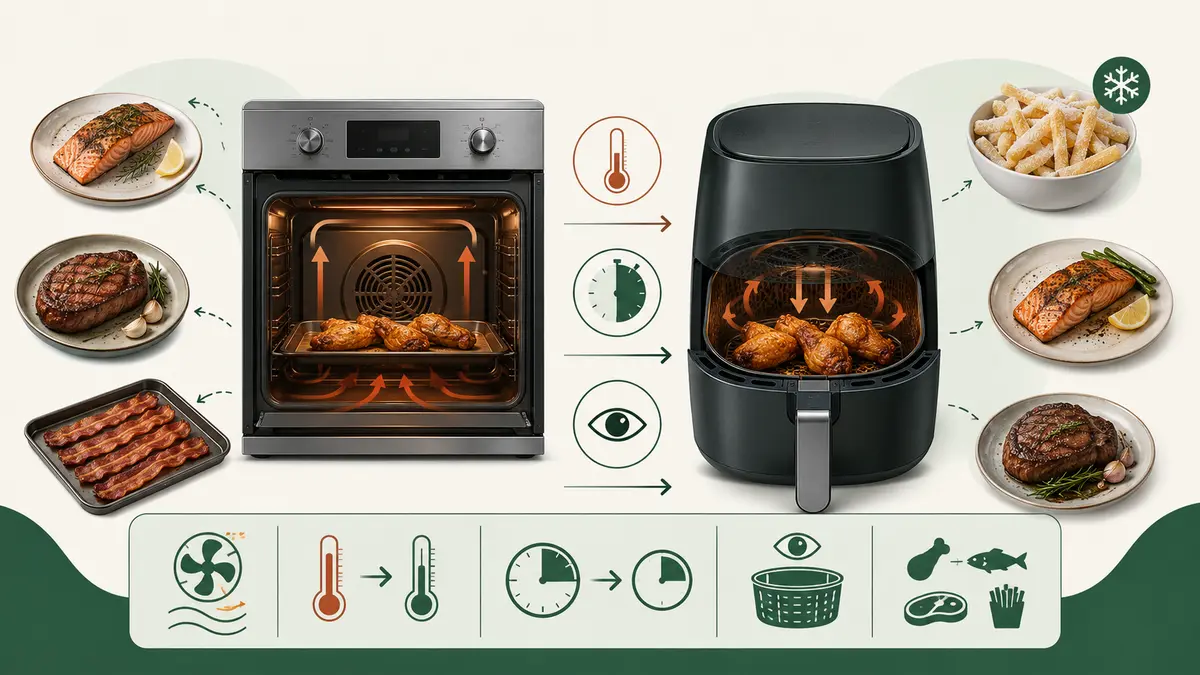
Oven, air fryer, and microwave tools for time and temperature
Oven to Air Fryer Calculator
Enter oven temperature and time, then refine the air fryer starting point with food and appliance details.
Best for adapting a specific oven recipe.Air Fryer Conversion Chart
See common oven temperature and time starting points in one quick reference.
Best for a fast general conversion.Oven Temperature Converter
Convert Celsius, Fahrenheit, fan oven settings, and Gas Mark values.
Best for oven scale conversion.Fan Oven Converter
Convert conventional recipe temperatures to common fan oven settings.
Best for conventional to fan recipes.Microwave Wattage Converter
Adjust microwave cooking time when recipe wattage and appliance wattage differ.
Best for 600W, 700W, 900W, 1000W, 1200W, and custom ratings.Chicken Wings Air Fryer
Use wing specific time, temperature, shake guidance, and poultry safety information.
Best for fresh or frozen wings.Frozen Fries Air Fryer
Use fry specific guidance for basket load, shaking, crispness, and early checking.
Best for packaged frozen fries.Appliance conversion research guides
Microwave wattage is a different conversion problem
The Microwave Wattage Converter adjusts cooking time when a recipe and microwave use different nominal wattages. It uses the wattage ratio to calculate an energy-equivalent starting time, then keeps stirring, standing time, package directions, and food-safety checks separate from the arithmetic.
Do not apply the oven-to-air-fryer rule to a microwave. Air fryer conversion is about moving hot air, food exposure, and appliance geometry. Microwave wattage conversion is about nominal microwave power and time. They belong in the same appliance hub but use different calculation engines.
Start with the right type of oven conversion
Conventional oven to air fryer conversion needs a different starting rule from fan oven to air fryer conversion. A conventional oven heats a larger chamber with less concentrated airflow around the food. A fan oven already moves hot air. An air fryer moves hot air through a smaller cooking space, often very close to the food.
A common general starting point for a conventional oven recipe is about 25°F lower and around 20% less time. This is a starting convention, not a promise. A 400°F oven recipe might begin near 375°F in the air fryer. A 30 minute oven time might begin with an estimated 24 minute air fryer time and an earlier check.
Food specific guidance should override a generic conversion when you have it. Chicken wings may benefit from a hotter profile for crisp skin. Frozen fries depend heavily on basket load and fry cut. Steak needs thickness and doneness context. A generic formula cannot see these food attributes unless the user supplies them.
Oven to air fryer temperature conversion
400°F conventional oven commonly starts near 375°F in a general air fryer conversion. That does not mean every 400°F recipe belongs at exactly 375°F. Breaded food, delicate pastries, thick meat, frozen products, and foods that depend on surface browning can need different choices.
350°F conventional oven commonly starts near 325°F in a general air fryer conversion. Use the Oven to Air Fryer Calculator when you have an exact oven recipe and want the temperature, estimated time, early check point, and food specific options in one result.
Use Celsius when the source recipe is written in Celsius. You do not need to convert to Fahrenheit first. The engine can normalize the temperature internally and then display a practical air fryer setting in the unit you prefer.
Do not reduce a fan oven temperature twice. If a recipe already says 180°C fan, it is already using a moving air oven convention. Treating it as 200°C conventional and subtracting again can make the air fryer starting point too low.
Oven to air fryer time conversion and check time
Thirty oven minutes commonly gives about 24 air fryer minutes as a general starting estimate. The more useful number is usually the check time. If the tool estimates 24 minutes, it may tell you to inspect the food several minutes earlier so you can respond to real browning and doneness.
Air fryer cooking time is strongly affected by food thickness and basket load. Two thin chicken cutlets can finish much sooner than one thick breast even if their total weight is similar. A single layer of fries can crisp faster than a crowded basket containing the same product.
Frozen state can change both time and surface moisture. Frozen food may release water or ice early in cooking. Package instructions are especially valuable because the manufacturer may have tested the exact product shape, coating, and portion size.
Do not treat 20% faster as a law. It is a convenient first estimate for some oven recipes. Real air fryer performance changes with wattage, basket design, food load, preheating, and how often the basket is opened.
Conventional oven, fan oven, Celsius, Fahrenheit, and Gas Mark
Exact Fahrenheit to Celsius math and practical oven settings are not always the same displayed number. Mathematically, 350°F is about 176.7°C. Many recipes use 180°C as the practical conventional oven equivalent because home ovens are set in convenient increments.
A common conventional to fan oven convention uses about 20°C less. A 200°C conventional recipe often appears as about 180°C fan in common UK cooking guidance. Your appliance can behave differently, so follow the oven manual when it gives a specific fan adjustment.
Gas Mark should be treated as a practical cooking scale. Use the Oven Temperature Converter for Celsius, Fahrenheit, fan, and Gas Mark comparisons rather than inventing a decimal Gas Mark that no oven control uses.
Air fryer food guides for common recipes
Chicken Breast
Thickness, fresh or frozen state, and poultry safety matter.
Chicken Wings
Airflow, skin crispness, shaking, and safe internal temperature matter.
Salmon
Fillet thickness, skin, and fresh or frozen state affect the time.
Steak
Cut, thickness, doneness preference, rest time, and safety guidance are separate inputs.
Bacon
Slice thickness, grease, smoke, and desired crispness affect cooking.
Frozen Fries
Fry cut, basket load, shaking, and package guidance affect crispness.
Chicken breast and chicken wings in an air fryer
Chicken breast cooking time depends heavily on thickness. A thin breast and a thick breast should not share one guaranteed time. Use the food page as a starting range and check the thickest part with a thermometer.
Chicken wings need airflow around the skin for better crispness. Crowding, surface moisture, sauce, and whether the wings are whole or split can change texture and time. Shaking or turning the wings helps expose more surface to moving air.
Poultry should reach 165°F or 74°C internally. Brown skin or a crisp coating does not prove the center is safely cooked. Use a thermometer in the thickest meaty part without touching bone when checking raw poultry.
Salmon and steak air fryer timing
Salmon fillet thickness matters more than a single universal salmon time. A thin tail piece can finish much sooner than a thick center cut. Skin on and skinless fillets can also brown differently where they contact the basket.
Fish should reach the appropriate safe internal temperature when food safety guidance applies. The salmon page keeps the official fish safety target visible while explaining that texture preferences and carryover cooking can affect when a user chooses to remove the food.
Steak doneness preference and official safety guidance are separate concepts. A user may prefer a certain center color or temperature, but KitchenMathHub does not present personal doneness preference as a replacement for food safety guidance.
Resting steak can affect the final temperature and juiciness. Use thickness, cut, air fryer behavior, and thermometer readings instead of relying only on a fixed minute count.
Frozen fries, bacon, and basket load
Frozen fries need space for hot air to reach the surfaces. A deep crowded basket traps steam and leaves more contact points between fries. Shaking redistributes the food and exposes paler surfaces.
Fry cut changes the useful time range. Shoestring fries, regular fries, crinkle cuts, and steak fries have different thickness. Package air fryer directions should take priority when they exist for the exact product.
Bacon cooking time depends on slice thickness and desired crispness. Grease can collect quickly, and some air fryers may smoke if rendered fat reaches a hot surface. Follow the appliance guidance for grease management and safe cleaning.
When a generic air fryer conversion is not enough
Large roasts and whole birds are not simple 20% time conversions. Food size, center temperature, air circulation, and appliance capacity matter too much for a single general formula.
Wet batter can behave poorly in an open air fryer basket. Airflow can move loose batter before it sets. Foods that need a deep layer of liquid or a covered cooking environment may also require a different method.
Delicate baked goods can depend on stable oven heat and pan geometry. Souffles, some cakes, meringues, and covered casseroles may not be good candidates for a basic oven to air fryer rule.
Use an early check instead of forcing a precise finish time. The goal of the calculator is to give a practical starting point that responds to real food, not to pretend two different appliances cook identically.
A practical oven to air fryer workflow
1. Enter the original oven setting
Use the temperature, time, and source oven type from the recipe. Keep conventional and fan oven inputs distinct.
2. Select the food when possible
Food type can add a better starting range, flip or shake guidance, fresh or frozen context, and food safety information.
3. Start with the calculated setting
Use the result as the beginning of the cook, not as an exact guarantee.
4. Check early
Inspect browning, texture, and internal temperature before the estimated finish time.
5. Record what works in your appliance
Once you know that your own air fryer runs hotter, cooler, faster, or slower for a particular food, that real experience is more useful than repeating a generic formula.
Questions about cooking appliance conversions
How do I convert an oven recipe to an air fryer?
Start with a lower temperature and shorter time, then refine the result with food type, thickness, frozen state, basket load, and an early check.
What is 400°F oven in an air fryer?
A common general starting point is around 375°F for a conventional oven recipe, but food specific guidance can use a different temperature.
How long is 30 oven minutes in an air fryer?
A general 20% time reduction gives about 24 minutes, but the useful result is an early check point rather than a guaranteed finish time.
Is fan oven conversion the same as conventional oven conversion?
No. A fan oven already uses moving air, so it should not receive the same automatic temperature reduction as a conventional oven.
Can I convert Fahrenheit to Celsius for an oven?
Yes. The Oven Temperature Converter shows both exact math and practical recipe settings.
What is 200°C conventional in a fan oven?
A common recipe convention is about 180°C fan, although appliance guidance can differ.
How long do chicken wings take in an air fryer?
KitchenMathHub starts chicken wings near a food specific time range and recommends checking, turning or shaking, and confirming safe internal temperature.
Can I air fry frozen food?
Many frozen foods work well in an air fryer, but package directions and food specific guidance should take priority over a generic oven conversion.
Should I preheat an air fryer?
Follow the appliance and recipe guidance because preheating recommendations vary by model and food.
Does an air fryer cook everything 20% faster?
No. A 20% reduction is only a general starting convention. Food size, load, moisture, thickness, and appliance design can change the real time.
How do I adjust microwave time for a different wattage?
Multiply the original time by the recipe wattage and divide by your microwave wattage, then treat that result as a starting estimate and follow package or safety instructions.
Calculation transparency
Read methodologyHow to interpret this result
Result typeReference resource
Calculation basisDeclared methods and cited culinary or measurement sources
Sources shown7
Latest source reviewAug 15, 2026
Sources and assumptions are shown so you can judge whether a reference fits your recipe or kitchen situation.
Sources and methodology
These are the references used for data, conventions, safety targets, or calculation context on this page. Review dates show when KitchenMathHub last checked the cited source.
North Lanarkshire CouncilChicken nuggets recipe oven temperature equivalenciesUsed for defined measurement guidance or public food-safety guidance where applicable.
Open source ↗FoodSafety.govCook to a Safe Minimum Internal TemperatureUsed for defined measurement guidance or public food-safety guidance where applicable.
Open source ↗USDA Food Safety and Inspection ServiceAir Fryers and Food SafetyUsed for defined measurement guidance or public food-safety guidance where applicable.
Open source ↗Instant PotInstant Vortex Plus Air FryerUsed for product or appliance-specific guidance where the manufacturer is the relevant authority.
Open source ↗Ninja Test KitchenAir Fryer Recipes and Cooking GuidanceUsed for product or appliance-specific guidance where the manufacturer is the relevant authority.
Open source ↗USDA Food Safety and Inspection ServiceCooking with Microwave OvensUsed for defined measurement guidance or public food-safety guidance where applicable.
Open source ↗