Instant PotCooking Time TablesUsed for product or appliance-specific guidance where the manufacturer is the relevant authority.
Open source ↗Salmon Fillet Air Fryer Time & Temperature
Cook salmon in the air fryer with a personalized starting range based on fresh or frozen state, fillet thickness, and skin status. Start around the food profile temperature and verify the thickest part reaches the 145°F or 63°C safety reference for fish.
Personalize this food estimate
Salmon Fillet personalized starting point
390°F
200°C · 8 to 12 min
Use this as a starting pointAir fryer model, food thickness, basket load, and starting temperature can change the real cooking time. Check food early.
Verify safe internal temperatureUse a food thermometer. The safety target for this food is 145°F / 63°C.
Show calculation
Food-specific baseline
The Salmon Fillet profile supplies the starting temperature, time range, and early check point.
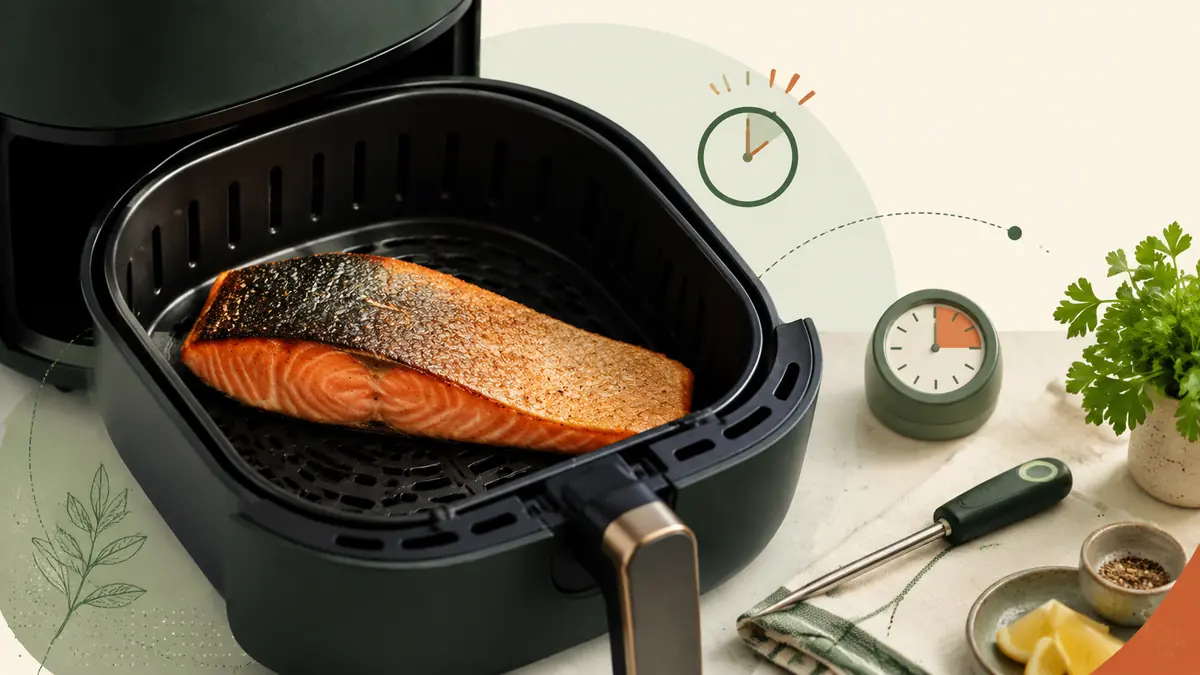
Salmon Fillet starting guide
| Setting | Guidance |
|---|---|
| Temperature | 390°F / 199°C |
| Time range | 8 to 12 minutes |
| Start checking | 8 minutes |
| Turn / shake | Usually no flip is required for a skin-side-down fillet; check early if thin. |
| Safety target | 145°F / 63°C |
Personalize the salmon fillet air fryer estimate
The salmon calculator now uses fillet thickness, fresh or frozen state, and skin status to make the starting plan more relevant. The result remains a starting range because air fryer power, basket design, food geometry, and starting temperature can still change the real finish time.
- Enter the thickest point of the fillet rather than measuring the thin tail end.
- Choose fresh or frozen so the estimate does not treat both starting conditions as identical.
- Choose skin on or skinless for handling guidance. The thermometer still goes into the thickest portion of the fish.
Use the early check as part of the calculation, not as an optional extra. A smart estimate is most useful when you check before the expected finish and then use temperature, browning, or texture to decide whether the food needs more time.
Salmon air fryer time and temperature
Salmon fillets usually need about 8 to 12 minutes in the air fryer at around 390°F. Start checking at 8 minutes. A thin tail piece can finish near the start of the range, while a thick center cut salmon fillet can need more time.
The best salmon air fryer time depends more on thickness than total weight. A wide, thin fillet may weigh the same as a narrow, thick fillet, but heat reaches the center of the thin piece faster. This is why the calculator gives you a time range and an early check point instead of one fixed finish time.
FoodSafety.gov lists 145°F or 63°C as the safe minimum internal temperature for fish such as salmon. Use a food thermometer in the thickest part of the fillet when you want a clear safety check. The agency also notes that fish can be checked for opaque flesh that separates easily with a fork.
Air fryer salmon at 390°F
390°F is a useful starting temperature for air fryer salmon. It gives the outside enough heat to cook quickly without forcing every fillet into the highest air fryer setting. Use the 8 minute check as your first look, then continue in short intervals if the center still needs time.
Air fryer salmon at 400°F
400°F can work well for a thick salmon fillet when you want faster surface browning. The hotter setting also gives you less room for error with thin pieces. Check early if the fillet is under one inch thick or tapers sharply at one end.
How to cook a salmon fillet in the air fryer
Place a salmon fillet in a way that lets hot air move around the exposed surface. If the salmon has skin, skin side down is a practical position because the flesh stays exposed to the moving air and the fillet is less likely to break from an unnecessary flip.
A skin on salmon fillet usually does not need to be flipped. The calculator reflects that approach in its handling guidance. If your air fryer heats unevenly, rotate the basket or the fillet only when your appliance instructions allow it.
Seasoning changes flavor, but thickness still controls much of the cooking time. A dry spice rub, lemon, herbs, or a light glaze can all work. Watch sugary glazes near the end because sugar can darken quickly at 390°F or 400°F.
Use the thickest part as your check point
Check doneness in the thickest part of the salmon, not the thin tail. The tail often cooks first. If one fillet has a very thin end, that part may become firm before the center is ready.
Fresh salmon and frozen salmon need different timing
Fresh or fully thawed salmon usually cooks faster than frozen salmon. The 8 to 12 minute profile is most useful as a starting range for a typical fresh fillet. A frozen portion first needs enough time for the center to thaw and then cook.
Frozen salmon can cook in an air fryer, but you should not assume the fresh salmon time will be enough. Follow package air fryer directions when they are available. If the package only gives oven instructions, use the calculator as a starting point and verify the center before serving.
Separate frozen salmon portions before cooking whenever the product allows it. Two pieces frozen together act like one thick block and can cook unevenly. Air needs access to the individual surfaces for a more even result.
Frozen salmon with sauce or glaze
Add a sugary glaze with care because the outside can brown before a frozen center is ready. If your recipe allows it, cook the salmon until it has partly heated through, then add the glaze later so you can control browning more easily.
How salmon thickness changes air fryer cooking time
Thick salmon needs more time because heat has farther to travel to the center. This is the main reason a salmon air fryer calculator should give you a range instead of promising that every fillet is done in 10 minutes.
A one inch center cut fillet can behave very differently from a thin tail piece. Start all pieces with the same early check only if they are similar in size. If one piece is much thinner, check or remove it first.
Cooking several salmon fillets can also change the result if the basket becomes crowded. Leave enough open space for moving air. If your basket cannot hold the pieces comfortably, two batches can give you a more even result than one packed batch.
How to know when air fryer salmon is done
A thermometer gives the clearest safety check for salmon. FoodSafety.gov lists 145°F or 63°C for fish. Put the thermometer into the thickest part and avoid pushing the probe all the way through to the hot basket.
Opaque flesh that separates easily with a fork is another common doneness cue for fish. Use visual texture as supporting information, not as a reason to ignore temperature when you need a reliable safety check.
Do not keep cooking salmon just because the maximum time on a chart has not passed. If the fish has reached the result you need earlier, remove it. Fixed time is a planning tool, while temperature and texture tell you what happened to the actual fillet.
Convert an oven salmon recipe to the air fryer
You can convert an oven salmon recipe by entering the original temperature and time with salmon selected. The calculator combines the general oven conversion with the salmon profile so you get a more useful starting point.
An oven recipe that says 400°F does not mean the air fryer must also use 400°F for the same number of minutes. An air fryer moves hot air through a small chamber, so many oven recipes need a lower temperature, less time, or both. Salmon also cooks quickly enough that an early check matters more than a simple percentage rule.
Use 390°F and the 8 to 12 minute salmon range as a starting reference, then compare it with your original recipe. A very thick oven roasted portion may still need more time. A thin oven fillet may need less.
When the original recipe uses a fan oven
Fan oven instructions already use moving air, so they need different handling from conventional oven instructions. Select the correct source oven type in the converter. This prevents the tool from treating a fan oven temperature as if it were a hotter conventional oven setting.
Common salmon air fryer problems
Salmon is dry
Dry salmon usually means the fillet cooked longer than it needed. Start checking at 8 minutes, especially for thin pieces. A thermometer can help you stop cooking once you reach the required temperature instead of adding time just to be safe.
The center is undercooked but the outside is dark
A dark outside with a cool center often points to high heat, a thick fillet, or a sugary coating. Use the lower part of the temperature range and give the center enough time. Add sweet glaze later when the recipe allows it.
The thin end cooks too fast
A tapered salmon fillet will not cook evenly from end to end. You can choose more even center cut pieces for easier timing, or simply use the thickest section as your main doneness check and watch the tail closely.
Use the salmon air fryer calculator as a starting point
The calculator gives you a useful starting plan, not a guarantee that every fillet finishes at the same minute. It combines a 390°F starting temperature, an 8 to 12 minute range, an 8 minute check point, skin side guidance, and the 145°F or 63°C safety target.
Your own air fryer can run hotter or cooler than another model. Basket size, heating element position, fillet thickness, fresh or frozen state, and food load can all change the real time. Use the first batch to learn your appliance, then keep notes for the salmon size you buy most often.
For repeatable salmon, record thickness as well as time. Writing down “390°F for 10 minutes” is less useful than noting “390°F for 10 minutes, 1 inch thick center cut fillet.” That extra detail makes the next batch easier to judge.
Common questions about air fryer salmon fillet
How long does salmon take in an air fryer?
Salmon fillets commonly start with an 8 to 12 minute range in this calculator. Begin checking at about 8 minutes because thin tail pieces can finish before thick center cut fillets.
What temperature should I use for salmon in the air fryer?
Start salmon at about 390°F, which is about 199°C. This gives the surface enough heat to cook quickly while you still have time to check the center.
What internal temperature should salmon reach?
FoodSafety.gov lists 145°F or 63°C as the safe minimum internal temperature for fish such as salmon. Check the thickest part of the fillet with a food thermometer when food safety is the main concern.
Do I need to flip salmon in the air fryer?
A skin on salmon fillet usually does not need to be flipped when it cooks skin side down. Leaving it in place also reduces the chance that a tender fillet will break when you turn it.
Can I cook salmon at 400°F in the air fryer?
400°F can work for salmon, especially for a thicker fillet that needs quick surface browning. Start checking early because thin fillets can dry out quickly at higher heat.
Can I cook frozen salmon in an air fryer?
Yes, frozen salmon can cook in an air fryer, but it normally needs more time than a thawed fillet. Separate any frozen pieces, follow package directions when available, and verify the center before serving.
How can I tell when salmon is done?
Salmon is done for food safety when the thickest part reaches the safe target or the flesh is opaque and separates easily with a fork. A thermometer gives a clearer answer than color alone.
Does salmon thickness change air fryer time?
Yes, thickness is one of the biggest reasons salmon air fryer time changes. A thick center cut fillet may need several minutes more than a thin tail piece at the same temperature.
Can I convert an oven salmon recipe to an air fryer?
Yes, enter the oven temperature and cooking time with salmon selected in the calculator. The salmon profile gives you a practical starting range instead of using only a general oven conversion rule.
Should salmon rest after air frying?
A short rest can help the heat settle through the fillet, but salmon does not use the three minute safety rest that applies to whole cuts of beef, pork, lamb, and veal. Serve it according to your recipe once you have confirmed safe doneness.
Calculation transparency
Read methodologyHow to interpret this result
Result typeCooking estimate
Calculation basisFood profile, appliance conversion rules, and early check points
Sources shown2
Latest source reviewAug 11, 2026
Cooking time is a starting range. Food thickness, load, appliance airflow, and starting temperature can change the finish time.
Sources and methodology
These are the references used for data, conventions, safety targets, or calculation context on this page. Review dates show when KitchenMathHub last checked the cited source.
FoodSafety.govCook to a Safe Minimum Internal TemperatureUsed for defined measurement guidance or public food-safety guidance where applicable.
Open source ↗