King Arthur BakingYeastUsed for established culinary measurements, baking methods, or formula guidance.
Open source ↗Yeast Conversion Ratios: Fresh, Dry and Instant
Yeast substitution is not one universal multiplier. Compare fresh, active dry, instant, packet, and manufacturer guidance, then choose a conversion rule that matches the yeast product and recipe you are actually using.
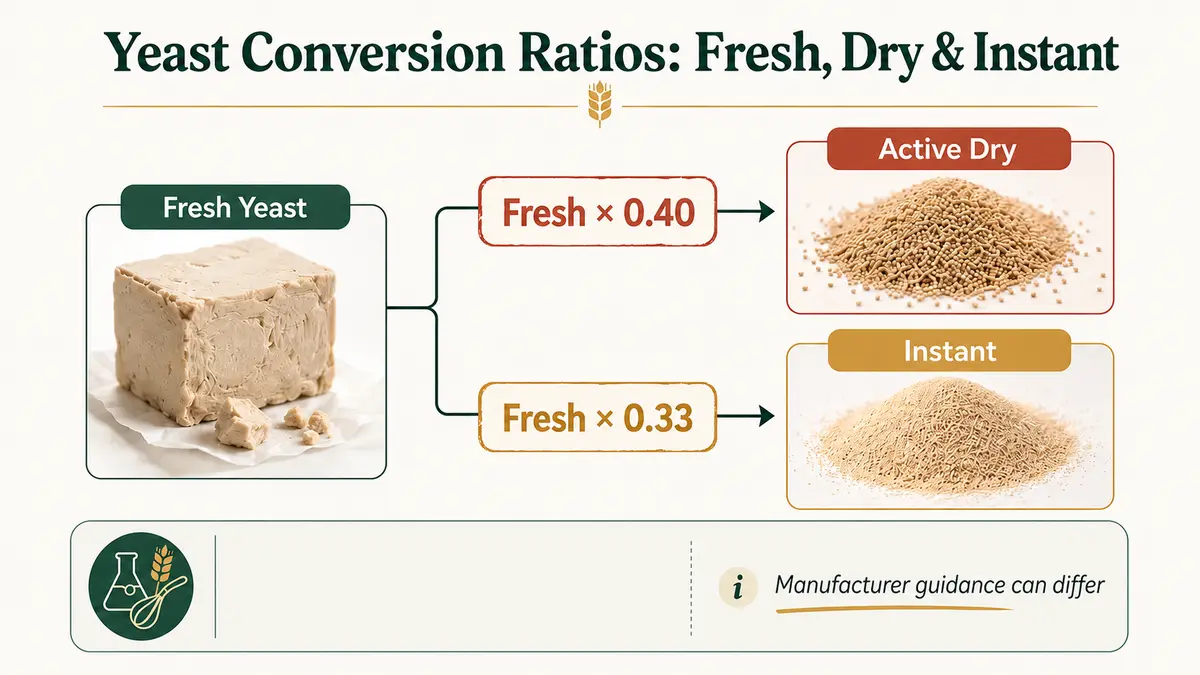
The short answer: yeast forms contain different amounts of water and behave differently
Fresh yeast, active dry yeast, and instant yeast are not the same physical product. Fresh compressed yeast contains much more water. Dry forms are concentrated and manufactured differently. That is why replacing 20 g of fresh yeast with 20 g of instant yeast would greatly increase the yeast dose.
A conversion ratio is therefore a practical substitution rule, not a unit identity. Unlike converting 1 ounce to grams, there is no international definition that says a fixed mass of fresh yeast must always equal one exact mass of instant yeast in every recipe.
KitchenMathHub keeps the source profile visible for this reason. The Yeast Conversion Calculator can use published guidance while reminding the user that manufacturer instructions outrank a generic rule for a named product.
Published yeast conversion guidance can legitimately differ
| Conversion context | Published guidance | What it means |
|---|---|---|
| Fresh to instant | Fresh × 0.33 | 20 g fresh becomes about 6.6 g instant |
| Fresh to active dry | Fresh × 0.40 | 20 g fresh becomes about 8 g active dry |
| Active dry to instant | Often 1:1 in modern home recipes | Rise speed may still differ |
| Red Star dry packet | 7 g, about 2 1/4 tsp | Useful package reference, not a universal global packet size |
| Fresh cake yeast | Manufacturer chart by flour amount | Product-specific guidance can use its own equivalence |
Why fresh yeast needs less dry yeast by weight
Fresh yeast carries water that dry yeast does not. A gram of fresh compressed yeast therefore contains less yeast solids than a gram of dry yeast. Drying makes the product more concentrated by mass.
The dry forms are also not identical to each other. Active dry yeast has larger granules and historically used a rehydration step. Instant yeast has smaller particles and is designed to mix more readily into dough. Modern formulations have reduced some of the old handling differences, but product performance is still not perfectly interchangeable in every process.
This explains the common 0.33 and 0.40 fresh-to-dry multipliers. They are practical concentration and performance allowances. They should not be interpreted as a chemical law that every yeast brand must obey.
Why active dry and instant yeast are often treated as 1:1 today
Many modern home-baking references allow active dry and instant yeast to be exchanged 1:1. King Arthur notes that active dry can start a little more slowly while catching up during a longer rise. Red Star also permits 1:1 substitution between its active dry and instant products, with a warning that fermentation speed can differ.
This does not mean the products are operationally identical. One dough may reach the target volume sooner. A bread machine may use a programmed cycle that leaves less room for timing differences. A short same-day dough reacts differently from a long refrigerated fermentation.
Judge dough by fermentation state as well as time. “Rise until doubled” is more robust than assuming a substituted yeast must hit the same clock minute as the original.
Why manufacturer charts can disagree with a general baking reference
A yeast manufacturer is describing its own products and packaging. Red Star's cake yeast conversion chart relates a specific fresh cake product to dry packets and flour quantity. A professional baking reference may instead present a generic weight ratio for fresh, active dry, and instant yeast.
Those are different questions. “How much of this branded cake yeast replaces one packet?” is not identical to “what general weight ratio should a baker use between compressed and instant yeast?”
The source should therefore travel with the number. KitchenMathHub's Stage 16 transparency system shows whether the page relies on a culinary authority, manufacturer, government source, or another reference type.
A worked example with 30 g of fresh yeast
Using a 0.33 instant multiplier, 30 g fresh yeast becomes about 9.9 g instant yeast. In a practical kitchen you might use about 10 g if the scale resolution supports it.
Using a 0.40 active dry multiplier, 30 g fresh yeast becomes 12 g active dry yeast. The two dry answers differ because the reference treats active dry and instant as separate forms.
A simplified consumer reference could instead use one dry-yeast conversion for both. That does not prove one table is fraudulent. It means the table chose a different simplification. When the recipe is sensitive, use the named manufacturer's instructions or the reference that best matches the product.
Packet, teaspoon, and gram conversions add another source of confusion
A U.S. dry yeast packet is commonly 7 g and about 2 1/4 teaspoons. That is a convenient retail standard, but packet sizes can differ by brand and country. If the package prints a net gram weight, use that printed amount.
Grams are more reliable for scaling a formula. A teaspoon is a volume measure and small quantities are sensitive to spoon filling. In a bakery formula, 3.5 g versus 4.0 g can matter more than the same half-gram difference would in flour.
Use the Baker's Percentage Calculator when yeast needs to scale with flour. A 0.5 percent yeast formula can be recalculated for 500 g or 5,000 g flour without relying on packet fractions.
Yeast amount is only one part of fermentation speed
Temperature can change dough timing even when the yeast conversion is perfect. Warm dough ferments faster than cool dough within a normal working range. Refrigeration slows fermentation dramatically.
Sugar, salt, fat, hydration, flour, and dough size also matter. Enriched dough can behave differently from lean bread dough. A very sweet formula can need a yeast designed for osmotic stress. A cold pizza dough may use a much smaller yeast percentage because it ferments for one or more days.
That is why a yeast calculator should not promise an exact rise time after substitution. It can convert the starting amount. The baker still evaluates the dough.
Why old recipes can be especially confusing
Older recipes may say “one cake of yeast” without giving a gram weight. Cake sizes have not been identical across every market and period, so the words alone may not identify the amount. A modern packet conversion should therefore start by identifying the original cake size if possible.
Vintage recipes can also assume older active dry handling methods. If the instructions dissolve yeast separately, keep the recipe's liquid balance in mind when adapting it to a modern instant product. The goal is not only to replace the yeast mass but also to preserve the dough formula and fermentation process.
Which conversion rule should you choose?
Use the recipe manufacturer's rule when a named yeast product is specified
If a bread-machine manual or yeast package gives a substitution instruction, that information is designed for the product and process in front of you.
Use a culinary reference for a generic fresh, active dry, or instant conversion
King Arthur's professional reference is useful when the recipe names the yeast form but not a specific retail brand.
Use grams for scaled dough formulas
When possible, convert the yeast to grams first and then scale the recipe. This avoids awkward packet and teaspoon fractions.
Watch the dough after substitution
A mathematically reasonable substitution can still change fermentation speed. Use dough expansion, texture, aroma, and recipe-specific fermentation cues rather than treating the original time as fixed.
Questions about yeast substitution ratios
Why do fresh to dry yeast conversion ratios differ?
Fresh yeast contains much more water than dry yeast, and manufacturers do not all publish the same substitution rule. Product formulation, recipe context, and yeast type affect the recommended ratio.
How much instant yeast replaces fresh yeast?
A common King Arthur professional guideline is fresh yeast × 0.33 for instant yeast. Follow the manufacturer or recipe instruction when it provides a different product-specific conversion.
How much active dry yeast replaces fresh yeast?
King Arthur's professional reference gives fresh yeast × 0.4 for active dry yeast. Other consumer references may use a simpler dry-yeast rule, so the named source matters.
Can active dry and instant yeast be substituted 1:1?
Many modern home-baking references allow a 1:1 substitution by amount. Rise speed and handling can still differ, so judge dough by expansion rather than the clock alone.
Is one packet of yeast always 7 grams?
A standard U.S. dry yeast packet is commonly 7 g or about 2 1/4 teaspoons. Check the package because product sizes can vary by market.
Why does one source say fresh yeast × 0.33 and another imply a different ratio?
The sources may be simplifying different dry yeast types or using a manufacturer-specific cake yeast equivalence. Treat the conversion profile as part of the calculation.
Does yeast conversion preserve rise time?
No. Equivalent yeast quantity does not guarantee identical fermentation speed because yeast type, temperature, dough composition, and inoculation all affect timing.
Should active dry yeast always be proofed first?
Not necessarily with modern products. Follow the manufacturer or recipe directions for the yeast you actually have.
Does bread machine yeast need a different rule?
It can. Bread machines use programmed temperature and timing, so machine instructions can be more important than a generic hand-mixed dough conversion.
Which yeast conversion should KitchenMathHub use?
Use a named reference profile and show the source. That is more transparent than presenting one ratio as universally correct.
Calculation transparency
Read methodologyHow to interpret this result
Result typeManufacturer + culinary comparison
Calculation basisPublished yeast substitution ratios and product-specific guidance
Sources shown2
Latest source reviewAug 11, 2026
Yeast conversion is a practical substitution rule rather than a universal unit identity. Product instructions should take priority when available.
Sources and methodology
These are the references used for data, conventions, safety targets, or calculation context on this page. Review dates show when KitchenMathHub last checked the cited source.
Red Star YeastYeast Conversion ChartUsed for product or appliance-specific guidance where the manufacturer is the relevant authority.
Open source ↗