King Arthur BakingBaker's PercentageUsed for established culinary measurements, baking methods, or formula guidance.
Open source ↗Dough Scaling Calculator
Scale an existing bread, pizza, roll, bun, or other dough recipe to the exact total weight you need. Enter the current ingredient weights, then choose the number of pieces and target grams per piece.
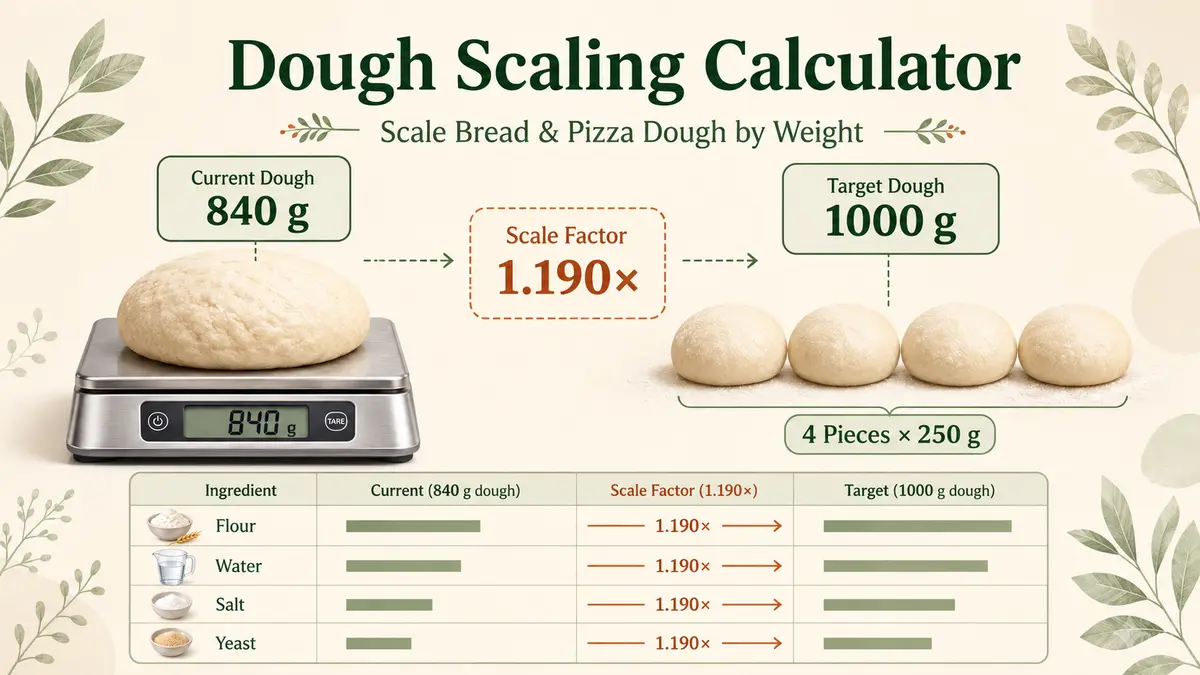
Scale factor
1.190×
840 g current dough → 1000 g target dough
| Ingredient | Current | Scaled |
|---|---|---|
| Flour | 500 g | 595 g |
| Water | 325 g | 387 g |
| Salt | 12 g | 14 g |
| Yeast | 3.0 g | 3.6 g |
| Oil | 0.0 g | 0.0 g |
Dough scaling formula
| Step | Example |
|---|---|
| Current dough | 840 g |
| Target | 4 pieces × 250 g = 1,000 g |
| Scale factor | 1,000 ÷ 840 = 1.190 |
| 500 g flour | 500 × 1.190 = 595 g |
How the dough scaling calculator works
The calculator first adds every current ingredient to find total dough weight. If a formula contains 500 g flour, 325 g water, 12 g salt, and 3 g yeast, the current total is 840 g.
Next, it calculates the dough you actually need. Four 250 g pizza balls or bread portions require 1,000 g total dough. Target dough divided by current dough gives the scale factor: 1,000 divided by 840 is about 1.190.
Every ingredient is multiplied by the same factor. The 500 g flour becomes about 595 g. The 325 g water becomes about 387 g. Salt and yeast are scaled from their original weights as well, which preserves the original ingredient relationships.
How to calculate target dough weight
Target dough weight equals the number of pieces multiplied by the target weight per piece. This works for pizza balls, burger buns, dinner rolls, bagels, baguette pieces, flatbreads, or loaf portions.
Eight 100 g rolls need 800 g dough. Six 150 g buns need 900 g dough. Three 850 g loaf pieces need 2,550 g dough. The calculator uses this target before touching the ingredient list.
Choose the portion weight from your actual product goal. A 100 g bun and a 250 g pizza ball are not interchangeable just because both are dough. Pan size, final shape, baking method, and desired serving size determine the useful target.
How to scale pizza dough by ball weight
Pizza dough is often easiest to scale from dough ball weight. If your current recipe makes three balls but you need eight, enter the current gram weights and set the target to eight pieces at your preferred ball weight.
This approach preserves the existing pizza formula. It does not decide the hydration, salt, or yeast percentage for you. That is useful when you already have a pizza recipe that performs well and only need a larger or smaller batch.
If you are designing a formula from scratch, use the Pizza Dough Calculator instead. It starts from pizza count, ball weight, hydration, and baker's percentages rather than from an existing ingredient list.
How to scale bread dough for loaves, rolls, or buns
The same proportional method works for bread dough. Suppose a bread formula currently weighs 1,600 g and you want two 900 g loaves. Your target is 1,800 g, so the scale factor is 1.125. Every ingredient is multiplied by 1.125.
For rolls, portion count becomes especially useful. If you want 18 rolls at 85 g each, the target is 1,530 g. The calculator can scale your existing formula directly to that batch size.
Allow for process loss when exact final portion weight matters. Small amounts of dough can remain on the bowl, mixer, scraper, or hands. Commercial production may add an allowance. At home, you can choose a slightly larger target if your process consistently loses measurable dough.
Dough scaling factor explained
The scale factor is target dough divided by current dough. A factor above 1 makes the batch larger. A factor below 1 makes it smaller. A factor of exactly 1 means the current formula already matches the target.
If 800 g dough becomes 1,200 g, the factor is 1.5. A 400 g flour amount becomes 600 g. If 1,200 g dough becomes 900 g, the factor is 0.75 and the same 400 g flour becomes 300 g.
One factor must be applied consistently to preserve the formula. Do not multiply flour by one number and water by another unless you intentionally want to change hydration. If you want to modify the formula itself, baker's percentage is the clearer tool.
Dough scaling versus baker's percentage
Dough scaling copies an existing formula at a new size. Baker's percentage describes the formula relative to flour. Both methods can produce the same scaled weights, but they answer different questions.
If you already know the ingredient grams and simply need more or less dough, the Dough Scaling Calculator is direct. If you want to change hydration from 65% to 70%, compare flour blends, or build from a target dough weight, the Baker's Percentage Calculator gives more control.
Baker's percentage is also useful for diagnosing the original dough. You can see whether the recipe is 60%, 70%, or 80% hydration and whether salt is 1.5%, 2%, or another value before you scale it.
Scaling sourdough dough
Sourdough can be scaled proportionally, but starter composition still matters when you analyze hydration. If you multiply the entire recipe by the same factor, the ratio stays consistent. However, the starter already contains flour and water.
If your only goal is making twice as much of a tested sourdough recipe, proportional scaling works. If you want to understand or change hydration, prefermented flour, or starter hydration, use the Sourdough Hydration Calculator.
Feed enough starter before scaling the final dough. The Sourdough Starter Feeding Calculator can calculate how much flour and water to add when building the starter quantity required by the larger batch.
Scaling yeast in a larger or smaller dough batch
A direct proportional scale multiplies yeast by the same factor as flour and water. This keeps the original formula unchanged. If 3 g yeast becomes a 1.5× batch, the proportional amount is 4.5 g.
Very small yeast quantities deserve careful measurement. If scaling down produces 0.3 g or 0.5 g, a kitchen scale that only reads whole grams is not precise enough. Use a finer scale, increase the batch, or follow a tested alternative method.
Proportional yeast does not guarantee identical fermentation timing in every batch size. Dough temperature, mixer friction, container geometry, ambient conditions, and fermentation schedule can change. Use the scaled yeast as the formula starting point and observe the dough.
Why dough recipes should be scaled in grams
Weight makes proportional scaling much more reliable than cups and spoons. Flour volume can change with scooping, aeration, and packing. Dough formulas are sensitive to the relationship between flour and water, so inconsistent volume measurement can change hydration unintentionally.
Grams also make awkward scale factors easy. A 1.173× factor can be applied directly to 425 g flour. Trying to multiply 3 1/3 cups by the same factor creates fractions that are harder to measure accurately.
If a source recipe is only in cups, convert supported ingredients with the Cups to Grams Calculator before using a dough formula. Use the recipe author's own gram values when provided because those reflect the tested recipe.
Rounding scaled dough ingredients
Round large flour and water amounts less aggressively than tiny yeast amounts. For a home batch, a 0.2 g difference in a 600 g flour amount is irrelevant, but rounding 0.6 g yeast to 1 g changes the yeast by more than 60%.
KitchenMathHub displays smaller quantities with extra decimal precision. Use a suitable scale when the displayed amount requires it. If your scale cannot measure that finely, avoid pretending the rounded number is equivalent.
The visible ingredient sum may differ slightly from the target after rounding. The mathematical calculation uses the unrounded scale factor. Display rounding is only for practical measurement.
Common dough scaling mistakes
Scaling only flour and water
Salt, yeast, oil, sugar, preferments, and other ingredients need the same factor if the formula is meant to stay unchanged.
Using final baked weight as target raw dough weight
Baking loses moisture. A 700 g baked loaf began with more than 700 g raw dough.
Changing portion count but forgetting portion size
Ten 80 g rolls and ten 120 g rolls require very different total dough.
Repeatedly scaling a rounded batch
Keep the original recipe as the source and calculate each new batch from it to reduce rounding drift.
A practical dough scaling workflow
1. Enter the current ingredient weights
Use the original gram values from the dough you trust.
2. Choose the number of target pieces
Count pizzas, rolls, buns, loaves, or other portions.
3. Choose grams per piece
Use a tested portion weight that matches the product you want.
4. Weigh the scaled ingredients
Pay special attention to small salt and yeast amounts.
5. Divide the finished dough by weight
After mixing and fermentation, use the target piece weight to portion the dough consistently.
Questions about scaling dough
How do I scale a dough recipe to a target weight?
Add the current ingredient weights, calculate the target dough weight, then multiply every ingredient by target weight divided by current weight.
How do I calculate dough weight for multiple portions?
Multiply the number of dough pieces by the target weight per piece. Four 250 g pieces need 1,000 g total dough.
Can I scale pizza dough with this calculator?
Yes. Enter the current pizza dough ingredient weights, then choose the number and weight of dough balls you want.
Can I scale bread dough with this calculator?
Yes. It works for bread, rolls, buns, bagels, flatbreads, pizza, and other doughs when the current formula is entered by weight.
What is the dough scale factor?
The scale factor is target total dough weight divided by current total dough weight.
How do I scale 800 g dough to 1,200 g?
Use a 1.5 scale factor. Multiply every ingredient by 1.5.
Should yeast be multiplied by the same factor?
For a direct proportional batch, yes, but fermentation schedules can change with batch size and very small yeast amounts require careful rounding.
Should salt and water be scaled too?
Yes. If you want the same formula, every ingredient is multiplied by the same scale factor.
What is the difference between dough scaling and baker's percentage?
Dough scaling multiplies an existing formula. Baker's percentage describes each ingredient relative to flour and can rebuild a formula from a new flour or dough target.
How do I scale dough for 12 rolls?
Choose 12 pieces and the target grams per roll. The calculator finds the total target dough and rescales every ingredient.
Can I use cups in the dough scaling calculator?
The calculator is designed for grams because proportional dough scaling is much more repeatable by weight.
Why can the scaled total differ slightly after rounding?
Displayed ingredient values are rounded for kitchen use, so the visible sum can differ by a small amount from the mathematical target.
Calculation transparency
Read methodologyHow to interpret this result
Result typeFormula + culinary reference
Calculation basisBread formula arithmetic with published baking references
Sources shown1
Latest source reviewAug 11, 2026
Formula math is deterministic. Product-specific yeast instructions and recipe-specific flour standards should take priority when supplied.
Continue with KitchenMathHub
Sources and methodology
These are the references used for data, conventions, safety targets, or calculation context on this page. Review dates show when KitchenMathHub last checked the cited source.