King Arthur BakingBaker's PercentageUsed for established culinary measurements, baking methods, or formula guidance.
Open source ↗Pizza Dough Calculator
Build a pizza dough formula from the number of pizzas, target dough ball weight, hydration, salt, yeast, oil, and sugar. The calculator uses baker's percentage so the final batch reaches the dough weight you actually need.
Percentages use total flour as 100%. Use your own formula rather than treating the defaults as a required pizza style.
Target dough
1000 g
4 dough balls × 250 g
| Ingredient | Baker's % | Weight |
|---|---|---|
| Flour | 100% | 595 g |
| Water | 65% | 387 g |
| Salt | 2.5% | 15 g |
| Yeast | 0.5% | 3.0 g |
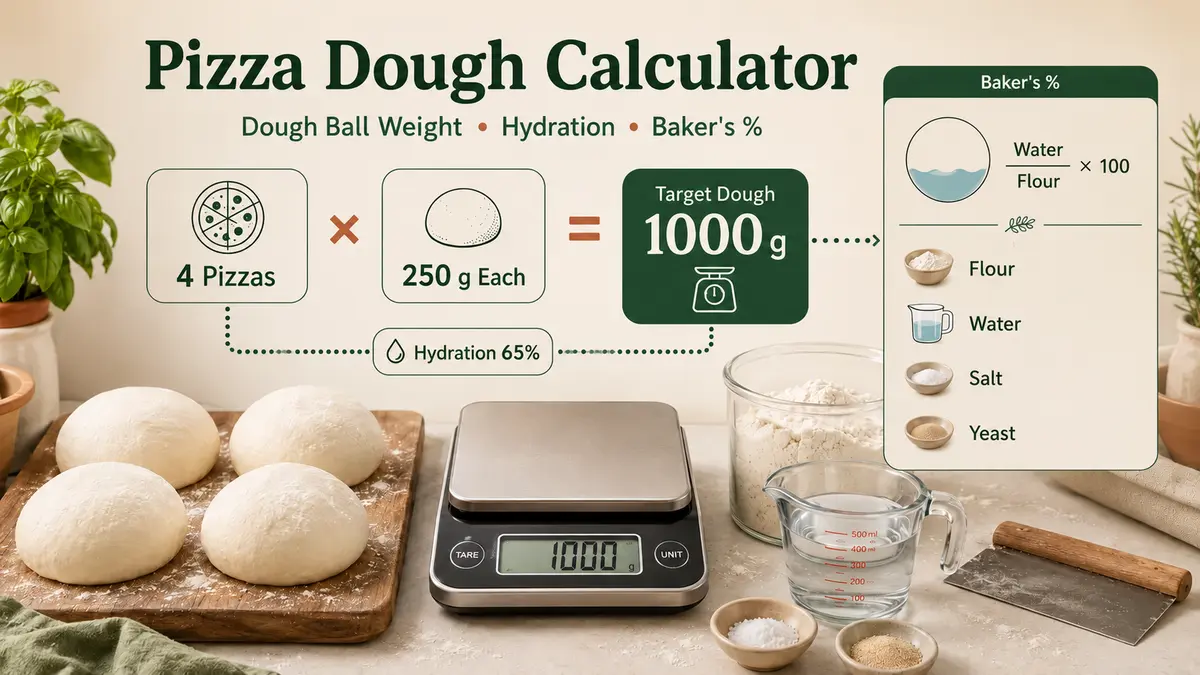
Pizza dough calculator example
| Setting | Example |
|---|---|
| Pizzas | 4 |
| Dough ball weight | 250 g |
| Target dough | 1,000 g |
| Hydration | 65% |
| Salt | 2.5% |
| Yeast | 0.5% |
How the pizza dough calculator works
The calculator starts with the amount of finished dough you want. If you need four pizzas and want each dough ball to weigh 250 g, your target dough weight is 1,000 g. That target is more useful than starting with an arbitrary flour amount because it connects directly to the number of pizzas you plan to make.
Baker's percentage then converts the target dough weight into ingredient weights. Flour is always 100%. Water, salt, yeast, oil, and sugar are percentages of total flour. A formula with 65% water, 2.5% salt, and 0.5% yeast has a total formula percentage of 168% before any oil or sugar is added.
The calculator divides the target dough weight by that formula total to find the flour basis. Every other ingredient is then calculated from the flour. This keeps the formula internally consistent when you change the number of pizzas, dough ball size, hydration, or any other percentage.
How much pizza dough do you need per pizza?
Dough ball weight depends on the pizza style, diameter, crust thickness, and pan or oven method. A thin pizza and a deep pan pizza should not be expected to use the same grams of dough for the same diameter. The calculator therefore asks you to choose the ball weight instead of forcing a universal value.
If you already use a recipe that makes a pizza you like, weigh one finished dough ball from that recipe and use it as your target. This is usually more reliable than copying a dough weight from a different pizza style. Once you have a useful ball weight, the calculator can scale it to two, four, six, or many more pizzas.
Total dough weight is simply pizza count multiplied by dough ball weight. Four 250 g balls need 1,000 g. Six 230 g balls need 1,380 g. Eight 300 g balls need 2,400 g. The baker's percentage engine then decides how much of that total should be flour, water, salt, and the other ingredients.
Pizza dough hydration explained
Pizza hydration is water weight divided by flour weight. A 65% hydration dough uses 650 g water for every 1,000 g flour. A 70% hydration dough uses 700 g water for the same flour amount.
Hydration changes more than stickiness. It affects mixing, gluten development, extensibility, gas retention, crust texture, oven spring, and how quickly the surface can dry and brown. Flour absorption also varies, so two doughs at the same hydration can feel different when they use different flour.
Higher hydration is not automatically better. A dough that works well at 70% in one flour and oven may be frustrating in another kitchen. Use a hydration that matches your flour, fermentation method, shaping skill, and baking environment. If you are comparing formulas, the Baker's Percentage Calculator makes the relationship easier to see.
Salt, yeast, oil, and sugar percentages
Salt percentage is measured against flour, not final dough weight. At 2.5% salt, 1,000 g flour would use 25 g salt. If your batch contains less flour because the target dough is smaller, the calculator reduces the salt automatically.
Yeast percentage should come from the fermentation plan. A short same-day dough can use a different yeast amount from a long cold fermentation. Instant yeast, active dry yeast, and fresh yeast are not always used at identical weights. If your recipe changes yeast type, use the Yeast Conversion Calculator and follow product instructions when they differ from a generic ratio.
Oil and sugar are optional because many pizza formulas do not use them. Oil can change tenderness, handling, and browning. Sugar can influence flavor and browning, especially in ovens that bake at lower temperatures than dedicated pizza ovens. Set either field to zero when the formula does not include it.
How to scale a pizza dough recipe
Keep the percentages the same and change the target dough amount. Suppose your current formula makes two 250 g balls and you want six. Instead of multiplying every ingredient by hand, set the calculator to six pizzas at 250 g each. The target changes from 500 g to 1,500 g while the formula relationships stay the same.
This approach is particularly useful when a recipe is already expressed in baker's percentages. If the recipe is only written as ingredient weights, you can first analyze it with the Baker's Percentage Calculator, or use the Dough Scaling Calculator to scale the existing gram weights directly.
Scale from the original formula rather than repeatedly scaling a rounded batch. Repeatedly multiplying rounded amounts can slowly introduce drift, especially for yeast. Keep the percentages or original ingredient weights as the source and calculate each new batch from that source.
Pizza dough ball weight and pizza size
Ball weight should be treated as a production target, not a quality score. More grams can produce a thicker crust or larger pizza, but pan geometry and shaping also matter. A dough spread across a rectangular pan behaves differently from a free-stretched round pizza.
If you are changing pizza diameter, make one test pizza before scaling a large batch. Record the dough ball weight, final diameter, rim thickness, and whether the center was too thin or too heavy. That test gives you a kitchen-specific target that the calculator can reproduce.
For pan pizza, weigh the dough that gives the depth you prefer in your actual pan. Once you know that amount, use it as the target piece weight. The same tool can then calculate enough dough for several identical pans.
Using pizza baker's percentage correctly
All flour types together form the 100% flour basis. If a pizza uses 800 g bread flour and 200 g whole wheat flour, total flour is 1,000 g. Water, salt, yeast, oil, and sugar should be calculated against the full 1,000 g.
If you use a flour blend, keep the flour shares consistent when scaling. For example, an 80% bread flour and 20% whole wheat blend remains 80/20 when the batch doubles. The formula total can be greater than 100%, which is normal because every ingredient is compared with flour.
Do not confuse baker's percentage with percentage of final dough. A 65% hydration dough is not 65% water by total dough weight. It means water weighs 65% as much as the flour.
Pizza dough calculator for sourdough
Starter or levain needs extra accounting because it already contains flour and water. A 100 g starter at 100% hydration contributes about 50 g flour and 50 g water. Treating all 100 g as a separate ingredient can hide the true hydration.
This direct pizza calculator intentionally avoids pretending that sourdough is the same as commercial yeast. For sourdough pizza, use the Sourdough Hydration Calculator to decompose starter, then use the resulting total flour and water relationships to build the pizza formula you want.
Prefermented flour also gives better information than simply saying a dough uses a certain percentage of starter. Two starters can have the same weight but different hydration, so their flour contribution can differ.
Common pizza dough calculation mistakes
Using volume instead of weight for the formula
Pizza dough math is much more repeatable in grams. Flour volume changes with scooping and packing, while small yeast quantities are especially difficult to reproduce by volume.
Changing hydration without considering flour
Higher water can change mixing and handling. Increase hydration deliberately, not because a higher number sounds more advanced.
Using the same yeast for every fermentation schedule
Fermentation time and temperature matter. A long cold dough and a fast warm dough can need very different yeast levels.
Forgetting optional ingredients in the formula total
If the dough includes oil or sugar, they contribute to final dough weight. The calculator includes them when it solves backward for flour.
A practical pizza dough planning workflow
1. Choose the number of pizzas
Count the pizzas or dough portions you actually need.
2. Choose a tested dough ball weight
Use a ball weight that fits your pizza diameter, crust thickness, or pan.
3. Enter your formula percentages
Set hydration, salt, yeast, and optional oil or sugar from the formula you trust.
4. Weigh the calculated ingredients
Use a digital scale, especially for yeast and salt.
5. Record the result after baking
If the crust was too thick, thin, dry, or difficult to handle, adjust one variable and keep notes. The calculator makes the next controlled test easy to reproduce.
Questions about pizza dough calculations
How does the pizza dough calculator work?
Choose the number of pizzas, target dough ball weight, hydration, salt, yeast, oil, and sugar percentages. The calculator works backward from the target dough weight to find the flour and every other ingredient.
How much dough do I need for four pizzas?
Multiply the number of pizzas by the dough ball weight. Four 250 g dough balls need 1,000 g of total dough before dividing.
What does 65% hydration mean in pizza dough?
A 65% hydration formula uses 65 g of water for every 100 g of total flour.
Is flour always 100% in pizza baker's percentage?
Yes. Total flour is the 100% reference and water, salt, yeast, oil, and sugar are expressed relative to it.
Can I use the calculator for Neapolitan, New York, or pan pizza?
Yes. Enter the baker's percentages that match your chosen formula instead of treating one preset as correct for every pizza style.
How do I calculate pizza dough ball weight?
Choose the dough weight you want for each pizza, then multiply it by the number of pizzas. Pan size, crust thickness, and pizza style influence the useful ball weight.
Does more hydration always make better pizza?
No. Higher hydration changes dough handling, extensibility, browning, and oven behavior, but the best level depends on flour, oven, fermentation, and pizza style.
How do I scale pizza dough for more people?
Increase the number of dough balls or their target weight while keeping the baker's percentages unchanged. The calculator recalculates all ingredient weights from the new total.
Can the pizza dough calculator include oil and sugar?
Yes. Oil and sugar are optional baker's percentages, so you can set either one to zero when the formula does not use it.
How much yeast should I use in pizza dough?
Yeast depends strongly on yeast type, dough temperature, fermentation time, and schedule. Use your tested formula or a trusted recipe rather than assuming one universal yeast percentage.
Can I use sourdough starter in this calculator?
This version is designed for direct dough formulas with flour, water, salt, and yeast. Use the Sourdough Hydration Calculator when starter or levain must be decomposed into flour and water.
Why does the calculator calculate flour last?
The target dough weight is known first. Baker's percentage lets the calculator divide that target by the complete formula percentage to solve the required flour basis.
Calculation transparency
Read methodologyHow to interpret this result
Result typeFormula + culinary reference
Calculation basisBread formula arithmetic with published baking references
Sources shown2
Latest source reviewAug 11, 2026
Formula math is deterministic. Product-specific yeast instructions and recipe-specific flour standards should take priority when supplied.
Continue with KitchenMathHub
Sources and methodology
These are the references used for data, conventions, safety targets, or calculation context on this page. Review dates show when KitchenMathHub last checked the cited source.
King Arthur BakingThe complete guide to hydration in bread doughUsed for established culinary measurements, baking methods, or formula guidance.
Open source ↗