USDA Food Safety and Inspection ServiceCooking with Microwave OvensUsed for defined measurement guidance or public food-safety guidance where applicable.
Open source ↗Microwave Wattage Converter
Convert a microwave cooking time from the wattage used by a recipe or package to the wattage of your microwave. The result is an energy-equivalent starting estimate, with clear limits for real food and food safety.
This is an energy-equivalent starting estimate, not a replacement for package directions, stirring, standing time, or temperature checks.
Adjusted starting time
5:43
Time factor 1.43×. Your target microwave is less powerful than the recipe microwave.
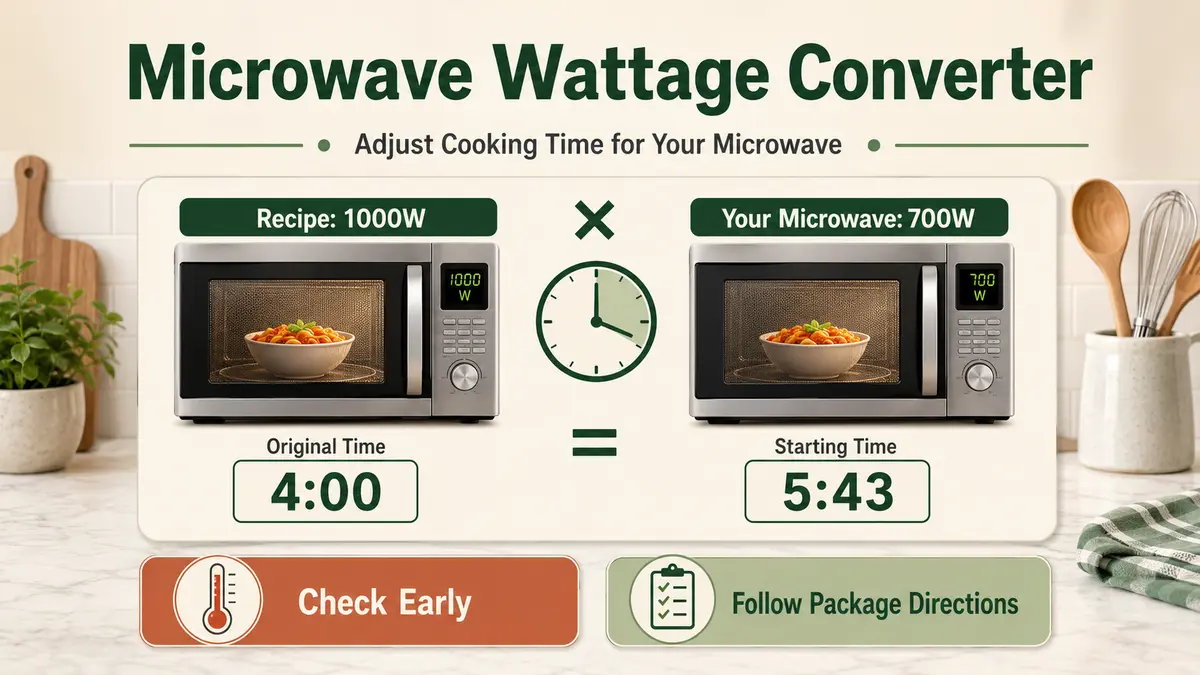
Microwave wattage conversion examples
| Recipe wattage | Your wattage | Original time | Starting estimate |
|---|---|---|---|
| 1000W | 700W | 4:00 | 5:43 |
| 900W | 1200W | 3:00 | 2:15 |
| 700W | 1000W | 5:00 | 3:30 |
How the microwave wattage converter works
The calculator uses a simple energy-equivalent time relationship. Original time is multiplied by the wattage the instruction was written for, then divided by the wattage of your microwave. A lower-power microwave therefore receives more time, while a higher-power microwave receives less.
For a 1000W instruction used in a 700W microwave, the factor is 1000 divided by 700, or about 1.43. Four minutes becomes about 5 minutes 43 seconds. For a 700W instruction used in a 1000W microwave, the factor is 0.70, so five minutes becomes about 3 minutes 30 seconds.
This is a starting estimate, not an exact doneness prediction. Microwaves with the same rated wattage can differ in power cycling, cavity geometry, turntable design, efficiency, and how evenly they heat a particular food.
1000W to 700W microwave conversion
A 700W microwave usually needs longer than a 1000W microwave for the same nominal energy input. Multiply the 1000W time by roughly 1.43. A 2 minute instruction becomes about 2 minutes 51 seconds. A 4 minute instruction becomes about 5 minutes 43 seconds.
Do not automatically run the entire calculated time without checking. If the package gives a time range, follow the package first. USDA recommends beginning with the minimum time in a stated range and adding time as needed.
Stirring or rotating can matter as much as extra seconds. Microwave heating can create hot and cold spots. For foods that can be stirred or turned, redistribute the food during cooking when instructions call for it.
700W to 1000W microwave conversion
A 1000W microwave generally needs less time than a 700W instruction. Multiply the original time by 0.70. Five minutes at 700W becomes about 3 minutes 30 seconds at 1000W as a starting estimate.
Higher power can make overcooking easier if you simply copy a lower-wattage time. This is particularly noticeable with small portions, chocolate, butter, sauces, and foods where a few extra seconds can change texture quickly.
Check before the converted finish time. The formula assumes nominal wattage is the main difference. Real cooking also depends on portion size, starting temperature, moisture, container shape, and whether the microwave cycles power.
How to find your microwave wattage
Look for the microwave wattage on the door area, serial plate, owner's manual, or manufacturer documentation. The input power printed on an electrical label is not always the same as the cooking output wattage, so use the rated cooking wattage when available.
USDA also describes a time-to-boil test using one cup of ice-cold water when wattage is unknown. Faster boiling indicates a higher-powered oven. This test provides a rough category rather than the precision of a manufacturer rating.
Do not guess wattage from microwave size alone. Two ovens with similar exterior dimensions can have different output ratings. A correct wattage value makes the time conversion more useful.
Why microwave wattage affects cooking time
Wattage describes power, so a higher wattage microwave can deliver energy faster. USDA specifically notes that higher-wattage microwave ovens cook food faster. That is why package directions sometimes list different times for different power ratings.
The simple conversion formula treats energy as power multiplied by time. If one microwave delivers fewer watts, it needs more time to reach a similar nominal energy input. If it delivers more watts, it needs less.
Food is not a perfect energy meter. Evaporation, phase changes, heat loss, container material, power cycling, and uneven absorption all affect the actual temperature of food. The mathematical result should therefore be treated as the first check point, not a guarantee.
Microwave standing time and carryover cooking
Standing time is part of microwave cooking, not dead time. Heat continues to move through the food after the magnetron stops. USDA explains that food can continue cooking during the standing period and that temperature can rise several degrees.
Dense foods can need more standing time than small, less-dense foods. Follow the recipe or package instructions when they specify a rest. For foods where safety matters, standing time can help reduce cold spots but does not replace temperature verification.
Do not shorten a required standing time just because you used a higher-wattage microwave. Wattage conversion changes the active heating estimate. Resting instructions may serve a separate heat-distribution or food-safety purpose.
Food safety when changing microwave cooking time
Raw meat, poultry, fish, egg dishes, and leftovers require more than wattage math. Follow product or recipe directions, stir or rotate where directed, and use a food thermometer to verify safe internal temperature.
USDA notes that microwave cooking times vary because ovens vary in power and efficiency. This is exactly why KitchenMathHub labels the result as a starting estimate rather than a safe-finish timer.
Use the thermometer in the appropriate thickest part after cooking. Do not leave a thermometer inside the microwave unless it is specifically labeled for microwave use. If the food has not reached the needed temperature, cook longer and recheck.
Microwave time conversion for packaged food
Package instructions should take priority over a generic calculator. Manufacturers can test the exact product, portion, packaging, moisture, and heating pattern. If the package provides a table for 700W, 900W, or 1000W microwaves, use that table.
The converter is most useful when the package or recipe names one wattage but your oven has another and no alternate time is provided. Enter the stated wattage as the source and your oven's rating as the target.
Keep packaging instructions about venting, covering, stirring, piercing, and standing time unchanged. Those steps cannot be derived from wattage.
Microwave power level versus microwave wattage
Rated wattage and a microwave power-level setting are not the same thing. Many ovens reduce average heating by cycling full power on and off rather than producing a perfectly steady lower wattage.
This calculator is therefore designed for converting full-power instructions between ovens with different nominal ratings. It does not pretend that 50% power on a 1000W microwave is always identical to a continuously operating 500W oven.
Follow the appliance manual for defrost, soften, melt, sensor, or multi-stage programs. Those modes can use timing and power logic that a single wattage equation cannot reproduce.
Altitude and microwave cooking
High elevation can change microwave cooking because moisture evaporates faster. Colorado State University Extension notes that microwave cooking times may need adjustment at elevation and recommends following recipe or package instructions and checking safe temperature.
This means a wattage conversion that works near sea level may still need additional time in a high-elevation kitchen. The wattage tool solves one variable. Elevation is a separate environmental variable.
If altitude is also affecting baked recipes, use the High Altitude Baking Calculator for the baking-specific problem instead of adding a random percentage to microwave time.
Common microwave conversion mistakes
Reversing the wattage ratio
A lower-powered target microwave needs more time, not less. The calculator handles the direction automatically.
Treating the result as exact
Nominal wattage does not model food shape, efficiency, cycling, or moisture.
Ignoring package instructions
Product-specific instructions can include tested steps that a generic converter cannot know.
Skipping standing time
Resting can be part of both heat distribution and food safety.
A practical microwave wattage workflow
1. Find the source wattage
Use the wattage printed in the recipe or package directions.
2. Find your microwave output wattage
Check the manual, product label, or manufacturer specification.
3. Enter the original time
Include both minutes and seconds.
4. Start checking before the converted finish
Add time only when needed rather than automatically overcooking the food.
5. Follow safety and standing instructions
Use package directions and a thermometer when doneness or food safety matters.
Questions about microwave wattage and cooking time
How do I convert microwave cooking time for different wattage?
Multiply the original cooking time by the recipe wattage, then divide by your microwave wattage. Use the result as a starting estimate and check the food.
How do I convert 1000W microwave time to 700W?
Multiply the 1000W time by about 1.43. A 4 minute instruction becomes about 5 minutes 43 seconds as an energy-equivalent starting estimate.
How do I convert 700W microwave time to 1000W?
Multiply the 700W time by 0.70. A 5 minute instruction becomes about 3 minutes 30 seconds as a starting estimate.
Does higher microwave wattage cook faster?
Generally yes. USDA notes that higher wattage microwaves cook food faster, but efficiency and food characteristics still affect real cooking.
Is microwave wattage conversion exact?
No. The formula matches nominal energy delivery, but microwave cycling, cavity design, food shape, moisture, load, and standing time can change the result.
Where can I find my microwave wattage?
Check the door area, serial plate, owner's manual, or manufacturer documentation. USDA also describes a time-to-boil test for estimating wattage.
Should I use the minimum or maximum package time?
Follow the package instructions first. USDA advises starting with the lower end of a time range and adding time if needed.
Why does microwave standing time matter?
Food continues heating after the microwave stops, and standing time helps heat distribute into colder areas.
Can I use wattage conversion for raw meat?
Use it only as a starting estimate. Follow food-safety instructions, rotate or stir as directed, observe standing time, and verify safe internal temperature with a food thermometer.
Can I convert microwave power levels with this calculator?
This tool converts full-power instructions between different nominal wattages. Power-level programs can use different cycling behavior and should follow the appliance manual.
Why should I check food before the calculated time?
A simple wattage formula cannot model every microwave or food, so an early check helps prevent overheating and lets you add time safely.
Does altitude affect microwave cooking?
It can. Faster evaporation at elevation may require extra cooking time, so wattage conversion alone may not capture high-altitude behavior.
Calculation transparency
Read methodologyHow to interpret this result
Result typeEnergy estimate + food safety
Calculation basisNominal wattage ratio with USDA microwave cooking guidance
Sources shown1
Latest source reviewAug 15, 2026
Converted time is a starting estimate. Follow package directions, stir or rotate as directed, observe standing time, and verify safe temperature when needed.
Sources and methodology
These are the references used for data, conventions, safety targets, or calculation context on this page. Review dates show when KitchenMathHub last checked the cited source.