King Arthur BakingIngredient Weight ChartUsed for established culinary measurements, baking methods, or formula guidance.
Open source ↗Grams to Cups Calculator
Convert ingredient weights from grams to practical US cups. Choose the ingredient first because flour, sugar, butter, oats, cocoa, honey, and other foods do not share one grams to cups formula.
All-Purpose Flour
Ingredient-specific culinary reference. Volume-to-weight values are not universal across foods.
Result
0 cups
1 g all-purpose flour
Reference usedhigh confidence
Published measure1 US cup = 120 gSourceKing Arthur BakingMethodPublished culinary volume/weight equivalencyReviewedAug 11, 2026
Show calculation
Reference
1 cup-us = 120 gConverted amount
1 g → 0.0083 cup-us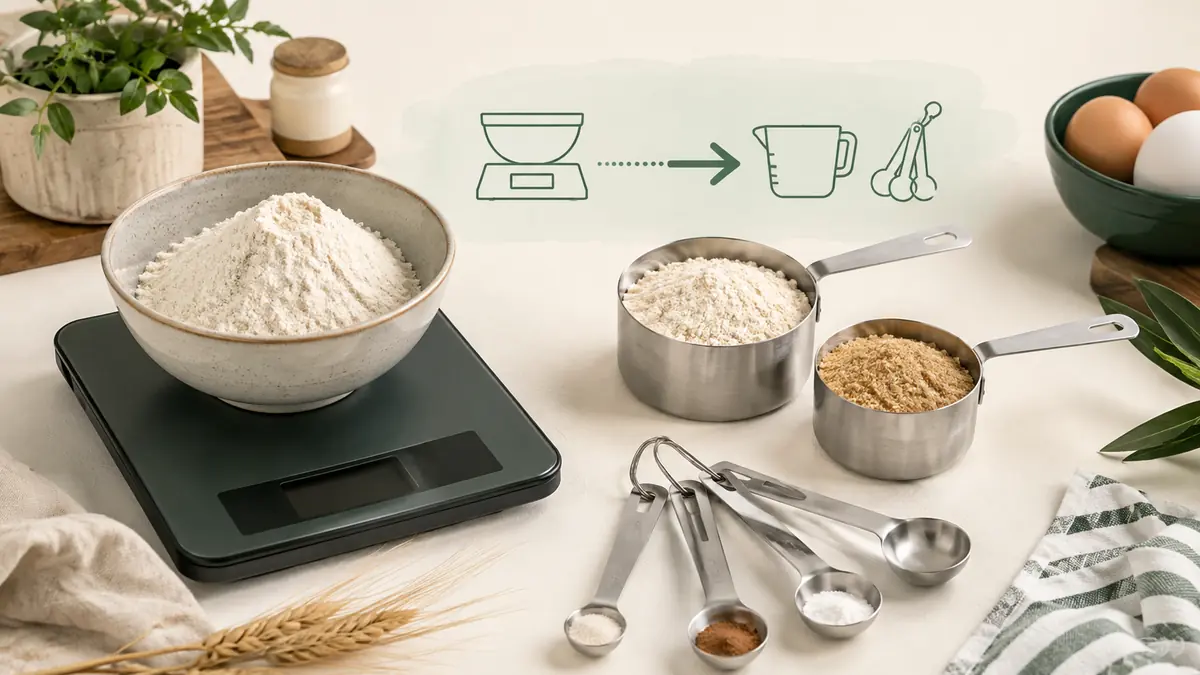
See why grams need ingredient specific cup values
Volume versus mass
The same cup volume can hold very different gram weights
Cups measure space. Grams measure mass. The ingredient decides the relationship.
1 US cupAll-purpose flour120 g
1 US cupGranulated sugar198 g
1 US cupRolled oats89 g
1 US cupHoney336 g
How the grams to cups calculator works
Grams to cups conversion depends on the ingredient. Grams measure mass, while cups measure volume. That is why 120 g of flour can be about 1 cup, while the same 120 g of granulated sugar is much less than 1 cup. The calculator first identifies the ingredient, then applies the culinary weight reference stored for that ingredient.
One grams to cups formula does not work for every food. A cup of flour contains many small particles with air spaces between them. Sugar packs differently. Butter is dense and compact. Rolled oats take up more space for their weight. Honey is a dense liquid. These physical differences change how many grams fit into the same cup volume.
The result is shown as a practical kitchen amount. If a conversion is close to ½ cup, ¾ cup, 1½ cups, or another familiar fraction, KitchenMathHub uses that style instead of showing a long decimal. This makes the answer easier to measure when you do not have a scale.
Common flour grams to cups examples
| All purpose flour | Approx. US cups at 120 g per cup |
|---|---|
| 60 | ½ cup |
| 90 | ¾ cup |
| 120 | 1 cup |
| 180 | 1½ cups |
| 240 | 2 cups |
| 300 | 2½ cups |
| 360 | 3 cups |
120 grams flour to cups and other useful baking amounts
120 grams of all purpose flour is about 1 US cup. That answer uses the 120 g per cup flour reference selected for KitchenMathHub. It is useful when a metric cake, cookie, pancake, or bread recipe gives flour by weight but your measuring tools are cups.
180 grams of flour is about 1½ cups. The calculation is 180 divided by 120, which gives 1.5 cups. If you are converting a full recipe, keep the original gram amount available because it is usually more precise than measuring flour by volume.
240 grams of flour is about 2 cups. This is a clean conversion because the amount is exactly twice the selected 120 g reference. For 300 g flour, the same method gives about 2½ cups.
Why flour can still weigh differently in your kitchen
Flour can settle and compact. Scooping a cup directly from a bag can place more flour into the cup than gently filling and leveling it. Humidity, flour type, brand, and the way the cup is filled can also affect the measured weight. A grams to cups calculator gives you a practical reference, but it cannot make every hand measured cup identical.
Sugar, butter, and other grams to cup conversions
198 grams of granulated sugar is about 1 US cup. Sugar has a higher weight per cup than all purpose flour, so you should not use the flour conversion when a recipe lists sugar. This is one of the clearest examples of why an ingredient weight to volume converter needs an ingredient selector.
113 grams of butter is about ½ US cup. A full cup of butter is therefore about 226 g with the KitchenMathHub reference. Butter is also commonly sold with package marks, sticks, blocks, or gram labels, so you may not need to move to cups if the package already gives you an easier amount.
Brown sugar needs its own conversion. KitchenMathHub treats packed brown sugar as a specific ingredient state because packing changes how much sugar fits into a cup. Powdered sugar also has its own reference, and sifted powdered sugar should not automatically be treated as the same volume state as unsifted powdered sugar.
Oats, cocoa, and honey also need separate values. Rolled oats have a different particle structure from flour. Cocoa powder is light and can settle. Honey is dense and flows into a cup with very little trapped air. Each ingredient needs a relevant culinary reference instead of a generic grams per cup number.
How to convert a metric recipe to cups
Convert each ingredient one at a time. If a recipe lists 240 g flour, 198 g sugar, 113 g butter, and 250 mL milk, do not divide every value by one universal number. Use the flour reference for flour, the sugar reference for sugar, the butter reference for butter, and a volume conversion for the milk.
Example: a simple cake formula
Imagine a recipe uses 240 g all purpose flour, 198 g granulated sugar, and 113 g butter. With the current KitchenMathHub references, the ingredient amounts become about 2 cups flour, 1 cup sugar, and ½ cup butter. Those results look simple, but they come from three different ingredient relationships.
Keep liquids as volume when that is more natural. A metric recipe may list water, milk, juice, or oil in milliliters. In many cases it is clearer to convert those liquids directly to cups, tablespoons, or teaspoons instead of looking for a mass to volume relationship.
If you need to convert an entire ingredient list, the Recipe Converter is faster than entering every line separately. It can keep ingredient names, quantities, and notes together while applying ingredient aware conversions where a validated reference exists.
US cups, metric cups, and regional measurements
A cup is not the same size in every measurement system. KitchenMathHub uses a US culinary cup as the default on this page. A metric cup is commonly 250 mL, so a recipe written for a metric cup can produce a different ingredient weight than one written for a US cup.
The original recipe's region can matter. American recipes often use US cups and 15 mL tablespoons. Other regions may use metric cups or different tablespoon conventions. If a recipe comes from another country, check its measurement notes before assuming every household unit matches your own tools.
This matters most when precision is important. A small difference may not change a forgiving soup or sauce, but it can matter more in a cake, bread dough, pastry, or other formula where flour and liquid balance affects the result.
When cups are useful and when grams are better
Use cups when cups are the tools you have. A practical conversion is useful if you are cooking away from home, following a metric recipe with only measuring cups, or helping someone who is more comfortable with volume measurements.
Use grams when repeatability matters. A kitchen scale removes much of the variation caused by scooping, packing, leveling, and ingredient particle size. That is especially useful for bread, cakes, cookies, pastry, and larger batch baking.
Do not convert just because you can. If a recipe already gives 300 g flour and you have a scale, keeping 300 g is usually easier and more repeatable than measuring 2½ cups. The grams to cups converter is most valuable when volume is the measurement system you actually need.
Use grams to cups after scaling a recipe
Scale the recipe before you round the cup result. Suppose a recipe uses 120 g flour and you increase it by 1.5 times. The normalized amount becomes 180 g, which converts cleanly to about 1½ cups. If you repeatedly round intermediate measurements, small errors can add up across several ingredients.
The Recipe Scaling Calculator changes ingredient amounts from the original and target yield. After scaling, you can choose the final measurement system that suits your kitchen. This order keeps the underlying quantity stable until the final display step.
Cooking time does not scale with cups. Changing an ingredient weight or converting it to cups does not tell you how long a larger cake, loaf, or casserole should cook. Pan size, food depth, oven behavior, and cooking method need separate consideration.
A practical grams to cups workflow for everyday cooking
Start with the ingredient name, not the number of grams. A value such as 150 g means very little for cup conversion until you know whether the ingredient is flour, sugar, butter, oats, cocoa, honey, or something else. The ingredient tells the calculator which reference to use.
Check the preparation state before you measure. Packed brown sugar, unsifted powdered sugar, rolled oats, and all purpose flour are more specific than broad names such as sugar, oats, or flour. A state word can change the correct volume to weight relationship.
Use the cup result as a practical measuring target. If the answer is close to a familiar fraction such as ½ cup or 1½ cups, measure that amount carefully and keep the cup level unless the recipe says to pack or heap the ingredient. If the answer is an awkward fraction and you have access to a scale, staying with grams may be easier.
Why another grams to cups chart may show a different value
Different reference values can all exist for the same ingredient. Recipe developers may use different measuring methods, brands, ingredient states, or cup conventions. Flour is a common example because a packed cup can weigh more than a gently filled cup.
KitchenMathHub does not average unrelated published numbers into one value with no clear source. The calculator uses a declared ingredient reference and keeps the source attached to the conversion. This makes the result easier to understand and easier to compare with the recipe you are following.
Use the recipe author's weight when it is provided. If a trusted recipe says its own cup of flour is 125 g, using that author's value may reproduce that specific recipe more closely than replacing it with a different house standard. KitchenMathHub is most helpful when the recipe gives only one measurement system or when you need a consistent general reference.
Questions about grams and cups
How do I convert grams to cups?
Choose the ingredient first, then convert its weight with that ingredient's grams per cup reference. A single formula cannot convert every food because cups measure volume while grams measure mass.
How many cups is 120 grams of flour?
120 g of all purpose flour is about 1 US cup with KitchenMathHub's 120 g per cup reference.
How many cups is 180 grams of flour?
180 g of all purpose flour is about 1½ US cups with the same 120 g per cup reference.
How many cups is 198 grams of sugar?
198 g of granulated sugar is about 1 US cup with the selected KitchenMathHub reference.
How many cups is 113 grams of butter?
113 g of butter is about ½ US cup under the butter reference used by KitchenMathHub.
Why does a grams to cups converter need an ingredient?
The ingredient changes the answer. Flour, sugar, butter, oats, cocoa, and honey have different weights even when each one fills the same cup.
Can I convert grams to cups for baking?
Yes. The calculator is designed for ingredient specific baking conversions and returns practical cup fractions when the result is close to a useful kitchen measure.
Should I use grams or cups for baking?
Use grams when you have a reliable scale and the recipe provides weights. Cups are useful when the recipe or your available measuring tools use volume.
Can I convert a metric recipe to cups?
Yes. Convert each ingredient separately because 200 g of flour and 200 g of sugar do not occupy the same volume.
Why can two grams to cups charts disagree?
Different recipe sources can use different ingredient standards, cup sizes, preparation states, and measuring methods. KitchenMathHub keeps one declared reference for each conversion instead of mixing unrelated values.
Does a US cup equal a metric cup?
No. A US culinary cup and a 250 mL metric cup are not the same volume, so the cup standard matters when you compare recipes from different regions.
Can I convert a full recipe from grams to cups?
Yes. Use the Recipe Converter when you want to convert several ingredients and keep the recipe together.
Calculation transparency
Read methodologyHow to interpret this result
Result typeIngredient-specific reference
Calculation basisPublished culinary volume and weight equivalencies
Sources shown2
Latest source reviewAug 11, 2026
Cup-to-weight values depend on the ingredient and its state. A recipe author's tested gram value should take priority when the recipe provides one.
Sources and methodology
These are the references used for data, conventions, safety targets, or calculation context on this page. Review dates show when KitchenMathHub last checked the cited source.
National Institute of Standards and TechnologyMetric Kitchen: Cooking Measurement EquivalenciesUsed for defined measurement guidance or public food-safety guidance where applicable.
Open source ↗