King Arthur BakingYeastUsed for established culinary measurements, baking methods, or formula guidance.
Open source ↗Yeast Conversion Calculator
Convert fresh, active dry, instant, and rapid rise yeast by grams, ounces, teaspoons, or standard dry packets. The calculator keeps fresh to dry conversions tied to a named reference profile because yeast products are not all identical.
Yeast conversion
6.6 g
Equivalent target yeast quantity under the selected general conversion profile.
Quantity is not the whole methodRise speed, rehydration, liquid temperature, and bread-machine instructions can differ by yeast product. Follow package guidance when it conflicts with a generic conversion.
Show calculation
Conversion profile
20 g × 0.33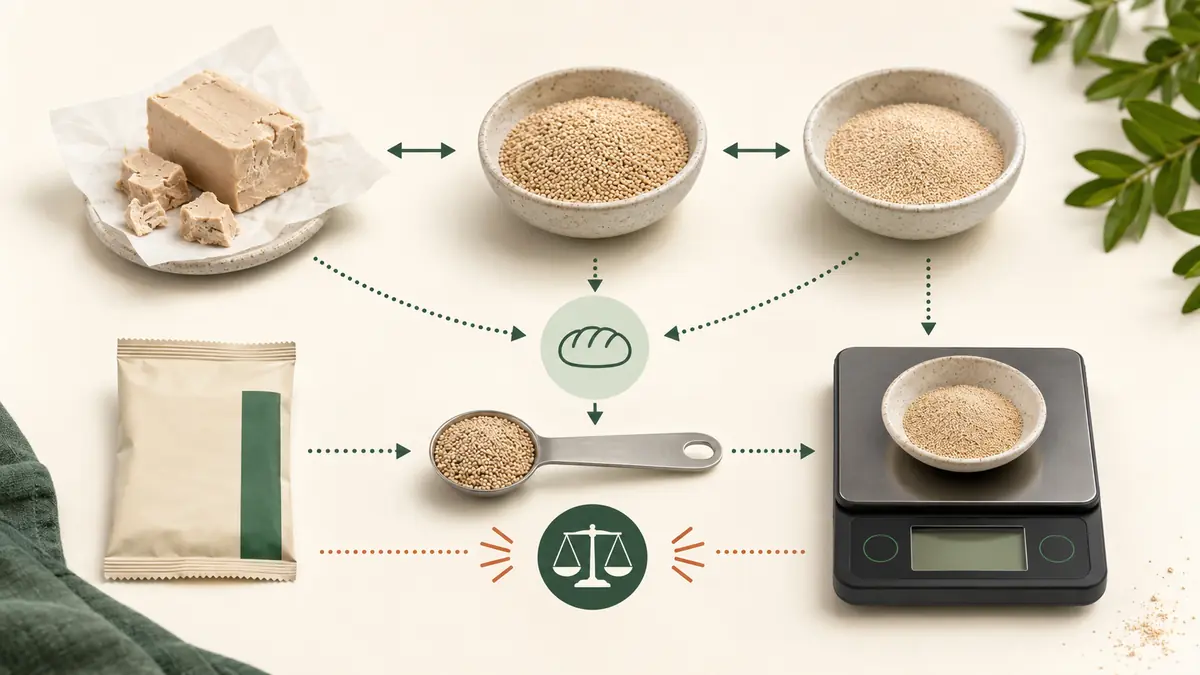
Yeast conversion chart for common types
| Conversion | KitchenMathHub default |
|---|---|
| Active dry to instant | 1:1 by weight |
| Instant to active dry | 1:1 by weight |
| Fresh to instant | Fresh weight x 0.33 |
| Fresh to active dry | Fresh weight x 0.40 |
| Standard dry packet | 7 g ≈ 2¼ tsp |
How the yeast conversion calculator works
Choose the yeast you have, enter the amount, and select the yeast you need. The calculator first normalizes the quantity, then applies the conversion rule for that yeast pair. Weight is the strongest base for comparison because grams do not depend on how tightly a spoon is filled.
Yeast conversion is not the same as converting centimeters to inches. Fresh yeast, active dry yeast, instant yeast, and rapid rise products are different forms. Their moisture level, processing, and recommended use can differ. This is why KitchenMathHub keeps a source aware conversion profile instead of hiding every product behind one universal number.
Use the package instructions when they conflict with a general calculator. A manufacturer knows the strength and intended method of its own product. The calculator is useful when a recipe names a different yeast type, when the package uses another unit, or when you need a practical starting amount.
Fresh yeast to dry yeast conversion
Fresh yeast needs more weight than dry yeast for the same general substitution. Fresh yeast contains more moisture, while dry forms are more concentrated. KitchenMathHub therefore does not use a 1:1 weight rule when fresh yeast is involved.
Fresh yeast to instant yeast
Multiply fresh yeast by 0.33 to estimate instant yeast with the default profile. For 30 g fresh yeast, the calculation is 30 x 0.33, which gives 9.9 g instant yeast. In a home kitchen, about 10 g is a practical result.
For 20 g fresh yeast, the same profile gives about 6.6 g instant yeast. For 15 g fresh yeast, it gives about 5 g instant yeast. These are reference conversions, not promises that fermentation time will stay exactly the same.
Fresh yeast to active dry yeast
Multiply fresh yeast by 0.40 to estimate active dry yeast with the default profile. A recipe calling for 30 g fresh yeast becomes about 12 g active dry yeast. A recipe calling for 20 g fresh yeast becomes about 8 g active dry yeast.
If your yeast brand gives a different fresh to dry ratio, use the brand guidance. Published conversion profiles can differ slightly because yeast products and professional practices are not fully standardized.
Active dry yeast to instant yeast
Active dry and instant yeast can often be substituted 1:1 by weight in ordinary bread dough. If a recipe calls for 7 g active dry yeast, 7 g instant yeast is a practical starting amount. The reverse conversion works the same way in the default general profile.
Equal weight does not mean equal speed. Instant yeast can begin working faster in some doughs because of its particle size and processing. Active dry yeast may also be handled differently depending on the product and recipe method.
If a recipe says to dissolve active dry yeast first, do not assume the instant yeast must follow the same preparation step. Read the package. Some instant yeast is designed to mix directly with flour, while active dry products may have different hydration or proofing instructions.
Yeast grams to teaspoons and packets
A standard 7 g dry yeast packet is about 2¼ teaspoons. This is one of the most useful kitchen relationships when a recipe gives a packet and you have a jar, or when a recipe gives teaspoons and you have packets.
One teaspoon of standard dry yeast is roughly 3.1 g when you derive it from the 7 g packet reference. Spoon measurement is still less precise than a scale, especially for small yeast amounts. If a formula needs 0.5 g or 1.2 g yeast, a small digital scale is much easier to use accurately.
Common dry yeast amounts
| Dry yeast | Approximate measure |
|---|---|
| 3.1 g | 1 tsp |
| 7 g | 2¼ tsp or 1 standard packet |
| 14 g | 4½ tsp or 2 standard packets |
| 21 g | 6¾ tsp or 3 standard packets |
Do not assume every packet is 7 g. Specialty instant yeast, sourdough yeast blends, or other branded products can use different packet weights. Check the front or back of the packet before treating it as a standard unit.
How to convert a recipe that uses cake yeast
Cake yeast is another name commonly used for fresh compressed yeast. If an older recipe calls for a cake or block, first identify the weight of that cake. Fresh yeast package sizes can differ, so the word cake alone is not enough to calculate an exact dry yeast amount.
Once you know the fresh yeast weight, use the fresh to instant or fresh to active dry profile. For example, if the old recipe uses 30 g fresh cake yeast, the default conversion gives about 10 g instant yeast or 12 g active dry yeast.
Keep the original recipe method in mind. Older fresh yeast recipes may use proofing, mixing, and rise instructions that do not match a modern instant yeast method. The quantity conversion solves the amount, not every process difference.
Bread machine yeast conversion
Bread machine yeast needs method specific care. A bread machine may use a normal cycle, rapid cycle, delayed start, or another program. The amount and type of yeast recommended for one cycle may not be right for another.
Instant and bread machine yeast are often closely related products, but you should still follow the machine manual and package instructions. Active dry yeast may work in some machines, yet short cycles can require a faster acting product or a different amount.
Do not rely on the ordinary 1:1 active dry to instant rule for every bread machine cycle. Use the calculator as a reference, then check the machine guidance before starting a timed or rapid program.
Yeast conversion when scaling a bread recipe
Scale the yeast amount mathematically first, then review fermentation separately. If a recipe uses 5 g instant yeast and you double the full formula, the mathematical yeast amount becomes 10 g. That keeps the original ingredient ratio.
Fermentation time may not double or stay identical. Dough mass, temperature, sugar, salt, fat, flour type, room conditions, and yeast activity all influence the rise. Watch the dough for volume, strength, and readiness instead of assuming the original clock time will always work.
If you work with bread formulas often, the Baker's Percentage Calculator can express yeast as a percentage of total flour. This makes it easier to compare a small loaf with a larger batch without losing the formula relationship.
Yeast percentage in bread formulas
Yeast percentage is yeast weight divided by total flour weight. A dough with 500 g flour and 5 g instant yeast uses 1% yeast. A dough with 500 g flour and 2.5 g yeast uses 0.5% yeast.
This percentage is useful because it separates formula strength from batch size. A 1 kg flour batch and a 10 kg flour batch can use the same yeast percentage even though the gram amount is very different.
Do not treat one yeast percentage as correct for every bread. Short same day doughs, enriched breads, cold fermented pizza, sweet doughs, and long fermentation formulas can use very different yeast levels. The calculator converts yeast type and unit. It does not prescribe one formula for every style.
Fresh yeast, dry yeast, and rise time
A yeast conversion gives you an equivalent starting quantity, not an exact rise time. Fermentation is a biological process. Dough temperature, room temperature, yeast freshness, flour, salt, sugar, fat, hydration, and mixing all affect speed.
Use the recipe's stated rise time as a guide, then look at the dough. Many recipes describe a visual target such as doubled in size, noticeably puffy, or expanded by a certain amount. These cues are often more useful than forcing the dough to match a fixed number of minutes.
Old or poorly stored yeast can perform differently even at the correct weight. If a dough does not rise as expected, the problem may be yeast activity rather than the conversion formula.
A practical yeast conversion workflow
1. Identify the exact yeast type
Decide whether the recipe means fresh, active dry, instant, rapid rise, or a product specific yeast. The phrase dry yeast can be ambiguous, so check the recipe notes when possible.
2. Convert by weight when possible
Grams are the cleanest base for yeast conversion. If the recipe gives teaspoons or packets, convert those to grams first, then apply the yeast type profile.
3. Check the product method
Look for instructions about dissolving, mixing directly with flour, liquid temperature, or bread machine use. Quantity and method are separate parts of a successful substitution.
4. Watch the dough
Use the calculated amount, but judge fermentation by dough development as well as time. This is especially important after changing yeast type or making a much larger batch.
5. Keep related bread math together
If the recipe uses sourdough starter as well as commercial yeast, the Sourdough Hydration Calculator can account for starter flour and water. For a full flour based formula, use baker's percentages so the ingredient relationships remain clear.
Questions about yeast conversion
Can I substitute instant yeast for active dry yeast?
For many ordinary dough recipes, use the same weight as a practical starting point. Rise speed and mixing method can still differ.
How do I convert fresh yeast to instant yeast?
KitchenMathHub uses fresh yeast multiplied by 0.33 as its default professional profile for instant yeast.
How do I convert fresh yeast to active dry yeast?
The default profile uses fresh yeast multiplied by 0.40 for active dry yeast.
How much instant yeast replaces 30 g fresh yeast?
About 9.9 g instant yeast with the default 0.33 profile, which is practical to round to about 10 g.
How much active dry yeast replaces 30 g fresh yeast?
About 12 g active dry yeast with the default 0.40 profile.
How many grams are in a standard yeast packet?
A common US dry yeast packet contains 7 g, about one quarter ounce, or roughly 2¼ teaspoons.
How many teaspoons are in 7 g of dry yeast?
About 2¼ teaspoons for a standard dry yeast packet.
Is every yeast packet 7 g?
No. Specialty products can use different packet weights, so the package label should override a generic packet assumption.
Does instant yeast rise faster than active dry yeast?
It can. Equal weight does not guarantee the same fermentation speed, so watch the dough rather than only the clock.
Can I use active dry yeast in a bread machine?
Sometimes, but bread machine cycles can use product specific amounts and methods. Follow the machine and yeast maker guidance.
Should I double yeast when I double a bread recipe?
The mathematical amount doubles, but fermentation behavior may not scale in the same way. Large dough changes deserve a timing check.
Is fresh yeast exactly three times instant yeast?
No. Three times is a useful rough idea for some conversions, but published professional and manufacturer profiles can differ.
Calculation transparency
Read methodologyHow to interpret this result
Result typeFormula + culinary reference
Calculation basisBread formula arithmetic with published baking references
Sources shown2
Latest source reviewAug 11, 2026
Formula math is deterministic. Product-specific yeast instructions and recipe-specific flour standards should take priority when supplied.
Sources and methodology
These are the references used for data, conventions, safety targets, or calculation context on this page. Review dates show when KitchenMathHub last checked the cited source.
Red Star YeastYeast Conversion ChartUsed for product or appliance-specific guidance where the manufacturer is the relevant authority.
Open source ↗