King Arthur BakingThe complete guide to hydration in bread doughUsed for established culinary measurements, baking methods, or formula guidance.
Open source ↗Sourdough Hydration Calculator
Calculate true sourdough hydration by including the flour and water inside your starter or levain. You can also work backward from a target hydration, dough weight, salt level, and prefermented flour percentage.
True dough hydration
72.7%
Total flour: 550.0 g
Total water: 400.0 g
Starter flour: 50.0 g
Starter water: 50.0 g
Prefermented flour: 9.1%
Salt: 1.82%
Show calculation
Starter flour
100 ÷ (1 + 1) = 50 gHydration
400 ÷ 550 × 100 = 72.73%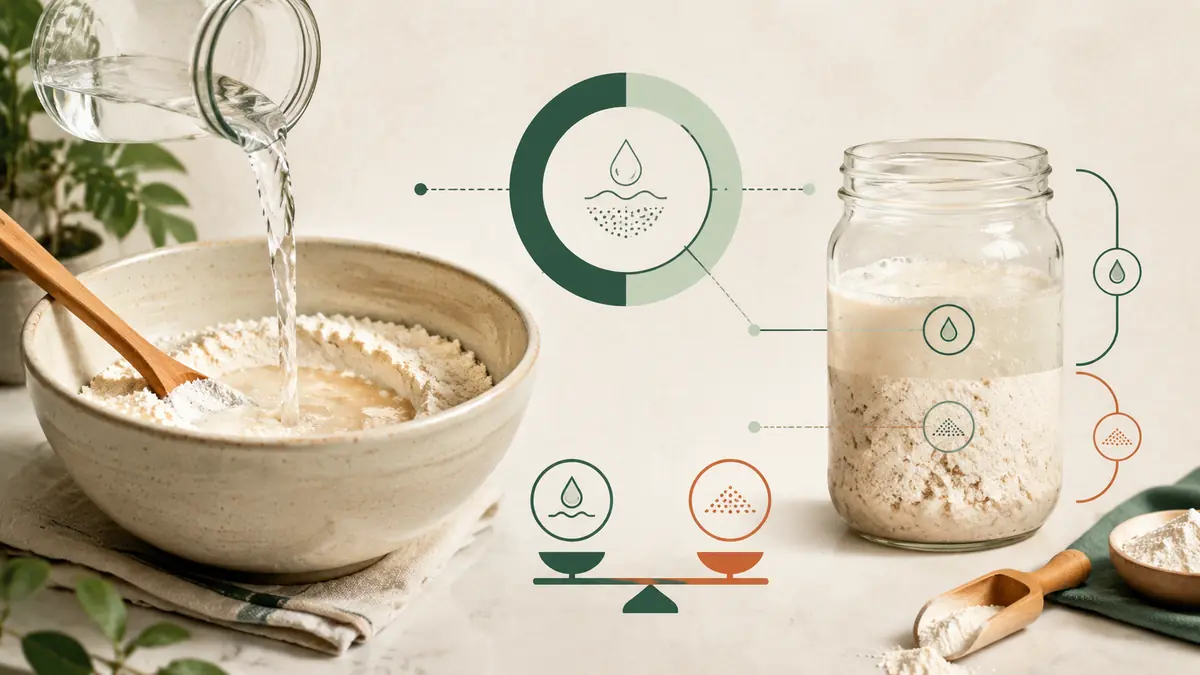
See sourdough hydration visually
Starter decomposition
A 100% hydration starter contributes both flour and water
True dough hydration includes the flour and water inside the starter.
100 g starter at 100%100 gEqual flour and water by weight
Starter flour50 g
Starter water50 g
Added flour500 g
+Starter flour50 g
=Total flour550 g
Added water350 g
+Starter water50 g
=Total water400 g
Dough hydration400 ÷ 550 × 100 = 72.7%
Sourdough hydration examples
| Added flour | Added water | Starter | Starter hydration | True dough hydration |
|---|---|---|---|---|
| 500 g | 350 g | 0 g | None | 70.0% |
| 500 g | 350 g | 100 g | 100% | 72.7% |
| 500 g | 350 g | 100 g | 60% | 68.9% |
| 500 g | 350 g | 100 g | 125% | 74.5% |
How to calculate sourdough hydration correctly
Hydration is total water divided by total flour, multiplied by 100. The important word is total. In sourdough, the starter or levain already contains flour and water, so those amounts belong in the final formula.
A basic dough with 500 g flour and 350 g water looks like 70% hydration because 350 divided by 500 equals 0.70. If you then add 100 g of 100% hydration starter, the true dough is not still 70% hydration. The starter adds 50 g flour and 50 g water.
With 100 g of 100% starter, the same dough becomes about 72.7% hydration. Total flour is 550 g. Total water is 400 g. Divide 400 by 550 and multiply by 100 to get about 72.7%.
This is why a sourdough hydration calculator is more useful than dividing only the water line by the flour line. It lets the starter contribute to the formula in the same way it contributes in the bowl.
What a 100 percent hydration starter means
A 100% hydration starter contains equal flour and water by weight. If the starter weighs 100 g, it contains 50 g flour and 50 g water. If it weighs 200 g, it contains 100 g flour and 100 g water.
The 100% does not mean the starter is all water. It means the water weight equals the flour weight. Hydration in bread math is always measured relative to flour.
Example: 150 g starter at 100% hydration
Half of the 150 g starter is flour and half is water. That gives 75 g flour and 75 g water. Those values are then added to the flour and water in the final mix before calculating dough hydration.
Do not divide every starter in half unless it is actually 100% hydration. A stiff starter and a liquid starter contain different flour and water proportions.
How starter hydration changes the dough calculation
A 60% hydration starter contains more flour than water. For 100 g total starter, the correct split is 62.5 g flour and 37.5 g water. That comes from dividing the starter weight by 1.60 to find the flour portion.
A 125% hydration starter contains more water than flour. For 100 g starter, there are about 44.4 g flour and 55.6 g water. This wetter levain raises total dough hydration more than a stiff starter of the same weight.
Take the same base recipe of 500 g added flour and 350 g added water. With 100 g of 60% starter, true hydration is about 68.9%. With 100 g of 100% starter, it is about 72.7%. With 100 g of 125% starter, it is about 74.5%.
Starter weight alone cannot tell you true dough hydration. You need the starter hydration as well because that tells you how much of the starter is flour and how much is water.
Prefermented flour percentage in sourdough
Prefermented flour percentage measures the flour inside the starter or levain compared with total flour. This is different from starter percentage. It focuses on the flour that fermented before the final dough was mixed.
Suppose a dough has 500 g added flour and 100 g of 100% hydration starter. The starter contains 50 g flour, so total flour is 550 g. Prefermented flour is 50 divided by 550, which equals about 9.1%.
Starter weight percentage would give a different number. The full 100 g starter is about 18.2% of the 550 g total flour. Both numbers can be useful, but they describe different attributes.
Prefermented flour stays meaningful even when starter hydration changes. A 60% starter and a 125% starter can be compared by the amount of flour they contribute rather than by their total wet weight.
How to calculate target dough hydration
Target hydration tells you how much total water the dough should contain for a known amount of total flour. If total flour is 550 g and the target hydration is 75%, total water should be 412.5 g.
The starter water must be included in that 412.5 g. If the dough uses 100 g of 100% starter, the starter already contributes 50 g water. The final mix therefore needs about 362.5 g additional water.
Example: target 75% hydration with a stiff starter
Use 500 g added flour and 100 g starter at 60% hydration. The starter contains 62.5 g flour and 37.5 g water. Total flour becomes 562.5 g. At 75% hydration, total water needs to be about 421.9 g. Subtract the 37.5 g already in the starter and the final mix needs about 384.4 g water.
The same starter weight can require a different added water amount when starter hydration changes. This is one of the most useful reasons to calculate starter contribution instead of assuming every levain is 50% flour and 50% water.
How to increase or reduce sourdough hydration
To increase hydration, add water while keeping total flour unchanged. If a dough has 500 g total flour at 70% hydration, it contains 350 g total water. To move to 75%, it needs 375 g total water, so the formula needs 25 g more water.
To reduce hydration, lower total water for the same flour amount. If 500 g flour is paired with 400 g water, hydration is 80%. A 72% target needs 360 g total water, which is 40 g less.
When starter is present, adjust the final mix water, not the water already inside the starter. The calculator accounts for that automatically. This helps you reformulate the recipe before mixing.
If the dough is already mixed, adding or removing water is more difficult. Treat the target calculation as a formula design tool rather than a guarantee that a fully mixed dough can be corrected without changing its structure.
Is 70, 75, or 80 percent hydration better
There is no single best sourdough hydration percentage. A 65% dough can make excellent bread, and an 80% dough can also make excellent bread. The right level depends on flour, bread style, mixing, fermentation, shaping skill, and the crumb you want.
Lower hydration dough often feels firmer and can be easier to shape. Higher hydration dough can feel softer and stickier. Those are general handling differences, not a quality ranking.
Flour absorption changes how a percentage feels. Strong bread flour, whole wheat flour, and rye can take up water differently from a lower protein white flour. Two 75% doughs can therefore feel very different.
Use hydration as a formula attribute, then judge the dough in your own flour and process. If you change flour type, you may also need to change water even when the target bread style stays the same.
Multiple flours in a sourdough hydration calculation
All flour types count toward total flour. If a recipe contains 400 g bread flour, 75 g whole wheat flour, and 25 g rye flour, the added flour total is 500 g. Flour inside the starter is then added on top of that.
The flour blend can affect water absorption, flavor, fermentation, and dough strength, but the hydration formula still uses total flour weight as its denominator. This keeps the math consistent across different blends.
If you want to express each flour as part of the blend, the Baker's Percentage Calculator is the better tool. It can show bread flour, whole wheat, and rye as percentages that add to the 100% flour basis.
Does milk, beer, or another liquid count as hydration
Recipe hydration can include liquids that replace part of the water in the formula. Milk, beer, tea, coffee, or juice may be treated as hydration liquids for practical bread math, even though they contain dissolved solids and are not pure water.
Do not automatically break every ingredient into laboratory water content. Eggs, butter, honey, fruit, and cheese contain water, but normal baker's hydration usually does not decompose every ingredient that way.
Use the formula convention consistently. If you count milk as a hydration liquid, count it the same way when comparing versions of the recipe. Consistency makes the percentage useful even when it is not a laboratory moisture analysis.
Salt percentage and sourdough hydration
Salt does not belong in the hydration numerator or denominator. It is normally expressed as a separate baker's percentage based on total flour. For 500 g total flour and 10 g salt, salt is 2%.
Keeping salt separate helps you compare formulas. A dough might be 75% hydration and 2% salt. Those percentages describe two different ingredient relationships.
If you build formulas regularly, baker's math can keep water, salt, starter, flour blend, fat, sugar, and inclusions in one normalized system. The sourdough hydration calculator focuses on the water and flour relationship while still showing useful starter metrics.
Build a target dough weight from hydration
You can work backward from final dough weight instead of starting with flour grams. Suppose you want 1,000 g dough at 75% hydration and 2% salt, with no other ingredients. The total formula is 177%: 100% flour, 75% water, and 2% salt.
Divide 1,000 by 1.77 to get about 565 g total flour. Water is about 424 g. Salt is about 11.3 g. If you also use prefermented flour, part of the total flour and water is moved into the levain rather than added as extra ingredients.
Target dough weight is useful when you need a specific loaf size. Two 850 g loaves need about 1,700 g dough before any handling allowance. Formula based scaling lets you reach that target while preserving hydration and salt percentage.
A practical sourdough hydration workflow
1. Add every flour amount
Include bread flour, whole wheat, rye, or other flour in the final mix. Do not forget flour inside the starter.
2. Add every hydration liquid
Count the water in the final mix and the water inside the starter. Include other declared hydration liquids if your formula uses that convention.
3. Calculate starter flour and water
Starter hydration determines the split. A 100% starter is equal flour and water by weight. A stiff or liquid starter needs the full formula, not a simple half and half assumption.
4. Divide total water by total flour
Multiply the result by 100 to get dough hydration. Keep salt and other ingredients as separate baker's percentages.
5. Adjust the formula, then watch the dough
Use the percentage to design a repeatable formula. During mixing and fermentation, still judge the actual dough because flour absorption, temperature, fermentation, and technique affect how it behaves.
Questions about sourdough hydration
What is sourdough hydration?
Sourdough hydration is total water divided by total flour, including the flour and water inside the starter or levain.
Does starter count toward dough hydration?
Yes. Starter contributes both flour and water, so both parts belong in the total dough calculation.
What is a 100% hydration starter?
It contains equal weights of flour and water. A 100 g starter at 100% hydration contains 50 g flour and 50 g water.
How much flour is in 100 g of 60% hydration starter?
It contains 62.5 g flour and 37.5 g water.
What is prefermented flour percentage?
It is the flour inside the starter or levain divided by the total flour in the dough.
Is starter percentage the same as prefermented flour?
No. Starter percentage uses starter weight, while prefermented flour looks only at the flour contained inside that starter.
Does salt count toward hydration?
No. Salt is normally shown separately as a percentage of total flour.
Can sourdough hydration be over 100%?
Yes. Hydration is relative to flour, so some formulas can use more water than flour by weight.
How do I raise dough hydration?
Keep total flour fixed and increase total water until water divided by flour reaches the target percentage.
How do I lower dough hydration?
Use less total water for the same flour amount, while still counting the water already present in the starter.
Is 75% hydration good for sourdough?
It can be a useful level, but there is no single ideal hydration. Flour type, bread style, and handling method matter.
Does whole wheat or rye change how hydration feels?
Yes. Different flours absorb water differently, so two doughs with the same hydration percentage can feel very different.
Calculation transparency
Read methodologyHow to interpret this result
Result typeFormula + culinary reference
Calculation basisBread formula arithmetic with published baking references
Sources shown2
Latest source reviewAug 11, 2026
Formula math is deterministic. Product-specific yeast instructions and recipe-specific flour standards should take priority when supplied.
Sources and methodology
These are the references used for data, conventions, safety targets, or calculation context on this page. Review dates show when KitchenMathHub last checked the cited source.
King Arthur BakingBaker's PercentageUsed for established culinary measurements, baking methods, or formula guidance.
Open source ↗