King Arthur BakingIngredient Weight ChartUsed for established culinary measurements, baking methods, or formula guidance.
Open source ↗Recipe Scaling Calculator
Use the recipe scaling calculator when you need more or fewer servings, cookies, portions, loaves, or batches. Enter the original yield and target yield, then scale the ingredient quantities with practical fractions, ranges, and partial egg guidance.
Scale factor: 1.750×
Ingredient quantities use target ÷ original. Cooking time is not multiplied by this factor.
Scaled recipe
14 servings
- 3½ cups all-purpose flour
- 2⅝ cups granulated sugar
- 5 whole eggs + about 13 g beaten egg large eggs
- ⅞ cups butter
- 3½ tsp baking powder
- 0.44 tsp salt
- 1¾ cups buttermilk
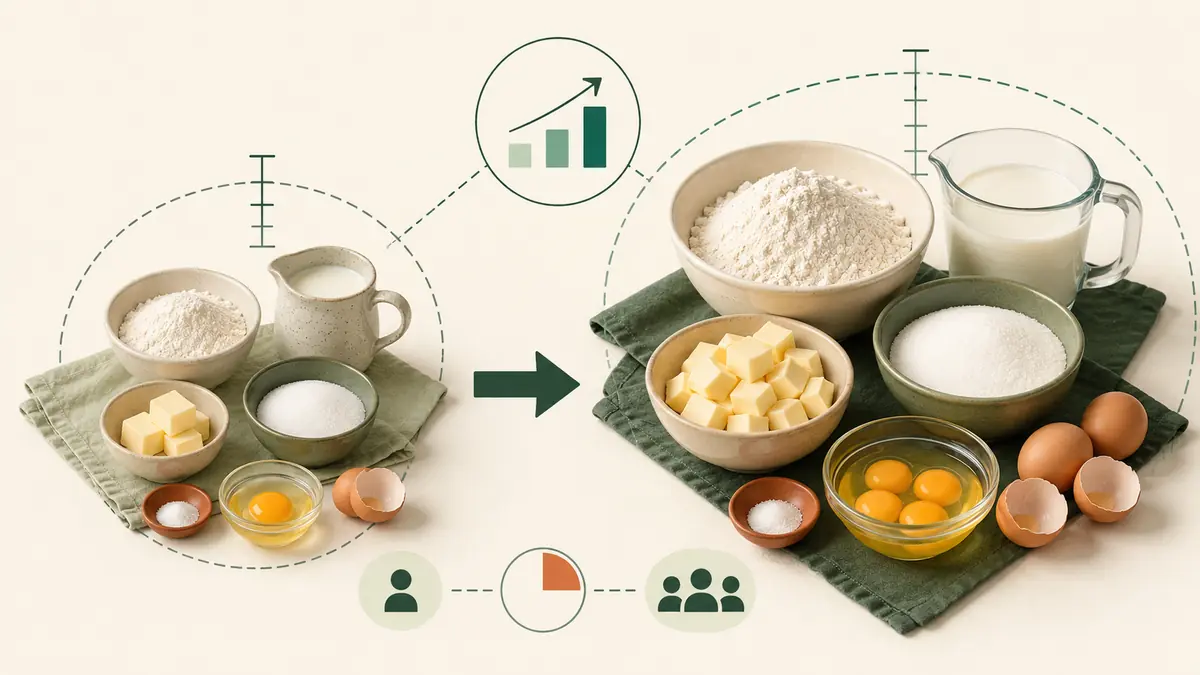
How the recipe scaling calculator works
A recipe scaling calculator uses one main formula: target yield divided by original yield. The result is the recipe multiplier. If a soup recipe serves 6 and you need 9 portions, the factor is 9 divided by 6, which equals 1.5. If a cookie recipe makes 24 cookies and you need 60, the factor is 60 divided by 24, which equals 2.5. The same method works for servings, cookies, muffins, rolls, jars, loaves, and other clear yield units.
The scale factor changes ingredient quantity, not every number in the recipe. Two cups of broth can become 3 cups when a 6 serving recipe becomes 9 servings. A 25 minute simmer does not become 37.5 minutes just because the ingredients increased by 50%. Oven temperature, pan size, mixer speed, resting time, and doneness need their own context. This separation is important for both home cooking and baking.
Practical formatting matters after the math is complete. A raw result such as 0.75 cup is easier to use as 3/4 cup. A result such as 1.5 tablespoons may be shown as 1 1/2 tablespoons. Gram amounts can stay in grams, while count ingredients may need a special note. KitchenMathHub keeps the underlying number accurate and formats the kitchen facing result at the end.
Recipe multiplier examples for common serving changes
| Recipe change | Scale factor | Simple example |
|---|---|---|
| 8 servings to 4 | 0.5x | 2 cups becomes 1 cup |
| 8 servings to 12 | 1.5x | 200 g becomes 300 g |
| 4 servings to 10 | 2.5x | 2 cups becomes 5 cups |
| 8 servings to 16 | 2x | 3 eggs becomes 6 eggs |
| 8 servings to 24 | 3x | 1 tbsp becomes 3 tbsp |
Scale recipe servings up for guests, meal prep, or a larger batch
Example: scale a recipe from 6 servings to 9 servings
Six servings to nine servings needs a 1.5x multiplier. A recipe with 2 cups rice becomes 3 cups. A 400 g tomato ingredient becomes 600 g. Two eggs become 3 eggs. One teaspoon of a scalable seasoning becomes 1 1/2 teaspoons. This is a comfortable increase because many of the new quantities still land on familiar kitchen measures.
A larger batch can change the cooking setup even when the ingredient math is simple. Nine portions of soup may still fit one large pot, while nine portions of baked pasta may need a larger casserole dish or two dishes. If food becomes deeper in the pan, heat takes longer to reach the center. If the food is split across two equal pans, the original bake window may remain a better starting point.
Example: scale a recipe from 4 servings to 10 servings
Four servings to ten servings uses a 2.5x scale factor. A 1 cup ingredient becomes 2 1/2 cups. A 150 g ingredient becomes 375 g. Two tablespoons become 5 tablespoons. Two eggs become 5 eggs. The recipe serving calculator is useful here because the multiplier is less obvious than doubling or tripling.
Large recipe scaling works best when the target yield is clear. “Serves 4” to “serves 10” is clear. “One cake” to “a bigger cake” is not. For cakes, brownies, and other pan baked foods, use the serving or ingredient multiplier only when the yield is known. If the real goal is to move from an 8 inch pan to a 10 inch pan, use the Cake Pan Conversion Calculator because pan area determines the batter scale more directly.
Scale a recipe down for a small batch or fewer servings
How to halve a recipe
Halving a recipe means multiplying each scalable ingredient by 0.5. Four cups become 2 cups. Two tablespoons become 1 tablespoon. One cup becomes 1/2 cup. A 300 g ingredient becomes 150 g. Simple weights and volumes are easy, but count ingredients such as eggs can become awkward.
Half an egg is easiest to measure by weight. Crack the egg into a bowl, whisk the white and yolk together, then weigh the amount you need. A large egg without shell is about 50 g in the reference used by KitchenMathHub, so half an egg is about 25 g. This method is especially useful for small cake, cookie, custard, and enriched dough recipes.
How to make one third or three quarters of a recipe
Use the exact target yield instead of guessing at the fraction. If a recipe makes 12 muffins and you want 4, the factor is 4 divided by 12, which is one third. If it serves 8 and you need 6, the factor is 6 divided by 8, which is 0.75. This approach is more reliable than trying to convert every ingredient in your head before you know the multiplier.
Small batches can expose measurement limits. One quarter teaspoon scaled to one third of a recipe becomes a very small amount. A kitchen scale may be more practical for tiny salt, yeast, spice, or leavener quantities. The calculator can preserve the mathematical result, but the measuring tool you use still affects real accuracy.
How to scale cups, grams, ranges, and mixed fractions
Cups and spoons scale by quantity before any ingredient conversion is applied. If 2/3 cup is doubled, the exact result is 1 1/3 cups. If 1 1/2 cups is multiplied by 1.5, the result is 2 1/4 cups. Keeping the fraction as a normalized number first prevents early rounding from changing the final answer.
Gram based recipes are usually the easiest to scale. A 375 g flour amount multiplied by 1.6 becomes 600 g. A 7 g yeast amount multiplied by 1.5 becomes 10.5 g before any separate yeast guidance is considered. Weight based baking formulas often scale cleanly because the quantities do not need fraction conversion.
Quantity ranges should keep the full range. If a sauce uses 2 to 3 tablespoons of water and the recipe doubles, the new range is 4 to 6 tablespoons. A range often reflects texture, taste, moisture, or ingredient variation, so replacing it with one fixed middle value would remove useful recipe information.
Recipe notes should stay attached to the ingredient. “1 cup walnuts, divided” can become “1 1/2 cups walnuts, divided” when the factor is 1.5. “Salt to taste” should stay “salt to taste.” “Flour for dusting” should stay unchanged. A recipe scaler should adjust the amount when it has a real numeric quantity and preserve the meaning when it does not.
Scaling baking recipes needs more than a serving multiplier
Check pan size when batter quantity changes
A doubled cake recipe may need two pans instead of one deeper pan. Ingredient scaling tells you how much batter you have. It does not tell you whether the original pan can hold it safely. A pan that is too full can overflow, bake unevenly, or leave the center underdone while the edges set. If the recipe amount changes a lot, compare the new batter quantity with the pan area and depth.
Pan geometry affects cake height and bake behavior. A wider pan spreads batter into a thinner layer. A smaller pan makes the batter deeper. Two pans can hold a similar total volume but still bake differently because the surface area, depth, material, and shape change heat transfer. Keep the recipe multiplier and pan decision as related but separate calculations.
Review baking powder, baking soda, and yeast in very large changes
Leaveners can be scaled mathematically, but a large batch deserves a check. Baking powder, baking soda, and yeast interact with formula size, mixing, dough temperature, fermentation time, and pan depth. KitchenMathHub shows the direct scaled amount rather than applying a hidden correction. This keeps the math transparent while reminding you that baking chemistry has more variables than a simple serving ratio.
Yeast quantity does not set fermentation time by itself. Doubling dough does not mean doubling rise time. Dough temperature, room temperature, flour, sugar, salt, yeast type, starter strength, and container shape all affect fermentation. Use the scaled yeast quantity as one part of the formula, then judge the dough by its development and the recipe method.
Cooking time after scaling a recipe
Cooking time is not multiplied by the recipe scale factor. This is one of the most important rules when you adjust recipe servings. A 30 minute bake does not become 60 minutes just because the ingredients double. If you divide doubled cake batter between two pans that match the original pan, each pan may still bake near the original time range. If you put all the batter into one deeper pan, the center may need much longer.
Food depth often matters more than total ingredient weight. A larger pot of soup can take longer to return to a simmer because there is more mass to heat, but it does not need a simple 2x time rule. A tray of cookies baked in two batches may keep the original bake time per tray. A casserole that becomes deeper may need more time at the same oven setting. Use doneness, internal temperature where relevant, and recipe specific cues.
Appliance capacity can change the best batch plan. Air fryers, toaster ovens, slow cookers, mixers, and pressure cookers have practical capacity limits. A larger recipe may need more batches instead of one larger load. If you change the appliance as well as the servings, use the relevant appliance calculator after the ingredient scaling is complete.
Common mistakes when using a recipe serving calculator
Do not scale oven temperature with the servings. A recipe baked at 350°F stays at the same oven temperature unless you are intentionally converting the temperature unit or changing the appliance method. Ingredient quantity and oven temperature are different attributes.
Do not round every step too early. If you turn one third into 0.33, scale it, convert it again, and round each stage, the final amount can drift. Keep the exact or normalized value through the calculation and round the final kitchen measure.
Do not force nonnumeric ingredients into fake amounts. “Pepper to taste,” “oil as needed,” and “water as needed” carry useful instructions. Preserve them. The user can adjust those ingredients during cooking based on taste, texture, or technique.
Do not assume serving count and pan size describe the same goal. A recipe may serve 8 in one 8 inch cake, but changing the pan to 10 inches does not automatically mean the serving target also changed. Decide whether you are scaling for people, yield, or pan geometry before applying a second multiplier.
Common questions about scaling a recipe
How do I scale a recipe to a different number of servings?
Divide the target servings by the original servings. That gives the recipe scale factor. Multiply each scalable ingredient by that factor, then format the result into practical cups, spoons, grams, or counts.
How do I scale a recipe from 4 servings to 10?
Use a 2.5x recipe multiplier. Ten divided by four equals 2.5, so 2 cups become 5 cups, 200 g becomes 500 g, and 2 eggs become 5 eggs.
How do I halve a recipe?
Use a 0.5x scale factor. Multiply every scalable ingredient by one half. Keep nonnumeric notes such as “to taste” or “for greasing” unchanged.
How do I double or triple a recipe?
Use 2x to double and 3x to triple the ingredients. Large batch changes still need a separate check for pan capacity, cooking time, yeast, leaveners, and strong seasonings.
What do I do with half an egg?
Whisk the egg and measure the part you need by weight. KitchenMathHub uses about 50 g for a large egg without shell, so half an egg is about 25 g and one quarter is about 12 to 13 g.
Does doubling a recipe double the cooking time?
No, cooking time does not follow the serving multiplier. Food depth, pan size, batch layout, oven behavior, and doneness can change the time even when the ingredient math is exact.
Should baking powder and yeast always scale exactly?
The calculator can show the exact mathematical amount, but large changes deserve review. Fermentation, leavening, dough temperature, pan depth, and batch size can affect how the recipe behaves.
Can I scale a range such as 2 to 3 tablespoons?
Yes, multiply both ends of the range by the same factor. A 2 to 3 tablespoon range scaled by 2 becomes 4 to 6 tablespoons.
What happens to salt to taste or flour for dusting?
Nonnumeric recipe notes stay unchanged. The calculator does not invent a teaspoon amount for “salt to taste” or guess how much flour you will need for dusting.
Can I convert units after scaling the recipe?
Yes, scale first and convert the normalized quantity after that. This order reduces rounding drift when a fraction is scaled and then changed from cups to grams or from metric to US units.
Calculation transparency
Read methodologyHow to interpret this result
Result typeRecipe transformation
Calculation basisRatio math, ingredient references, and separate cooking transformations
Sources shown2
Latest source reviewAug 11, 2026
KitchenMathHub keeps the original quantities intact and applies transformations from normalized values before final kitchen rounding.
Sources and methodology
These are the references used for data, conventions, safety targets, or calculation context on this page. Review dates show when KitchenMathHub last checked the cited source.
King Arthur BakingWhy the size of your baking pan matters so muchUsed for established culinary measurements, baking methods, or formula guidance.
Open source ↗