King Arthur BakingIngredient Weight ChartUsed for established culinary measurements, baking methods, or formula guidance.
Open source ↗Honey Cups to Grams Converter
Convert honey from US cups to grams using a source backed culinary reference. One cup is approximately 336 g under the selected KitchenMathHub standard.
Honey
Ingredient-specific culinary reference. Volume-to-weight values are not universal across foods.
Result
336 g
1 cup honey
Reference usedhigh confidence
Published measure1 tbsp = 21 gSourceKing Arthur BakingMethodPublished culinary volume/weight equivalencyReviewedAug 11, 2026
Show calculation
Reference
1 tbsp-us = 21 gConverted amount
1 cup-us → 336 g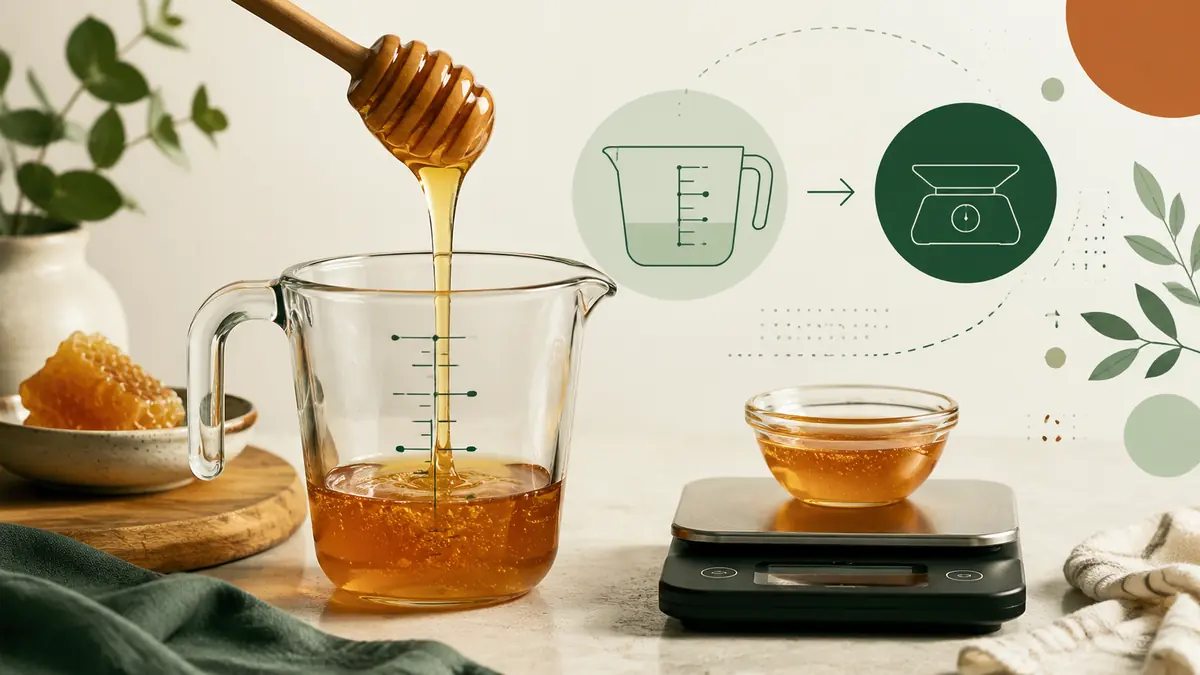
Honey cups to grams chart
| US cups | Approximate weight |
|---|---|
| ⅛ cups | 42 g |
| ¼ cups | 84 g |
| ⅓ cups | 112 g |
| ½ cups | 168 g |
| ⅔ cups | 224 g |
| ¾ cups | 252 g |
| 1 cup | 336 g |
| 1¼ cups | 420 g |
| 1½ cups | 504 g |
| 2 cups | 672 g |
| 2½ cups | 840 g |
| 3 cups | 1008 g |
| 4 cups | 1344 g |
How many grams are in a cup of honey?
1 US cup of honey is about 336 g on this page. The source reference gives 21 g for 1 US tablespoon. A US cup contains 16 tablespoons, so the same reference gives about 336 g for a full cup.
½ cup honey is about 168 g. A quarter cup is about 84 g, ¾ cup is about 252 g, 1½ cups is about 504 g, and 2 cups is about 672 g.
Honey cups to grams is an ingredient specific conversion. Honey is much denser than water and has a different cup weight from maple syrup, molasses, corn syrup, oil, flour, or sugar. Keep the ingredient identity attached to the measurement.
Honey tablespoons to grams
1 US tablespoon of honey is about 21 g under the selected reference. This is the direct culinary measure stored for honey in KitchenMathHub. Two tablespoons are about 42 g, four tablespoons are about 84 g, and eight tablespoons are about 168 g.
¼ cup honey is about 84 g because ¼ US cup equals 4 tablespoons. This relationship is useful when a recipe gives cups but you want to measure honey directly into a bowl on a scale.
Use the tablespoon value for small honey amounts. It avoids deriving a tiny amount from the full cup weight and keeps the calculation close to the stored source reference.
Honey cups to grams examples for baking and cooking
Example: half cup honey in grams
½ cup honey is about 168 g. This amount can appear in breads, granola, marinades, sauces, cakes, muffins, energy bars, and other recipes that use honey as a liquid sweetener.
Example: 1 cup honey in grams
1 cup honey is about 336 g. A large batch may be easier to measure by weight because you can pour honey straight into the mixing bowl instead of filling, emptying, and scraping a full measuring cup.
Example: 2 tablespoons honey in grams
2 tablespoons honey is about 42 g. Small sauce, dressing, glaze, and breakfast recipes often use tablespoon measures, so this direct relationship is useful even when you do not need a full cup conversion.
How to measure sticky honey more cleanly
Weigh honey directly into the mixing bowl when possible. Put the bowl on the scale, tare it to zero, and pour until you reach the target grams. This reduces the honey left behind on a measuring cup or spoon.
A lightly greased measuring spoon or cup can help honey release when you use volume. Use only a very thin coating so you do not add a meaningful amount of extra oil to a small recipe.
Warm honey flows more easily, but temperature can change how quickly it pours. Do not heat it only to change the conversion. The gram target stays the same, so stop pouring when the scale reaches the required mass.
Honey is not a direct substitute for granulated sugar
Converting honey to grams does not make it interchangeable with dry sugar. Honey contributes liquid, dissolved sugars, flavor, acidity, and moisture. Replacing granulated sugar with honey can require broader recipe changes.
Use this page to change the measurement system, not the ingredient. If a recipe calls for ½ cup honey, converting it to about 168 g keeps the same ingredient and the same intended sweetener.
Maple syrup, molasses, golden syrup, corn syrup, and other liquid sweeteners should also use their own references. They can have different densities, flavors, solids, and recipe effects.
Scale honey in a recipe
Scale honey with the recipe factor before final rounding. If a bread recipe uses ½ cup honey and you make 1.5 times the batch, the new amount is ¾ cup. With the reference on this page, that is about 252 g.
Scale the flour and liquids at the same time when the recipe yield changes. Honey affects the balance of the formula, so increasing only the honey would make the recipe sweeter and wetter than intended.
Use the Recipe Scaling Calculator for the full batch. It can apply one yield factor across the ingredient list while preserving the original ingredient names.
Convert honey grams back to cups
336 g honey is about 1 US cup. About 168 g is ½ cup, 84 g is ¼ cup, and 504 g is about 1½ cups under the same reference.
Choose honey before converting grams to cups. A generic grams to cups formula cannot know the ingredient density. The Grams to Cups Calculator uses the honey reference in reverse.
If the recipe already gives a honey weight and you have a scale, keep the grams. Weight measurement is usually cleaner for sticky ingredients because less honey remains on a cup or spoon.
Why honey cup weights can vary slightly
Honey is a natural product, so composition can vary. Water content, floral source, processing, storage, and temperature can affect physical properties. A culinary reference is a practical standard, not a claim that every jar has exactly the same density.
Use the recipe's own weight when it gives one. A tested recipe that lists both cups and grams has already chosen a conversion standard for that formula.
For a complete recipe change, use the Recipe Converter. It can convert honey using its ingredient reference while handling flour, sugar, butter, and liquids with their own rules.
Honey temperature, flow, and accurate pouring
Warm honey pours faster, but the target gram amount does not change. A cold jar may flow slowly while warm honey runs quickly from the spoon or bottle. Use the scale reading, not the speed of the pour, to decide when you have added enough.
Pour slowly near the target weight. Honey can continue to run from the container after you stop tipping it. Slowing down for the final few grams helps you avoid overshooting a small recipe.
If honey has crystallized, the texture can make volume measuring harder. The mass is still measurable on a scale. If the recipe needs fluid honey for mixing, follow safe product handling and recipe instructions rather than changing the ingredient amount just because the texture is thicker.
Honey in bread, granola, sauces, and glazes
Honey weight is useful when the recipe depends on a repeatable sweetener ratio. Bread dough, granola, barbecue sauce, salad dressing, glaze, energy bars, and muffins can all use honey in very different amounts.
Keep the recipe context after conversion. A 42 g honey amount in a dressing is still a liquid sweetener. A 168 g amount in a bread formula still contributes both sweetness and moisture. Grams make the quantity easier to repeat, but they do not remove the ingredient's role.
For bread formulas, honey may be expressed as a percentage of flour in more advanced recipe systems. The Baker's Percentage Calculator can help when you want to work with dough formulas rather than only convert household units.
US cups, tablespoons, and honey recipe conversion
A US cup of honey is derived from 16 US tablespoons in the reference used here. Because one tablespoon is 21 g, the full cup becomes about 336 g. This keeps the tablespoon and cup answers internally consistent.
Use tablespoons for small honey amounts and grams for larger precise amounts. A teaspoon or tablespoon can be convenient for a dressing. A scale is often cleaner for ½ cup or 1 cup because you do not have to scrape sticky honey from a large measuring cup.
When converting a full American recipe to metric, keep honey as honey and convert it with the ingredient reference. Do not replace it with a generic liquid volume conversion if your goal is to express the ingredient by mass.
Keep preparation notes after the conversion. If the recipe asks you to warm the honey, mix it with another liquid, or divide it between two steps, the gram value should stay attached to that instruction instead of becoming a loose number.
Questions about measuring honey
How many grams are in 1 cup of honey?
About 336 g with the honey reference used on this page.
How many grams are in half a cup of honey?
168 g.
How many grams are in a quarter cup of honey?
84 g.
How many grams are in 1½ cups of honey?
504 g.
How many grams are in 2 cups of honey?
672 g.
How many grams are in 1 tablespoon of honey?
About 21 g with the direct tablespoon reference used by KitchenMathHub.
Is 336 grams of honey 1 cup?
Yes. A US cup contains 16 tablespoons, so the 21 g tablespoon reference gives about 336 g per cup.
Is weighing honey easier than measuring cups?
Often yes. You can pour honey directly into a tared bowl and avoid leaving part of the ingredient on the measuring cup.
Can I use the honey conversion for maple syrup?
No. Different liquid sweeteners can have different densities and recipe behavior, so use an ingredient specific reference.
Does converting honey to grams make it a substitute for sugar?
No. Conversion changes the measurement system, not the ingredient or its effect on the recipe.
Can I scale honey in a bread or granola recipe?
Yes. Apply the recipe factor with the Recipe Scaling Calculator and scale the related ingredients too.
Can I convert honey grams back to cups?
Yes. Select honey in the Grams to Cups Calculator.
Calculation transparency
Read methodologyHow to interpret this result
Result typeIngredient-specific reference
Calculation basisPublished culinary volume and weight equivalencies
Sources shown2
Latest source reviewAug 11, 2026
Cup-to-weight values depend on the ingredient and its state. A recipe author's tested gram value should take priority when the recipe provides one.
Sources and methodology
These are the references used for data, conventions, safety targets, or calculation context on this page. Review dates show when KitchenMathHub last checked the cited source.
National Institute of Standards and TechnologyMetric Kitchen: Cooking Measurement EquivalenciesUsed for defined measurement guidance or public food-safety guidance where applicable.
Open source ↗