King Arthur BakingIngredient Weight ChartUsed for established culinary measurements, baking methods, or formula guidance.
Open source ↗Ingredient Weight Database
Search 118 cooking and baking ingredient weight references by name or category. Each row shows the reference measure, gram weight, ingredient state, confidence level, and review date used by KitchenMathHub.
Showing 118 of 118 ingredient references
| Ingredient | State | Reference amount | Weight | Source | Method | Confidence | Reviewed | Convert |
|---|---|---|---|---|---|---|---|---|
| All-Purpose Flour | Standard reference | 1 US cup | 120 g | King Arthur Baking | Published culinary volume/weight equivalency | high | Aug 11, 2026 | Convert → |
| Almond Butter | Standard reference | ¼ US cup | 68 g | King Arthur Baking | Published culinary volume/weight equivalency | high | Aug 11, 2026 | Convert → |
| Almond Flour | Standard reference | 1 US cup | 96 g | King Arthur Baking | Published culinary volume/weight equivalency | high | Aug 11, 2026 | Convert → |
| Almond Meal | Standard reference | 1 US cup | 84 g | King Arthur Baking | Published culinary volume/weight equivalency | high | Aug 11, 2026 | Convert → |
| Almonds, sliced | sliced | ½ US cup | 43 g | King Arthur Baking | Published culinary volume/weight equivalency | high | Aug 11, 2026 | Convert → |
| Almonds, slivered | slivered | ½ US cup | 57 g | King Arthur Baking | Published culinary volume/weight equivalency | high | Aug 11, 2026 | Convert → |
| Almonds, whole | whole | 1 US cup | 142 g | King Arthur Baking | Published culinary volume/weight equivalency | high | Aug 11, 2026 | Convert → |
| Amaranth Flour | Standard reference | 1 US cup | 103 g | King Arthur Baking | Published culinary volume/weight equivalency | high | Aug 11, 2026 | Convert → |
| Apples, dried diced | diced, dried | 1 US cup | 85 g | King Arthur Baking | Published culinary volume/weight equivalency | high | Aug 11, 2026 | Convert → |
| Apples, peeled sliced | sliced, peeled | 1 US cup | 113 g | King Arthur Baking | Published culinary volume/weight equivalency | high | Aug 11, 2026 | Convert → |
| Applesauce | Standard reference | 1 US cup | 255 g | King Arthur Baking | Published culinary volume/weight equivalency | high | Aug 11, 2026 | Convert → |
| Apricots, dried diced | diced, dried | ½ US cup | 64 g | King Arthur Baking | Published culinary volume/weight equivalency | high | Aug 11, 2026 | Convert → |
| Baking Powder | Standard reference | 1 tsp | 4 g | King Arthur Baking | Published culinary volume/weight equivalency | high | Aug 11, 2026 | Convert → |
| Baking Soda | Standard reference | ½ tsp | 3 g | King Arthur Baking | Published culinary volume/weight equivalency | high | Aug 11, 2026 | Convert → |
| Bananas, mashed | mashed | 1 US cup | 227 g | King Arthur Baking | Published culinary volume/weight equivalency | high | Aug 11, 2026 | Convert → |
| Barley Flour | Standard reference | 1 US cup | 85 g | King Arthur Baking | Published culinary volume/weight equivalency | high | Aug 11, 2026 | Convert → |
| Barley Malt Syrup | Standard reference | 2 tbsp | 42 g | King Arthur Baking | Published culinary volume/weight equivalency | high | Aug 11, 2026 | Convert → |
| Barley, cooked | cooked | 1 US cup | 215 g | King Arthur Baking | Published culinary volume/weight equivalency | high | Aug 11, 2026 | Convert → |
| Barley, pearled | Standard reference | 1 US cup | 213 g | King Arthur Baking | Published culinary volume/weight equivalency | high | Aug 11, 2026 | Convert → |
| Basil Pesto | Standard reference | 2 tbsp | 28 g | King Arthur Baking | Published culinary volume/weight equivalency | high | Aug 11, 2026 | Convert → |
| Bell Peppers, fresh | Standard reference | 1 US cup | 142 g | King Arthur Baking | Published culinary volume/weight equivalency | high | Aug 11, 2026 | Convert → |
| Berries, frozen | frozen | 1 US cup | 142 g | King Arthur Baking | Published culinary volume/weight equivalency | high | Aug 11, 2026 | Convert → |
| Blueberries, dried | dried | 1 US cup | 156 g | King Arthur Baking | Published culinary volume/weight equivalency | high | Aug 11, 2026 | Convert → |
| Blueberry Juice | Standard reference | 1 US cup | 241 g | King Arthur Baking | Published culinary volume/weight equivalency | high | Aug 11, 2026 | Convert → |
| Bran Cereal | Standard reference | 1 US cup | 60 g | King Arthur Baking | Published culinary volume/weight equivalency | high | Aug 11, 2026 | Convert → |
| Bread Flour | Standard reference | 1 US cup | 120 g | King Arthur Baking | Published culinary volume/weight equivalency | high | Aug 11, 2026 | Convert → |
| Breadcrumbs, dried | dried | ¼ US cup | 28 g | King Arthur Baking | Published culinary volume/weight equivalency | high | Aug 11, 2026 | Convert → |
| Breadcrumbs, fresh | Standard reference | ¼ US cup | 21 g | King Arthur Baking | Published culinary volume/weight equivalency | high | Aug 11, 2026 | Convert → |
| Brown Rice Flour | Standard reference | 1 US cup | 128 g | King Arthur Baking | Published culinary volume/weight equivalency | high | Aug 11, 2026 | Convert → |
| Brown Rice, cooked | cooked | 1 US cup | 170 g | King Arthur Baking | Published culinary volume/weight equivalency | high | Aug 11, 2026 | Convert → |
| Brown Sugar, packed | packed | 1 US cup | 213 g | King Arthur Baking | Published culinary volume/weight equivalency | high | Aug 11, 2026 | Convert → |
| Buckwheat Flour | Standard reference | 1 US cup | 120 g | King Arthur Baking | Published culinary volume/weight equivalency | high | Aug 11, 2026 | Convert → |
| Buckwheat, whole | whole | 1 US cup | 170 g | King Arthur Baking | Published culinary volume/weight equivalency | high | Aug 11, 2026 | Convert → |
| Bulgur | Standard reference | 1 US cup | 152 g | King Arthur Baking | Published culinary volume/weight equivalency | high | Aug 11, 2026 | Convert → |
| Butter | Standard reference | ½ US cup | 113 g | King Arthur Baking | Published culinary volume/weight equivalency | high | Aug 11, 2026 | Convert → |
| Buttermilk | Standard reference | 1 US cup | 227 g | King Arthur Baking | Published culinary volume/weight equivalency | high | Aug 11, 2026 | Convert → |
| Buttermilk Powder | Standard reference | 2 tbsp | 18 g | King Arthur Baking | Published culinary volume/weight equivalency | high | Aug 11, 2026 | Convert → |
| Cacao Nibs | Standard reference | 1 US cup | 120 g | King Arthur Baking | Published culinary volume/weight equivalency | high | Aug 11, 2026 | Convert → |
| Caramel Bits | Standard reference | 1 US cup | 156 g | King Arthur Baking | Published culinary volume/weight equivalency | high | Aug 11, 2026 | Convert → |
| Caraway Seeds | Standard reference | 2 tbsp | 18 g | King Arthur Baking | Published culinary volume/weight equivalency | high | Aug 11, 2026 | Convert → |
| Carrots, cooked pureed | cooked | ½ US cup | 128 g | King Arthur Baking | Published culinary volume/weight equivalency | high | Aug 11, 2026 | Convert → |
| Carrots, diced | diced | 1 US cup | 142 g | King Arthur Baking | Published culinary volume/weight equivalency | high | Aug 11, 2026 | Convert → |
| Carrots, grated | grated | 1 US cup | 99 g | King Arthur Baking | Published culinary volume/weight equivalency | high | Aug 11, 2026 | Convert → |
| Cashews, chopped | chopped | 1 US cup | 113 g | King Arthur Baking | Published culinary volume/weight equivalency | high | Aug 11, 2026 | Convert → |
| Cashews, whole | whole | 1 US cup | 113 g | King Arthur Baking | Published culinary volume/weight equivalency | high | Aug 11, 2026 | Convert → |
| Celery, diced | diced | 1 US cup | 142 g | King Arthur Baking | Published culinary volume/weight equivalency | high | Aug 11, 2026 | Convert → |
| Cheese, grated | grated | 1 US cup | 113 g | King Arthur Baking | Published culinary volume/weight equivalency | high | Aug 11, 2026 | Convert → |
| Cherries, candied | Standard reference | ¼ US cup | 50 g | King Arthur Baking | Published culinary volume/weight equivalency | high | Aug 11, 2026 | Convert → |
| Cherries, dried | dried | ½ US cup | 71 g | King Arthur Baking | Published culinary volume/weight equivalency | high | Aug 11, 2026 | Convert → |
| Cherries, fresh chopped | chopped | ½ US cup | 80 g | King Arthur Baking | Published culinary volume/weight equivalency | high | Aug 11, 2026 | Convert → |
| Cherries, frozen | frozen | 1 US cup | 113 g | King Arthur Baking | Published culinary volume/weight equivalency | high | Aug 11, 2026 | Convert → |
| Chia Seeds | Standard reference | ¼ US cup | 37 g | King Arthur Baking | Published culinary volume/weight equivalency | high | Aug 11, 2026 | Convert → |
| Chickpea Flour | Standard reference | 1 US cup | 85 g | King Arthur Baking | Published culinary volume/weight equivalency | high | Aug 11, 2026 | Convert → |
| Chives, fresh | Standard reference | ½ US cup | 21 g | King Arthur Baking | Published culinary volume/weight equivalency | high | Aug 11, 2026 | Convert → |
| Chocolate Chips | Standard reference | 1 US cup | 170 g | King Arthur Baking | Published culinary volume/weight equivalency | high | Aug 11, 2026 | Convert → |
| Chocolate Chunks | Standard reference | 1 US cup | 170 g | King Arthur Baking | Published culinary volume/weight equivalency | high | Aug 11, 2026 | Convert → |
| Chocolate, chopped | chopped | 1 US cup | 170 g | King Arthur Baking | Published culinary volume/weight equivalency | high | Aug 11, 2026 | Convert → |
| Cocoa Powder, unsweetened | Standard reference | ½ US cup | 42 g | King Arthur Baking | Published culinary volume/weight equivalency | high | Aug 11, 2026 | Convert → |
| Coconut Cream, unsweetened | Standard reference | 1 US cup | 284 g | King Arthur Baking | Published culinary volume/weight equivalency | high | Aug 11, 2026 | Convert → |
| Coconut Flour | Standard reference | 1 US cup | 128 g | King Arthur Baking | Published culinary volume/weight equivalency | high | Aug 11, 2026 | Convert → |
| Coconut Milk, canned | Standard reference | 1 US cup | 241 g | King Arthur Baking | Published culinary volume/weight equivalency | high | Aug 11, 2026 | Convert → |
| Coconut Oil | Standard reference | ½ US cup | 113 g | King Arthur Baking | Published culinary volume/weight equivalency | high | Aug 11, 2026 | Convert → |
| Coconut Sugar | Standard reference | ½ US cup | 77 g | King Arthur Baking | Published culinary volume/weight equivalency | high | Aug 11, 2026 | Convert → |
| Coconut, desiccated | Standard reference | 1 US cup | 85 g | King Arthur Baking | Published culinary volume/weight equivalency | high | Aug 11, 2026 | Convert → |
| Coconut, large flakes | Standard reference | 1 US cup | 60 g | King Arthur Baking | Published culinary volume/weight equivalency | high | Aug 11, 2026 | Convert → |
| Coconut, sweetened shredded | shredded | 1 US cup | 85 g | King Arthur Baking | Published culinary volume/weight equivalency | high | Aug 11, 2026 | Convert → |
| Coconut, toasted | Standard reference | 1 US cup | 85 g | King Arthur Baking | Published culinary volume/weight equivalency | high | Aug 11, 2026 | Convert → |
| Coconut, unsweetened shredded | shredded | 1 US cup | 53 g | King Arthur Baking | Published culinary volume/weight equivalency | high | Aug 11, 2026 | Convert → |
| Cookie Butter | Standard reference | ¼ US cup | 72 g | King Arthur Baking | Published culinary volume/weight equivalency | high | Aug 11, 2026 | Convert → |
| Cookie Crumbs | Standard reference | 1 US cup | 85 g | King Arthur Baking | Published culinary volume/weight equivalency | high | Aug 11, 2026 | Convert → |
| Corn Syrup | Standard reference | 1 US cup | 312 g | King Arthur Baking | Published culinary volume/weight equivalency | high | Aug 11, 2026 | Convert → |
| Corn, fresh or frozen | frozen | ¼ US cup | 38 g | King Arthur Baking | Published culinary volume/weight equivalency | high | Aug 11, 2026 | Convert → |
| Cornmeal, whole | whole | 1 US cup | 138 g | King Arthur Baking | Published culinary volume/weight equivalency | high | Aug 11, 2026 | Convert → |
| Cornmeal, yellow | Standard reference | 1 US cup | 156 g | King Arthur Baking | Published culinary volume/weight equivalency | high | Aug 11, 2026 | Convert → |
| Cornstarch | Standard reference | ¼ US cup | 28 g | King Arthur Baking | Published culinary volume/weight equivalency | high | Aug 11, 2026 | Convert → |
| Cottage Cheese | Standard reference | ½ US cup | 113 g | King Arthur Baking | Published culinary volume/weight equivalency | high | Aug 11, 2026 | Convert → |
| Cracked Wheat | Standard reference | 1 US cup | 149 g | King Arthur Baking | Published culinary volume/weight equivalency | high | Aug 11, 2026 | Convert → |
| Cranberries, dried | dried | ½ US cup | 57 g | King Arthur Baking | Published culinary volume/weight equivalency | high | Aug 11, 2026 | Convert → |
| Cranberries, fresh or frozen | frozen | 1 US cup | 99 g | King Arthur Baking | Published culinary volume/weight equivalency | high | Aug 11, 2026 | Convert → |
| Cream Cheese | Standard reference | 1 US cup | 227 g | King Arthur Baking | Published culinary volume/weight equivalency | high | Aug 11, 2026 | Convert → |
| Cream of Coconut | Standard reference | ½ US cup | 142 g | King Arthur Baking | Published culinary volume/weight equivalency | high | Aug 11, 2026 | Convert → |
| Creme Fraiche | Standard reference | ½ US cup | 113 g | King Arthur Baking | Published culinary volume/weight equivalency | high | Aug 11, 2026 | Convert → |
| Currants | Standard reference | 1 US cup | 142 g | King Arthur Baking | Published culinary volume/weight equivalency | high | Aug 11, 2026 | Convert → |
| Dates, chopped | chopped | 1 US cup | 149 g | King Arthur Baking | Published culinary volume/weight equivalency | high | Aug 11, 2026 | Convert → |
| Demerara Sugar | Standard reference | 1 US cup | 220 g | King Arthur Baking | Published culinary volume/weight equivalency | high | Aug 11, 2026 | Convert → |
| Durum Flour | Standard reference | 1 US cup | 124 g | King Arthur Baking | Published culinary volume/weight equivalency | high | Aug 11, 2026 | Convert → |
| Egg White, large | Standard reference | 1 count | 32.5 g | King Arthur Baking | Published culinary volume/weight equivalency | high | Aug 11, 2026 | Convert → |
| Egg Yolk, large | Standard reference | 1 count | 14 g | King Arthur Baking | Published culinary volume/weight equivalency | high | Aug 11, 2026 | Convert → |
| Egg, large | Standard reference | 1 count | 50 g | King Arthur Baking | Published culinary volume/weight equivalency | high | Aug 11, 2026 | Convert → |
| Espresso Powder | Standard reference | 1 tbsp | 7 g | King Arthur Baking | Published culinary volume/weight equivalency | high | Aug 11, 2026 | Convert → |
| Feta Cheese | Standard reference | ½ US cup | 57 g | King Arthur Baking | Published culinary volume/weight equivalency | high | Aug 11, 2026 | Convert → |
| Figs, dried chopped | chopped, dried | 1 US cup | 149 g | King Arthur Baking | Published culinary volume/weight equivalency | high | Aug 11, 2026 | Convert → |
| Flax Meal | Standard reference | ½ US cup | 50 g | King Arthur Baking | Published culinary volume/weight equivalency | high | Aug 11, 2026 | Convert → |
| Flaxseed | Standard reference | ¼ US cup | 35 g | King Arthur Baking | Published culinary volume/weight equivalency | high | Aug 11, 2026 | Convert → |
| Garlic, minced | Standard reference | 2 tbsp | 28 g | King Arthur Baking | Published culinary volume/weight equivalency | high | Aug 11, 2026 | Convert → |
| Garlic, sliced | sliced | 1 US cup | 149 g | King Arthur Baking | Published culinary volume/weight equivalency | high | Aug 11, 2026 | Convert → |
| Ghee | Standard reference | ¼ US cup | 44 g | King Arthur Baking | Published culinary volume/weight equivalency | high | Aug 11, 2026 | Convert → |
| Ginger, fresh sliced | sliced | ¼ US cup | 57 g | King Arthur Baking | Published culinary volume/weight equivalency | high | Aug 11, 2026 | Convert → |
| Gluten-Free All-Purpose Flour | Standard reference | 1 US cup | 156 g | King Arthur Baking | Published culinary volume/weight equivalency | high | Aug 11, 2026 | Convert → |
| Glutinous Rice Flour | Standard reference | 1 US cup | 120 g | King Arthur Baking | Published culinary volume/weight equivalency | high | Aug 11, 2026 | Convert → |
| Graham Cracker Crumbs | Standard reference | 1 US cup | 100 g | King Arthur Baking | Published culinary volume/weight equivalency | high | Aug 11, 2026 | Convert → |
| Granola | Standard reference | 1 US cup | 113 g | King Arthur Baking | Published culinary volume/weight equivalency | high | Aug 11, 2026 | Convert → |
| Granulated Sugar | Standard reference | 1 US cup | 198 g | King Arthur Baking | Published culinary volume/weight equivalency | high | Aug 11, 2026 | Convert → |
| Hazelnut Flour | Standard reference | 1 US cup | 89 g | King Arthur Baking | Published culinary volume/weight equivalency | high | Aug 11, 2026 | Convert → |
| Hazelnut Spread | Standard reference | ½ US cup | 160 g | King Arthur Baking | Published culinary volume/weight equivalency | high | Aug 11, 2026 | Convert → |
| Hazelnuts, whole | whole | 1 US cup | 142 g | King Arthur Baking | Published culinary volume/weight equivalency | high | Aug 11, 2026 | Convert → |
| Heavy Cream | Standard reference | 1 US cup | 227 g | King Arthur Baking | Published culinary volume/weight equivalency | high | Aug 11, 2026 | Convert → |
| Honey | Standard reference | 1 tbsp | 21 g | King Arthur Baking | Published culinary volume/weight equivalency | high | Aug 11, 2026 | Convert → |
| Jam or Preserves | Standard reference | ¼ US cup | 85 g | King Arthur Baking | Published culinary volume/weight equivalency | high | Aug 11, 2026 | Convert → |
| Milk Powder, nonfat | Standard reference | ¼ US cup | 28 g | King Arthur Baking | Published culinary volume/weight equivalency | high | Aug 11, 2026 | Convert → |
| Oats, rolled | Standard reference | 1 US cup | 89 g | King Arthur Baking | Published culinary volume/weight equivalency | high | Aug 11, 2026 | Convert → |
| Panko Breadcrumbs | Standard reference | 1 US cup | 50 g | King Arthur Baking | Published culinary volume/weight equivalency | high | Aug 11, 2026 | Convert → |
| Parmesan, grated | grated | ½ US cup | 50 g | King Arthur Baking | Published culinary volume/weight equivalency | high | Aug 11, 2026 | Convert → |
| Popcorn, popped | Standard reference | 4 US cup | 21 g | King Arthur Baking | Published culinary volume/weight equivalency | high | Aug 11, 2026 | Convert → |
| Potato Flakes, dried | dried | ½ US cup | 43 g | King Arthur Baking | Published culinary volume/weight equivalency | high | Aug 11, 2026 | Convert → |
| Powdered Sugar, unsifted | sifted, unsifted | 1 US cup | 113 g | King Arthur Baking | Published culinary volume/weight equivalency | high | Aug 11, 2026 | Convert → |
| Ricotta Cheese | Standard reference | 1 US cup | 227 g | King Arthur Baking | Published culinary volume/weight equivalency | high | Aug 11, 2026 | Convert → |
| Whole Milk Powder | whole | ½ US cup | 50 g | King Arthur Baking | Published culinary volume/weight equivalency | high | Aug 11, 2026 | Convert → |
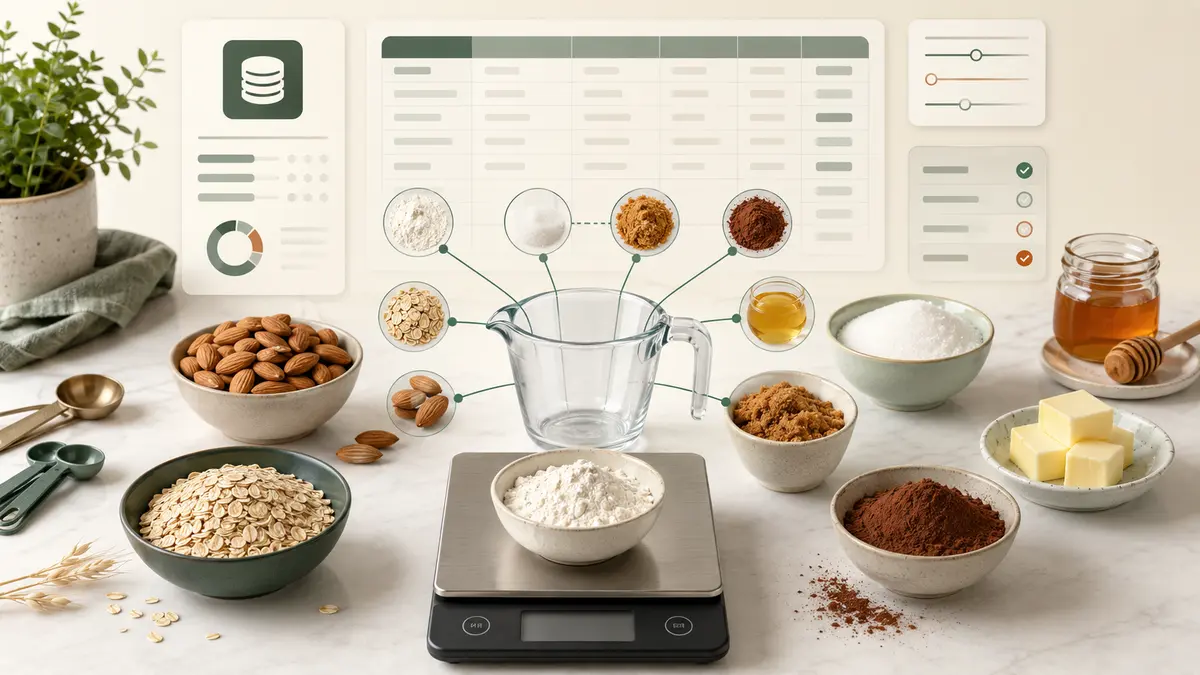
A searchable ingredient weight chart for real recipe conversion
This ingredient weight database shows the reference values behind KitchenMathHub conversions. Search flour, sugar, cocoa, nuts, fruit, grains, dairy, fats, vegetables, and other common ingredients. The table is designed for users who want to see the measurement before they trust a cups to grams result.
The database currently contains 118 ingredient references. These records power the general Cups to Grams Calculator and Grams to Cups Calculator. Only a small group of high value ingredients have dedicated conversion pages, but the broader database can still be searched and used inside the tools.
A reference amount is not always one full cup. Some published culinary references are given as half a cup, a quarter cup, one tablespoon, or one teaspoon. KitchenMathHub keeps that direct reference instead of pretending every source started with a one cup measurement. The calculator can then scale the reference mathematically when you ask for another amount.
How to read an ingredient weight reference
Ingredient name
Choose the closest ingredient name to the food in your recipe. All purpose flour, almond flour, almond meal, sliced almonds, and whole almonds are different records because their physical form changes how much fits into a measuring cup.
State
The state tells you what form the reference describes. A record may describe packed brown sugar, mashed banana, peeled sliced apples, cooked barley, or another preparation state. The same food can occupy a different volume after chopping, packing, cooking, or draining.
Reference amount
The reference amount is the household measure used by the source. For all purpose flour, KitchenMathHub currently stores a one US cup reference. For baking powder, the direct source record is one teaspoon. Keeping the source measure visible makes the calculation easier to inspect.
Weight
The gram value is the mass associated with that reference amount. If one US cup of all purpose flour is 120 g in the selected reference, two cups calculate to 240 g. If a quarter cup of almond butter is 68 g, half a cup calculates to 136 g.
Why cups to grams depends on the ingredient
There is no universal cups to grams multiplier. A cup is a volume measure. A gram is a mass measure. One cup of a light powder, one cup of sugar crystals, one cup of sliced fruit, and one cup of honey can have very different masses even though the container volume is the same.
Particle size and empty space change cup weight. Rolled oats leave large spaces between flakes. Fine sugar crystals pack more closely. Sliced almonds leave more air than almond butter. This is why a generic “one cup equals X grams” calculator can give the wrong answer when it does not ask for the ingredient.
Ingredient state can matter as much as ingredient name. Packed brown sugar is intentionally compressed. Sifted powdered sugar contains more air than unsifted powdered sugar. Chopped nuts do not fill a cup in the same way as whole nuts. A useful ingredient measurement database must keep those states visible.
Useful examples from the ingredient database
One US cup of all purpose flour is 120 g in the current KitchenMathHub default. That makes half a cup 60 g, one and a half cups 180 g, and two cups 240 g before any final kitchen rounding.
One US cup of granulated sugar is 198 g in the current reference. The same cup volume therefore weighs much more than flour. This difference is normal and is the reason ingredient identity must stay attached to the measurement.
One packed US cup of brown sugar is 213 g in the current reference. Packed is part of the measurement. A loosely filled cup should not silently receive the packed value.
Honey uses a direct tablespoon reference in the database. The current record is 21 g per tablespoon. If your recipe uses several tablespoons, the converter scales from that direct value instead of inventing a new density from another website.
Baking powder and baking soda use teaspoon references. Small leavening amounts need finer measurements than flour or sugar. Keeping the original teaspoon reference also avoids showing fake precision at a one cup scale that a home recipe would never use.
How KitchenMathHub handles sources and confidence
Every ingredient record keeps its source ID and review date. The current ingredient collection is based on published culinary volume and weight references from King Arthur Baking. KitchenMathHub structures those values into searchable ingredient records and keeps the measurement state, source, and confidence attached to the result.
High confidence means the stored result comes from a direct published culinary reference for that ingredient and measure. It does not mean every physical cup in every kitchen will contain exactly that weight. A user's measuring method, ingredient brand, moisture, particle size, and packing can still change the amount in a real cup.
Use a recipe specific gram weight when the recipe author gives one. A tested recipe may intentionally define its own cup of flour as 125 g or another value. That recipe specific standard should take priority for that recipe. The KitchenMathHub database is most useful when the original recipe gives only volume or when you need one consistent general reference.
The latest database review date shown in this release is August 11, 2026. Review dates are stored with the references so the site can recheck important source data over time rather than treating a copied number as permanent and unexplained.
Use the database with a full recipe
Use the Recipe Converter when several ingredients need conversion at once. The recipe parser can identify supported ingredient names and apply the same reference data across multiple lines. This avoids converting flour, sugar, butter, cocoa, and milk one by one.
Unknown ingredients should stay unchanged instead of receiving a guessed gram weight. A homemade mixture, unusual brand, or unsupported preparation state may not have a reliable database record. In that case, keeping the original measurement is safer than making up a density.
Use the Recipe Scaling Calculator before final unit conversion when servings change. KitchenMathHub keeps raw quantities until the final formatting step. That reduces rounding drift when a recipe is both scaled and converted.
Use the Ingredient Conversion Tools hub when you are not sure which measurement tool fits the job. Standard unit conversions such as ounces to grams do not need ingredient data, while volume to mass conversions do.
Why ingredient weight charts can disagree
Different websites can publish different cup weights without one of them being a simple math error. Flour is the best example. One source may use a spoon and level method. Another may use a different flour, cup convention, packing method, or internal recipe standard.
Regional kitchen units can also change the result. A US cooking cup and a metric cup are not exactly the same volume. Australian tablespoon conventions can also differ from common US tablespoon conventions. Always keep the source recipe's measurement system in mind.
Preparation words should not be thrown away during conversion. Packed, sifted, chopped, sliced, mashed, cooked, and drained can describe measurable changes. Semantic ingredient conversion works better when the tool treats those words as attributes rather than decoration.
What this database does not claim
This database does not claim that every ingredient has one permanent physical density. Culinary volume measurements include air gaps, packing, shape, moisture, and preparation method. The values are practical recipe references.
This database does not replace a gram value already tested with a recipe. Keep the author's weight when it is available and relevant.
This database does not turn every ingredient into a separate search page. A supported calculator record can be useful without creating another URL. KitchenMathHub keeps dedicated pages for ingredients where a standalone chart and explanation add clear user value.
This database does not hide uncertainty behind long decimal numbers. Source, confidence, state, and review information remain visible so users can understand what the reference actually represents.
Questions about ingredient weight references
What is the KitchenMathHub Ingredient Weight Database?
It is a searchable table of 118 ingredient volume and weight references used by KitchenMathHub conversion tools.
Can one cups to grams value work for every ingredient?
No. Cups measure volume and grams measure mass, so each ingredient needs its own reference weight.
How many grams are in one cup of all purpose flour?
The current KitchenMathHub default for all purpose flour is 120 g per US cup.
Why does ingredient state matter?
Packing, chopping, slicing, sifting, mashing, and other preparation states can change how much food fits into the same volume.
Can I search ingredients that do not have their own dedicated page?
Yes. The database includes supported calculator ingredients even when they do not have a separate public conversion page.
Where do the ingredient weights come from?
Each database row keeps a source reference, confidence level, measurement method, and review date instead of using an unexplained universal density.
Should I use the recipe author's gram value instead?
Yes. If a tested recipe already gives a gram weight for its own cup measurement, keep that recipe specific value.
Can I convert a database ingredient into another amount?
Yes. Use the Convert link on a row to open the ingredient converter with that ingredient selected.
Why do ingredient weights differ between websites?
Different sources can use different measuring methods, product states, cup conventions, or reference standards.
Is weighing ingredients better for baking?
Weight is often more repeatable for flour, sugar, cocoa, and similar ingredients because it reduces variation from how a cup is filled.
Calculation transparency
Read methodologyHow to interpret this result
Result typeIngredient-specific reference
Calculation basisPublished culinary volume and weight equivalencies
Sources shown1
Latest source reviewAug 11, 2026
Cup-to-weight values depend on the ingredient and its state. A recipe author's tested gram value should take priority when the recipe provides one.
Continue with KitchenMathHub
→
Cups to Grams Calculator
Choose an ingredient and convert any cup amount into grams.
→
Grams to Cups Calculator
Use the same ingredient references in reverse to get practical cup fractions.
→
Recipe Converter
Apply supported ingredient references across a full recipe instead of converting one line at a time.
Sources and methodology
These are the references used for data, conventions, safety targets, or calculation context on this page. Review dates show when KitchenMathHub last checked the cited source.